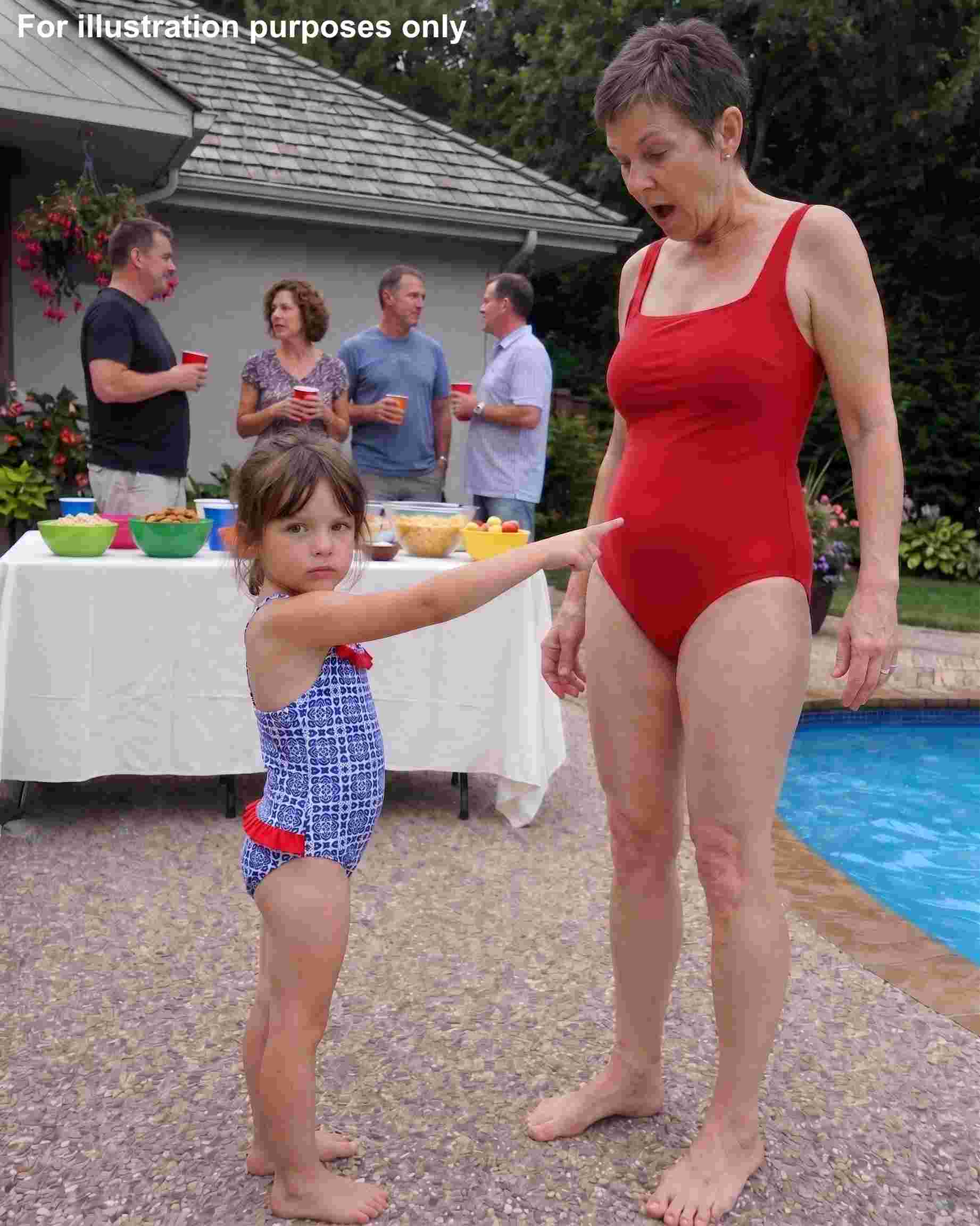
Everyone laughed when my three-year-old daughter pointed at my stepmother’s stomach and shouted, “Daddy’s in there!”
I laughed too.
Then Ariel’s face crumpled, and she grabbed my wrist with both hands.
“No, Mommy,” she cried. “I’m not lying. Look!”
She dragged me toward the pool, pointing beneath the edge of Clara’s swimsuit.
At first, I saw nothing unusual.
But when I leaned closer and followed the exact direction of Ariel’s trembling finger, something painfully familiar came into view.
My laughter stopped.
Across the patio, my husband, Glen, looked in the same direction.
The color drained from his face.
And when the towel slipped from his hand, I knew my daughter had not imagined anything.
By noon, wet footprints covered my kitchen floor, half-eaten cupcakes lined the patio table, and one pink sandal floated alone in the deep end of our pool.
It was exactly the kind of cheerful chaos I had expected for Ariel’s third birthday.
My daughter stood near the water wearing purple goggles and a paper crown that had already gone soft around the edges.
She had insisted on keeping it on while swimming because, according to her, queens did not remove their crowns just because things got wet.
Glen was beneath the maple tree, grilling hot dogs and occasionally lifting the lid to glare at the smoke as though the grill had personally offended him.
“Everything under control?” I called.
“Completely,” he replied as another cloud of smoke rose around him.
I laughed and carried a large bowl of watermelon toward the patio.
That was when my stepmother, Clara, appeared outside the garden gate.
She paused before entering.
That was Clara’s way.
She rarely walked into a room without first checking whether anyone might resent her for taking up space.
She wore a white cover-up over a swimsuit and carried a neatly wrapped present beneath one arm.
“You’re late,” my father called from his chair on the lawn.
Clara gave him a small smile.
“I know.”
She did not explain.
She rarely did.
Fifteen years earlier, Clara had married my father two years after my mother passed away.
I had been seventeen then—old enough to understand that my mother was never coming back, but still too young to know what to do with the anger she left behind.
I hated seeing another woman standing in my mother’s kitchen.
I hated hearing another woman laugh beside my father.
Most of all, I hated how everyone seemed determined to continue living when my mother could not.
Clara never fought with me.
She never demanded that I accept her. She never asked me to call her Mom, and she never tried to remove my mother’s photographs from the house.
Instead, she became careful.
She did not sit in Mom’s favorite chair.
She left the curtains exactly as they were.
She asked before touching anything in the kitchen, even after she had lived there for years.
At the time, I interpreted her caution as coldness.
Eventually, distance became the only language we shared.
Still, she had come to Ariel’s birthday.
That mattered more than I wanted to admit.
The moment Ariel saw her, she ran across the patio with both arms raised.
“Grandma Clara!”
Clara’s expression immediately softened.
She bent down, hugged Ariel, and handed her the present.
Inside was a wooden tea set painted with tiny red strawberries.
Ariel gasped as if she had been given a real palace.
“Can we have tea now?”
“After the cake,” Clara told her.
Ariel frowned at this terrible injustice, considered protesting, and then decided she could survive the wait.
For the next two hours, the party moved the way most children’s parties do—loud, sticky, and always one second away from disaster.
Preschoolers chased one another around the lawn with water toys.
My father fell asleep beneath a striped umbrella.
Glen burned the first tray of hot dogs and blamed the wind, although there was barely a breeze.
Clara remained at the edge of everything.
She refilled empty cups.
She collected abandoned paper plates.
She retied a balloon ribbon that had come loose from the fence.
Whenever someone thanked her, she gave a small smile and quickly found another task to do.
I watched her for a moment before walking over.
“Are you planning to swim?” I asked.
Clara glanced toward the crowded pool.
“Maybe later.”
“You wore a swimsuit.”
Her smile was brief.
“That doesn’t mean I’m brave enough to get in.”
I assumed she meant she was afraid of being knocked over by a group of excited toddlers.
I had no idea she was talking about something else entirely.
After the cake was served, the afternoon heat became unbearable.
Even Clara finally removed her cover-up.
Her swimsuit was a simple one-piece with narrow cutouts along the sides. She walked down the pool steps slowly, keeping one hand wrapped around the rail.
Ariel was racing past with two friends when she stopped so suddenly that the children behind her crashed into her back.
She stared at Clara.
Then she raised one small finger.
“Mommy, Daddy’s in there!”
Every adult close enough to hear turned toward us.
For one second, no one understood what she meant.
Then laughter spread across the patio.
My father nearly spilled his lemonade.
Glen raised both hands from behind the grill.
“I can confirm I am not.”
The guests laughed harder.
Even I covered my mouth, embarrassed and amused at the same time.
Clara looked down at her stomach, then glanced at me with the patient expression adults use when children say something impossible.
I hurried toward Ariel.
“Sweetheart, we don’t point at people’s bodies.”
“But Daddy’s in there.”
She did not sound playful.
She sounded certain.
I crouched beside her and pointed toward the maple tree.
“Daddy is over there.”
Glen waved his grilling tongs.
“Right here, bug.”
Ariel looked at him.
Then she turned back toward Clara.
“No,” she insisted. “Daddy’s in there.”
Her eyes filled with tears.
This was not the dramatic crying she used when we refused to give her another cookie.
She looked genuinely frightened, as though all the adults were laughing at something important.
She grabbed my wrist and pulled me toward the pool.
“Come see!”
Clara stepped out of the water and reached for a towel.
“Oh, Helen, honestly,” she said. “She’s three. She probably saw a shadow or the fabric moving.”
But Ariel tugged harder.
“No, Mommy! I’m not lying. Look!”
I followed the direction of her finger.
At first, all I saw was the smooth fabric of Clara’s swimsuit and a narrow strip of pale skin beneath one of the cutouts.
Then I leaned closer.
Clara shifted slightly.
A faint trace of faded blue-gray ink appeared along her ribs.
It was part of an old tattoo.
A narrow lighthouse stood against curling waves.
Beside it was a tiny smiling sun.
A simple circle.
Seven short rays.
Two dots for eyes.
One crooked curve for a mouth.
The yard seemed to tilt beneath my feet.
I knew that sun.
I had seen it on grocery lists.
On restaurant napkins.
On birthday cards.
On every small note Glen tucked into Ariel’s lunch bag.
Whenever he signed a message for our daughter, he drew the same uneven little sun beside his name.
Ariel had recognized it instantly.
I stood up so quickly that my knees nearly struck her chin.
“Glen.”
Something in my voice silenced the yard.
He left the grill and walked toward me, wiping his hands on a towel.
“What happened?”
I pointed toward Clara’s waist.
“Why is your drawing on her body?”
Glen looked.
The towel slipped from his hand.
Clara stared at him.
For one long second, neither of them spoke.
My aunt stopped collecting plates.
My father sat upright beneath the umbrella.
Someone reached over and turned off the music.
Glen’s face had lost all color.
“Please,” he said quietly. “Let me explain.”
Of all the things he could have said, those were probably the worst.
“Explain what?” I demanded. “Why my daughter just recognized her father’s drawing on my stepmother’s body?”
Clara quickly wrapped the towel around her waist.
“I don’t know what kind of story you’ve already created in your head, Helen.”
“In my head?”
My voice shook.
“My three-year-old recognized something my husband draws every day. It is permanently marked on your skin.”
Ariel stood between us, tracing an invisible circle in the air.
“Daddy draws the happy sun.”
Glen knelt beside her.
“You’re right, bug.”
His confirmation moved through the guests like a cold current.
I stared at him.
“How?”
Glen kept one hand on Ariel’s shoulder, as though he needed something steady to hold on to.
“Before I met you, I volunteered at an arts center downtown.”
“I know that.”
He had told me about painting community murals and teaching weekend classes.
He had never mentioned Clara.
“There was a program there for people recovering from surgery,” he continued. “Local artists helped them design images to cover scars. I wasn’t the one who applied the tattoos. I only made sketches.”
Clara’s fingers tightened around her towel.
“The community room on Willow Street,” she whispered.
Glen looked at her.
“You remember?”
“Only pieces.”
Her hand moved toward the covered lighthouse.
“I remember a young man with long hair and paint all over his hands.”
My father looked between them.
“Are you saying neither of you knew who the other person was?”
“No,” Clara answered. “It was nearly twenty years ago.”
Glen sat back on his heels.
“A woman came in one Saturday. She used a different last name. She told everyone she needed an image that meant hope.”
Clara closed her eyes.
The birthday party seemed to disappear around us.
No plates clattered.
No children shouted.
Even Ariel stood still.
“I had just undergone surgery,” Clara said.
My father’s expression changed.
Clara touched the towel covering her ribs.
“There had been a tumor. It was removed, but the scar ran across my stomach. Every time I looked at it, I remembered everything that could have happened.”
My father stared at her.
“You never told me that.”
“I told you I had surgery.”
“You said it happened a long time ago.”
“It did.”
“But you never told me why.”
Clara looked down at the wet patio.
“I didn’t want to spend the rest of my life introducing myself through the worst thing that had ever happened to me.”
The anger inside me did not disappear, but something shifted.
Glen rubbed his thumb against his palm.
“She told everyone in the class that she felt as though her body had betrayed her. I drew the lighthouse because it remains standing in terrible weather without pretending the storm isn’t there.”
Ariel leaned against his shoulder.
“And the sun?”
Glen looked at her and managed a faint smile.
“I drew that little sun on everything back then too.”
Clara slowly lowered the edge of the towel.
“Underneath the lighthouse, he wrote two words.”
Almost hidden beneath the seam of her swimsuit, faded letters curved along the old scar.
Still Standing.
My father sank back into his chair.
Nobody was laughing anymore.
My suspicion did not vanish all at once.
It loosened slowly as Glen and Clara pieced the story together.
Glen had been twenty-one.
Clara had used her maiden name.
The session had lasted only one afternoon in a crowded community room.
Years later, Clara married my father.
By then, Glen had moved away, cut his hair, and become the man I eventually met at a friend’s barbecue.
Clara had changed too.
Different hair.
Different name.
A frightened woman and a young volunteer had passed briefly through each other’s lives, then disappeared beneath two decades of ordinary living.
Until a three-year-old noticed one crooked sun.
Ariel reached toward Clara’s stomach.
“Can I touch it?”
Clara nodded.
Ariel placed one finger gently on the lighthouse.
“Daddy made it pretty.”
Tears gathered in Clara’s eyes.
“He did.”
Ariel traced the smiling sun.
“You kept it.”
Those three words settled over all of us.
The drawing.
The scar.
The life Clara had lived afterward.
I looked at my stepmother differently.
For the first time, I did not see only the woman who had entered my father’s life after my mother was gone.
I saw someone sitting alone in a community center, afraid to look at her own reflection, asking strangers to help her find a reason to keep going.
I should have felt only tenderness.
Instead, another question rose from a place I had kept closed for fifteen years.
“Then why have you always hated me?”
Clara flinched.
My father started to say my name, but she raised one hand.
“I never hated you, Helen.”
“You barely spoke to me for fifteen years.”
“I know.”
“You missed birthdays. You left family dinners early. You acted as though being around me was something you had to endure.”
The other guests began guiding the children toward the pool, giving us privacy by pretending not to listen.
Clara sat on the edge of a lounge chair.
“I was afraid of you.”
I almost laughed.
“Of me?”
She nodded.
“Of what loving you might look like.”
Her fingers rested over the lighthouse.
“Your mother had been gone only two years when I married your father. Her photographs were everywhere. Her recipes were still taped inside the cabinets. You wore her green sweater even in warm weather because it still smelled like her.”
I remembered that sweater.
The wool scratched my neck.
The sleeves hung past my hands.
I wore it until the scent disappeared.
Clara continued carefully.
“I thought that if I tried too hard, you would believe I wanted to replace her. But if I did too little, you would think I didn’t care.”
“So you chose to do nothing.”
Her eyes lowered.
“I stayed too far away.”
It was not a defense.
It was an admission.
“I convinced myself that distance was respectful,” she continued. “Then the years passed. Every attempt to come closer felt more awkward than the one before it. I didn’t know how to cross the space between us, so I pretended it wasn’t growing.”
Memories returned, but they looked different now.
Clara wrapped my Christmas gifts in brown paper because that was how Mom had always done it.
She baked cinnamon rolls using Mom’s recipe but never accepted praise for them.
She kept my childhood drawings framed in the hallway.
At my graduation, she stood at the edge of every photograph.
I had interpreted each step backward as rejection.
Perhaps some of it had been fear.
Perhaps some of that fear had belonged to me too.
Before I could respond, Ariel climbed into Clara’s lap without asking permission.
Clara froze.
Then she slowly wrapped one arm around her.
Ariel touched the tattoo again.
“Does the lighthouse still work?”
Clara blinked.
“It’s a tattoo, sweetheart.”
“No. I mean the hope.”
Clara looked at me.
The question broke something open between us.
“Yes,” she whispered. “I think it does.”
The party continued, but it did not feel the same.
Glen returned to the grill, although no one trusted him with another tray of hot dogs.
My father brought Clara a dry towel.
Ariel spent the rest of the afternoon drawing smiling suns on everyone’s paper cups.
Near sunset, after the last guest had left, I found Clara sitting beside the empty pool with her feet in the water.
Deflated balloons drifted against the fence.
Ariel’s abandoned paper crown rested beneath a chair.
I sat beside Clara.
For a while, neither of us spoke.
Then I gently touched the edge of the lighthouse.
“I thought this tattoo was hiding something that would break our family.”
Clara wiped beneath one eye.
“But it was hiding the reason you survived long enough to become part of it,” I finished.
She covered my hand with hers.
“I’m sorry I made you feel unwanted.”
“I’m sorry I never asked whether you were frightened too.”
Across the patio, Ariel was drawing with sidewalk chalk.
A crooked lighthouse rose between pink waves. Inside it stood three smiling figures beneath a yellow sun.
I called to her.
“Who is that, sweetheart?”
She looked up, delighted that I had asked.
“Family.”
Clara’s fingers tightened around mine.
The chalk picture remained on the patio until the evening air softened its edges.
I did not take a photograph.
I did not need to.
Some things remain because we preserve them.
Others remain because they finally explain everything that came before.
For fifteen years, Clara and I had stood on opposite sides of the same loss, each waiting for the other person to cross the distance.
It took a three-year-old child, one faded lighthouse, and a crooked smiling sun to show us where the door had been all along.