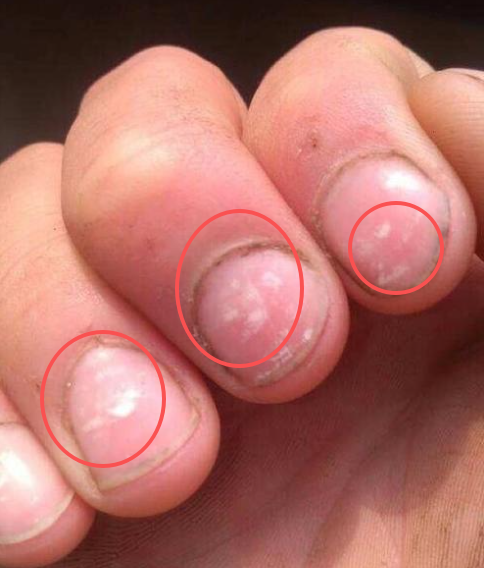
Ah, the classic myth of the “calcium spot.” For generations, we’ve been told that those little white flecks on our fingernails are a sure sign we need to drink more milk. It’s a piece of folklore as stubborn as a stain, but it’s time to set the record straight.
DID YOU KNOW that if nails have white spots, it’s NOT because your body lacks calcium?
Those spots have a name: leukonychia. And in the vast majority of cases, especially the common small, scattered spots, they are not a billboard for a nutritional deficiency. They are far more likely to be tiny scars.
The Real Cause: A Mini-Trauma, Not a Mini-Famine
Think of your nail as a timeline growing out from the cuticle. The visible nail plate is made of keratin, a protein that’s manufactured in the nail matrix (the “root” under your cuticle). If this delicate matrix gets a minor bump, pinch, or knock—something so small you don’t even remember it—the keratin production at that spot can be disrupted.
- The Trauma: You shut a drawer on your fingertip, whack it with a hammer, or even have an overzealous manicure.
- The Result: A microscopic flaw is embedded in the nail layers as it forms. As the nail grows, that flaw travels out, appearing as a white spot or line.
- The Proof: The spots grow out with the nail and eventually get clipped off. You cannot “rub them out” because they are inside the nail plate.
It’s the equivalent of a tiny air bubble or a flaw in laminated glass. Your body isn’t crying out for minerals; it’s just displaying a healed injury from weeks or even months ago.
When White Spots Might Signal Something More (The Rare Exceptions)
While trauma is the #1 cause, there are specific, less common patterns that can point to other issues:
- Paired Horizontal White Lines (Mees’ Lines): These are rare but significant. They appear as parallel white bands across the nail. They can be a sign of systemic stress like poisoning (heavy metals like arsenic), chemotherapy, a high fever, or severe illness. The body temporarily halts nail growth during the crisis, leaving a line.
- Large, Diffuse White Areas: If most of the nail is white, it could be linked to conditions like liver cirrhosis, kidney failure, or heart failure. This is very distinct from little spots.
- True Deficiency Link (Extremely Rare): In cases of severe protein deficiency or zinc deficiency, you might see more generalized nail changes, but this would be accompanied by many other severe symptoms (hair loss, skin lesions, growth failure). It is not the cause of your random white speckles.
Your Action Plan: Observe, Don’t Obsess
- Watch the Pattern: Are they random, small, and scattered? Almost certainly trauma. Do they form neat, horizontal lines across all nails? Time to see a doctor.
- Give It Time: Let the nail grow. If the spot grows out and disappears, case closed.
- Protect Your Nails: Wear gloves for chores, be gentle during manicures, and avoid using your nails as tools.
- When to See a Doctor: Only if the white spots are:
- Horizontal lines across most nails.
- Not growing out.
- Accompanied by other nail changes (pitting, ridges, thickening) or you feel generally unwell.
So, the next time you see a white spot, don’t reach for a supplement. Remember—it’s far more likely to be the ghost of a stubbed finger past than a plea for more cheese. Your body is simply showing you a healed history, written in keratin, one millimeter at a time.