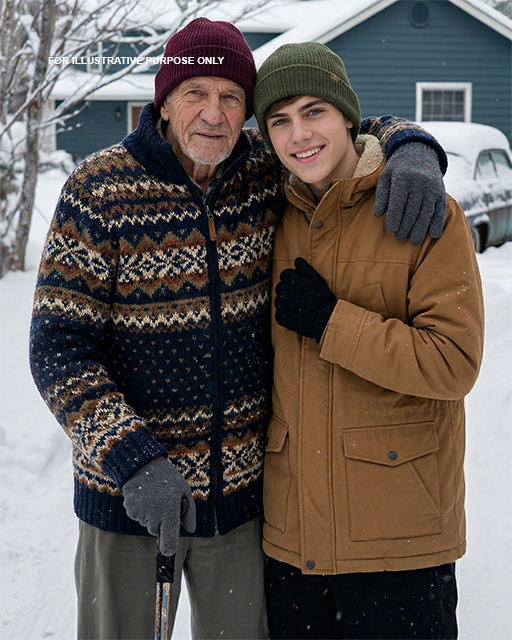
My name is Walter. I’m 68 years old, a retired Marine with a bad knee, a stubborn streak, and more memories than I sometimes know what to do with.
For the past twelve years, I’ve lived alone in a small brick house on a quiet street where nothing much happens. The lawns are trimmed. The mail arrives at the same hour each day. On summer evenings, the air smells faintly of cut grass and someone’s charcoal grill. It’s the kind of neighborhood where people wave but rarely linger.
That changed on Saturday, the house across from mine sold.
A moving truck pulled in just after eight in the morning. By noon, boxes were stacked in the garage and laughter drifted across the road. I watched from my porch swing, the wood creaking under my weight.
A man in his mid-forties directed the movers with brisk efficiency. His wife carried lighter boxes inside. A teenage boy hauled furniture with tight shoulders and silent focus. A little girl skipped around the driveway with a stuffed rabbit tucked under her arm.
They looked like a family from a brochure, sunlight catching in their hair, easy smiles, purposeful movement.
I’ve learned not to trust brochures.
The next afternoon, they came over together.
The father rang my bell. When I opened the door, he extended his hand immediately.
“Good afternoon. I’m Michael. We just moved in across the street. This is my wife, Rebecca. Our son is Connor, and our daughter is Lucy.”
Rebecca held out a pie, still warm. “We didn’t want to be the rude new neighbors.”
Connor stood slightly behind them, tall and lean, hands buried in the pockets of his hoodie despite the heat. His dark hair fell into his eyes. Lucy waved enthusiastically.
“Walter,” I said, shaking Michael’s hand. His grip was firm and confident. “Welcome to the neighborhood.”
We exchanged pleasantries. Michael mentioned he had transferred for work. Rebecca said they were excited for a fresh start. Connor said nothing. His gaze drifted past me, scanning the quiet interior of my house as though measuring it.
After a few minutes, they headed back across the street, Lucy hopping along the sidewalk cracks.
Life settled into routine again. I spent my afternoons on the porch with iced tea, watching delivery trucks come and go. Some evenings, I caught sight of Michael and Connor in the yard, throwing a football.
At first, it seemed ordinary. A father and son passing time.
Then I started to listen.
“Again,” Michael would say. “You’re dropping your elbow.”
Connor would retrieve the ball from the hedge, jaw tight.
“Focus. You’ve got the arm, but you’re sloppy.”
It wasn’t cruel. Not exactly.
It was relentless.
One afternoon, Connor’s throw veered wide and landed near my curb. He jogged across to retrieve it.
“Keep your elbow higher,” I called out before I could stop myself. “Step into it.”
He blinked at me, surprised.
“You’ve got strength,” I added. “You just need cleaner mechanics.”
He nodded once. “Thanks, sir.”
His next pass spiraled better. Michael gave a short nod of approval, but he checked his watch immediately after, as if efficiency mattered more than progress.
I told myself it was none of my business.
Then the lights started.
It was a Tuesday night. I was halfway through an old paperback when a flicker caught my eye. Across the street, in Connor’s upstairs bedroom window, a beam of light pulsed against the darkness.
Three short flashes.
Three long.
Three short.
S.O.S.
My heart reacted before my mind did. The pattern was engraved in muscle memory from another lifetime, from humid nights and sudden mortar fire. I stood, my knee protesting, and stepped closer to the window.
The street was still. No shouting. No broken glass. Just that steady, deliberate signal.
After a moment, the light went dark.
The next morning, the house looked perfectly ordinary. Rebecca watered her flowers. Michael left in a pressed shirt and tie. Connor climbed into the passenger seat with a backpack slung over one shoulder. Lucy waved from the back seat.
No sirens. No chaos.
I convinced myself it was a kid fooling around.
But the next night, it happened again.
Three short. Three long. Three short.
On the fourth night, irritation replaced concern. I snapped my lamp on and off once, a sharp burst of light aimed across the street.
Connor’s window went dark immediately.
Two days later, I intercepted him by the mailboxes.
“Son,” I said evenly, “that signal isn’t a toy. It means someone’s in serious trouble. Don’t throw it around for fun.”
He didn’t look embarrassed. He didn’t look mischievous.
He looked tired.
“I’m not joking, sir,” he said quietly. “Watch your window carefully.”
Then he walked away.
The signals stopped for several nights. I told myself I had handled it.
Until the following Monday.
I was about to turn in when the light flared again. Not the familiar pattern this time. The rhythm was different. Intentional.
I grabbed a pen and the back of an envelope, translating as the pulses came.
W E.
Pause.
N E E D.
Pause.
Y O U R.
Pause.
H E L P.
My throat tightened.
C O M E.
Pause.
I N T O.
Pause.
T H E.
Pause.
H O U S E.
The message repeated once.
Then darkness.
A cold clarity settled over me, the same instinct that used to hum under my skin before things went bad overseas.
I took my cane and stepped outside.
Their front door was slightly ajar.
I knocked once and pushed it open. “Hello?”
A loud thud echoed from inside, followed by raised voices.
I moved toward the sound and found the living room in disarray. A side table lay on its side, a drawer spilled open. Michael stood near the couch, face flushed, chest heaving.
Connor stood opposite him, fists clenched.
“I am not letting you throw your future away,” Michael was saying. “I’ve spent years setting you up for something solid. I’ve made calls. I’ve put in favors. You have opportunities most kids would k1ll for.”
“I’m not throwing anything away,” Connor shot back. “I just don’t want what you want.”
They both turned when they saw me.
Michael’s expression hardened. “Walter. What are you doing in my house?”
“Your door was open,” I said calmly. “I heard a crash. Figured you might have an intruder.”
“We’re fine,” he replied tightly. “Family discussion.”
“Connor asked for help,” I said.
Silence dropped like a weight.
Michael looked at his son. “You’ve been signaling him? Broadcasting our business?”
Connor lifted his chin. “Every time I try to talk to you, you talk over me. I needed someone to actually listen.”
Michael’s jaw flexed. “What is there to listen to? I’ve lined up meetings with the dean at the business school. You’ve got the grades. You could walk straight into a stable career.”
“I don’t want business school.”
“Then pre-med. Law. Engineering. Something that pays.”
Connor’s voice cracked, but did not falter. “I want to be an EMT.”
Michael stared at him as if he had spoken another language. “An EMT? You want to ride around in an ambulance for barely any money? You want to scrape people off pavement at three in the morning?”
“I want to help when it matters.”
“If you’re interested in medicine, become a doctor. Have authority. Stability.”
“Stability isn’t the same as purpose,” Connor said.
Michael laughed without humor. “Purpose doesn’t pay the mortgage.”
He rubbed his hands over his face, suddenly looking older.
“I worked construction through college because my father couldn’t keep the lights on. I swore my son would never feel that kind of insecurity.”
“I’m not afraid of working hard,” Connor replied. “I’m afraid of waking up at fifty and realizing I lived someone else’s life.”
I shifted my weight, the old ache in my knee reminding me I was not as steady as I once was.
“In the Marines,” I said quietly, “the ones we remembered most weren’t always the decorated officers. It was the medics. The ones who crawled through chaos to keep someone breathing.”
Michael’s gaze flicked to me.
“It takes nerve,” I continued, “to run toward emergencies instead of away from them. You raised a kid who wants to be that person.”
Connor’s eyes glistened, but he did not look down.
Michael sank onto the arm of the couch. The anger had drained, leaving something rawer behind.
“I’m not trying to control you,” he said to his son. “I’m trying to protect you.”
“I know,” Connor whispered. “But protecting me from struggle means protecting me from choice.”
The room felt different then. Less explosive. More fragile.
I moved toward the door.
“Pressure can build strength,” I said to Michael. “But too much, without room to breathe, just crushes.”
He did not respond right away. He was looking at his son, really looking at him.
I left them there.
A week passed before Connor knocked on my door.
He stood straighter than before.
“Dad said I could ask you about first aid,” he said. “If that’s okay.”
I stepped aside. “Come in.”
We did not talk about glory. We talked about basics. How to stay calm when someone else is panicking. How adrenaline lies to you. How your hands might shake but you can still act.
I showed him how to wrap a compression bandage properly. We practiced steady breathing.
Sometimes, while Connor sat at my kitchen table, I would see Michael outside through the window, trimming hedges or washing the car. He would glance over.
Once, he gave me a short nod.
It was not a surrender.
It was acceptance.
Over the next few months, Connor enrolled in a volunteer first responder course. Michael attended the orientation with him. I saw them return that night talking, not arguing.
One evening, near the end of summer, I noticed Connor’s bedroom light flicker again.
I smiled before the pattern even finished.
T H A N K.
Pause.
Y O U.
I reached over and flicked my lamp once.
Message received.
As I climbed into bed, I realized something I had not felt in years. Not since I had hung up my uniform and boxed away the version of myself that used to make a difference in obvious ways.
Service does not always mean distant battlefields or dramatic rescues.
Sometimes it means noticing a light in the dark.
Sometimes it means walking across the street when a door stands open.
And sometimes it means reminding a father that loving his son includes letting him choose his own way to serve.
Across the road, Connor’s room went dark for the night.
For the first time in a long while, I slept without dreams.