My name is Beryl, I’m 28, and for as long as I can remember, I’ve been the kind of person who plans everything.
I plan meals a week in advance. I map out alternate routes in case of traffic. I even had a color-coded spreadsheet for my honeymoon before my fiancé, David, had officially proposed.
Order makes me feel safe. Predictability makes me feel in control. So when it came to my wedding day, I believed that if I planned it carefully enough, it would unfold exactly the way I imagined—the happiest, most seamless day of my life.
It was unforgettable, all right.
Just not for the reasons I expected.
David, my husband, is 31. He’s thoughtful, easygoing, and genuinely kind in a way that feels rare. Being with him has always felt simple and steady—except for one complication.
His mother, Monica.
Their relationship was… intense. The kind of closeness that might be endearing in small doses but overwhelming in practice. She called him every morning without fail, usually before 7 a.m., and if he didn’t answer, she’d follow up with a text like, “Just checking you’re alive, sweetheart!”
She packed him homemade lunches. She reminded him to drink water. And yes—she still folded his laundry because, as she liked to say, “David prefers his shirts done properly.”
At first, I tried to see it as harmless. A little unusual, maybe, but rooted in love. I told myself I wouldn’t be the kind of partner who felt threatened by a close mother-son bond.
So I smiled when she called him “the most important man in my life,” even after we got engaged. I laughed when she sent us cookies for weekend trips. I bit my tongue when she commented on my cooking, my clothes, even the way I made coffee.
I kept telling myself it would settle down once we were married.
I was wrong.
The moment wedding planning began, Monica inserted herself into every detail with a level of enthusiasm that quickly became suffocating.
When I showed her a picture of the lace dress I’d fallen in love with, she barely glanced at it before saying, “The pattern is… not very flattering on your frame.”
When I mentioned peonies for my bouquet, she wrinkled her nose. “David doesn’t like peonies.”
“He’s never said that,” I replied.
“They make his eyes itchy,” she said dismissively. Then, without missing a beat, “You should wear your hair up. He prefers it that way.”
It was constant. Every choice I made was questioned, redirected, or quietly overridden.
To David’s credit, I did try to talk to him about it.
“She’s not just being involved,” I told him one evening. “She’s taking over.”
He laughed softly, tying his shoes like it was nothing. “She means well. Just let her enjoy it.”
“It’s not enjoyable for me,” I said. “It feels like I’m losing control of my own wedding.”
He kissed my forehead. “It’s one day. It’ll pass.”
But it didn’t feel like one day anymore. It felt like I was being edged out of my own life.
Monica insisted on approving every vendor, every menu, every seating arrangement. Somehow, the guest list ballooned by over a hundred people—her friends, her acquaintances, people I had never met.
More than once, I heard her refer to the wedding as “our special day.”
By the time the actual day arrived, I was exhausted but determined. I had done everything I could to keep things together, to keep the peace, to make it work.
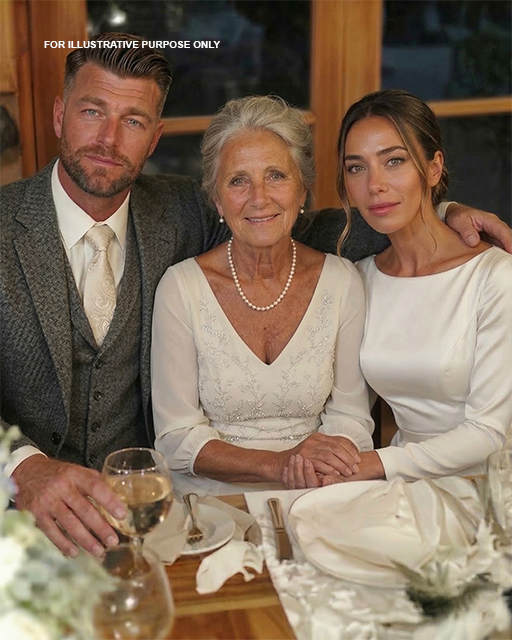
Then Monica walked in wearing white.
Not off-white. Not champagne. White.
A full-length, shimmering ivory gown that caught the light like she had stepped out of a bridal catalog.
I was in the bridal suite when my cousin rushed in, wide-eyed.
“Beryl,” she whispered, “your mother-in-law is… in white.”
I stepped into the hallway, half-hoping there had been some misunderstanding.
There hadn’t.
There she was, smiling, glowing, greeting guests like she was the one they had come to see.
At one point, she even turned and said, laughing lightly, “Well, I couldn’t let my son have all the attention today.”
I looked at David. “Are you going to say something?”
“I will,” he said.
But he didn’t.
He never did.
The ceremony itself passed in a blur. I focused on David, on the vows, on the moment we had worked toward for so long. For a little while, I managed to push everything else aside.
But the reception brought it all rushing back.
Monica moved through the room like a host, greeting guests, directing staff, and inserting herself into conversations. Every few minutes, she appeared at our table, fussing over David.
“Are you eating enough?”
“Do you need another napkin?”
“Should I fix your collar?”
I sat there beside him, smiling politely, feeling increasingly invisible.
Then, just when I thought it couldn’t get worse, it did.
After the meal began, I saw her stand up from her assigned table. She picked up her plate, her glass, and—without hesitation—walked straight toward us.
Before I could react, she pulled a chair from a nearby table and placed it directly between David and me.
“Mom, what are you doing?” David asked, startled.
“Oh, don’t be dramatic,” she said, settling in. “I’m just making sure you’re taken care of.”
I felt every eye in the room shift toward us.
“This table is for us,” I said carefully.
She waved a hand. “You’ll have the rest of your lives to sit together.”
There were a few awkward chuckles from nearby tables. I could feel the tension tightening in my chest.
David glanced at me—the same look he’d given me all day. Please don’t make a scene.
So I smiled.
“Of course,” I said calmly. “Let’s make it a night to remember.”
Because in that moment, something shifted inside me.
If she wanted attention so badly, I would give it to her—just not in the way she expected.
Dinner continued, and Monica only grew bolder. When David’s plate arrived, she picked up his knife and began cutting his food for him.
“There we go,” she said warmly. “Just how you like it.”
Then she dabbed at the corner of his mouth with a napkin.
I heard someone at a nearby table stifle a laugh.
David shifted uncomfortably, but still said nothing.
And that was when I realized something important: confronting her directly would only create the kind of spectacle she thrived on.
But reflection? Exposure?
That was different.
Later, during the mother-son dance, Monica glided across the floor like she was reliving her youth, radiant and completely absorbed in the moment.
I took that opportunity to find our photographer, Nina, who was reviewing shots near the bar.
“I need a favor,” I said.
She looked up immediately. “What kind?”
“I want every photo of Monica from today included in the slideshow,” I said. “The candid ones. The… honest ones.”
Her eyebrows lifted. “You mean the ones where she’s stepping in front of you? Or the ones where she’s in the middle of everything?”
“Exactly those.”
There was a pause, then a slow smile. “Got it.”
By the time evening settled and guests gathered around the large screen in the ballroom, everything was ready.
The slideshow began with childhood photos, then engagement pictures. The room softened with nostalgia—smiles, quiet laughter, warm murmurs.
Then came the wedding photos.
And there she was.
Monica is sitting between us at the head table.
Monica was adjusting David’s tie while I stood beside them.
Monica is stepping into our first kiss.
Monica is reaching for the bouquet mid-toss, blocking me entirely.
One image after another, each more unmistakable than the last.
At first, there was silence.
Then a snort of laughter from the back.
Then another.
Within seconds, the entire room erupted.
People laughed openly now, no longer trying to hide it. Some covered their mouths. Others leaned into each other, shaking with amusement.
Even David’s relatives, clearly recognizing the pattern, couldn’t hold it in.
Then the final slide appeared:
“True love can survive anything… even an unexpected third presence.”
The room burst into applause.
I turned just in time to see Monica’s expression collapse—shock, embarrassment, then a deep flush of red. She stood abruptly and left the room without a word.
David sat frozen.
I took a slow sip of champagne, letting the moment settle.
When he finally turned to me, something had changed in his expression.
Understanding.
Then, unexpectedly, he laughed.
“I guess I had that coming,” he admitted. “For not stepping in sooner.”
I met his gaze. “You think?”
The mood in the room shifted after that—lighter, freer. Conversations picked up, glasses clinked, and for the first time all day, I felt like the bride again.
A few minutes later, David stood and quietly slipped out to find his mother.
When he returned, Monica was with him.
She looked smaller somehow. Her confidence had cracked, replaced with something more human—embarrassment, maybe even reflection.
David rested a hand on her shoulder. “Mom,” he said gently, “I love you. But today isn’t about you. It’s about us. And if we’re going to move forward as a family, things have to change.”
She didn’t argue.
She didn’t deflect.
After a long pause, she nodded. “You’re right,” she said quietly. “I went too far.”
It wasn’t a dramatic apology. But it was real.
And for the first time, it felt like a beginning.
David turned to me next, his voice softer. “I’m sorry. I should’ve protected this day for you.”
I squeezed his hands. “We’ll do better from here.”
The rest of the evening unfolded differently. Monica kept her distance, joining conversations at her own table, offering polite smiles instead of constant interruptions.
When David and I shared our final dance, she watched from afar—and clapped along with everyone else.
Later, when the guests had thinned and the music softened, I slipped off my heels and sat down, exhausted but oddly content.
David joined me, loosening his tie.
“For a day that went completely off-script,” he said, “it turned out pretty memorable.”
I leaned my head against his shoulder. “Not exactly what I planned.”
He smiled. “Better, maybe?”
I thought about it for a moment.
About the chaos. The tension. The turning point.
And the quiet understanding that followed.
“Yeah,” I said finally. “Better.”
Because that day, I didn’t just get married.
I learned that love isn’t about staying silent to keep the peace. It’s about knowing when to speak—and how.
And sometimes, the most powerful way to reclaim your moment… is to let the truth speak for itself.