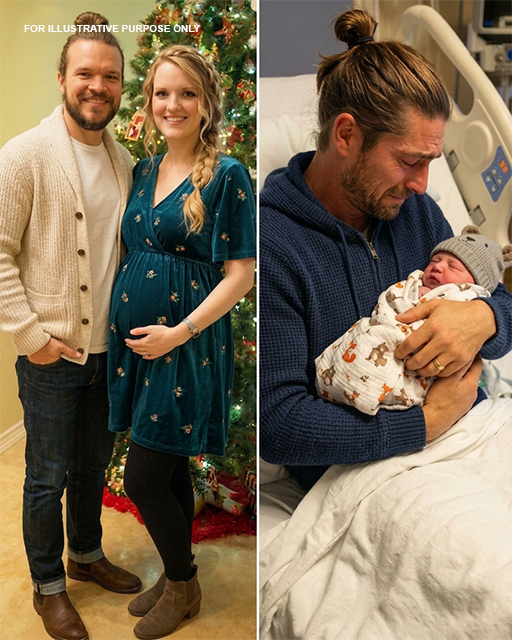
My wife di3d on Christmas Day, leaving me alone with a newborn and a promise I never broke. I would raise our son with everything I had.
For ten years, it was just the two of us, along with the same quiet absence of the woman I had loved. The woman our son had only met for a handful of fleeting moments.
The week before Christmas always moved more slowly than the rest of the year. It wasn’t peaceful. It felt as though the air itself had thickened, and time had to force its way through it.
That morning, my son Isaac sat at the kitchen table, in the same chair Mira used to lean against when she brewed cinnamon tea. Her photograph rested on the mantel in a deep green frame. Her smile was caught mid-laugh, as if someone had just said something outrageous and she hadn’t quite recovered.
I didn’t need to look at it to remember. I saw Mira in Isaac every day. In the way he tilted his head when he was thinking. In the quiet hum that escaped him when he concentrated.
“Dad,” he said, not looking up from the carefully arranged pieces beside his cereal bowl, “do you think Santa gets bored of chocolate chip cookies?”
I leaned against the counter, cradling my mug. “Bored? Of cookies? That seems unlikely.”
“But we make the same kind every year,” he insisted. “What if he wants something different?”
“We make them,” I said, “and then you eat half the dough before they even make it to the oven.”
“I do not eat half.”
“You ate enough last year to put a reindeer into a sugar coma.”
That got a laugh out of him, soft and quick. He shook his head and went back to building, his fingers moving with careful precision. Isaac liked patterns, routines, and things that made sense. He liked knowing what came next. He was his mother’s son in all the ways that mattered.
“Come on,” I said after a moment. “Time for school.”
He groaned, but stood anyway, slinging his backpack over one shoulder. “See you later, Dad.”
The door closed with a soft click, and the house settled into silence.
I stayed where I was for a long moment, running my thumb along the edge of the placemat Mira had sewn during those restless final weeks of pregnancy. The corners were uneven. She had loved that about it.
“Don’t tell anyone I made this,” she had said, laughing, one hand resting on her belly. “Especially our son. Unless he turns out sentimental like me.”
For ten years, it had just been Isaac and me. A team.
I never remarried. I never wanted to. My heart had already chosen its path, and I wasn’t interested in rewriting it.
Mira’s stocking stayed folded in the back of a drawer. I couldn’t bring myself to hang it, but I couldn’t throw it away either. Some years, without thinking, I still set out her old mug.
“We miss you,” I murmured once, staring at the empty chair. “This time of year especially.”
That afternoon, when I pulled into the driveway, I saw a man standing on my porch.
At first, it was just a shape. A stranger. But as I got closer, something in my chest tightened.
He looked like he belonged there.
When I stepped out of the car and really saw him, my stomach dropped.
He looked like my son.
Not in a vague or passing resemblance. Not in a way that could be dismissed. It was precise. The same angle of the jaw. The same slight inward curve of the shoulders, as though bracing against something unseen.
For a split second, I had the absurd, chilling thought that I was looking at Isaac grown up. A version of him from the future.
“Can I help you?” I asked, keeping one hand on the car door.
“I hope so,” he said.
His voice was steady, but there was something strained underneath it.
“Do I know you?”
“No,” he replied. “But I think you know my son.”
The words didn’t make sense. They hovered in the air between us, heavy and wrong.
“You need to explain that.”
“My name is Bruno,” he said. “And I believe I’m Isaac’s biological father.”
Everything inside me recoiled.
“You’re mistaken,” I said immediately. “You have to be. Isaac is my son.”
“I’m not here to argue with you,” Bruno said quietly. “I’m here because I have proof.”
“I think you need to leave.”
He didn’t move. Instead, he reached into his coat and pulled out a plain envelope.
“I didn’t want to start like this,” he said, “but you should see it.”
I should have told him to go. I should have shut the door in his face and protected what was mine.
Instead, I opened the door and let him follow me inside.
We sat at the kitchen table Mira had picked out years ago, when our biggest concern had been whether the finish matched the cabinets.
My hands felt numb as I opened the envelope.
Inside was a paternity test. Clinical, precise, final.
Bruno’s name.
Mira’s name.
And the result. A 99.9 percent probability.
The room didn’t move, but it felt like it had tilted.
“She never told me,” Bruno said after a long silence. “Not while she was alive. I only found out recently.”
“How?” My voice sounded distant, even to me.
“Your sister-in-law,” he said. “Hera.”
My head snapped up. “Hera knew?”
“She didn’t tell me outright,” he clarified. “But she posted a photo of Isaac. I saw it. I couldn’t ignore the resemblance. I reached out. She hesitated, but eventually she told me Mira had left something with her. For me. In case I ever came looking.”
He pulled out a second envelope and slid it across the table.
My name was written on it in Mira’s careful, looping handwriting.
My chest tightened as I opened it.
Abel,
I didn’t know how to tell you.
It happened once. Bruno and I knew each other before you, and there was always something unresolved between us.
It was a mistake. One I thought I could bury.
Then I found out I was pregnant.
I knew the truth, but I also knew the life we had built. I was afraid of losing it. Afraid of losing you.
Please love our boy anyway. Please stay.
You were always meant to be his father, no matter what biology says.
I love you.
Mira
My hands trembled as I lowered the letter.
“She lied to me,” I said, barely above a whisper. “And then she di3d.”
Bruno didn’t interrupt.
“I built my entire life around that promise,” I continued. “Around her. Around him.”
“You did what most people wouldn’t have had the strength to do,” Bruno said. “You stayed.”
“I didn’t just stay,” I snapped, looking up. “I became his father. I was there when he took his first breath. I was the one holding him when he cried. I’ve spent ten years loving him with everything I have.”
“I know,” Bruno said. “And I’m not here to take that away from you.”
“Then what are you here for?”
He hesitated, then met my eyes. “I don’t want custody. I don’t want to disrupt his life. But I won’t disappear either. He’s my son too, and he deserves to know where he comes from.”
The words landed heavily between us.
“I’ve spoken to a lawyer,” he added. “I haven’t filed anything. I don’t want a battle. I just want a place in his life, however small that may be.”
“You think this is about fairness?” I asked bitterly. “He’s ten years old. He still sleeps with a stuffed reindeer his mother picked out. He still believes in Santa.”
“And he also deserves the truth,” Bruno said. “I’m asking for one thing. Tell him. On Christmas.”
That afternoon, I went to the cemetery.
The memory I usually kept buried surfaced without resistance.
Ten years ago, Mira and I had walked into the hospital hand in hand. She had been exhausted, but she was smiling.
“If he looks like you,” she had teased, squeezing my hand, “I’m sending him back.”
We had a name. A tiny stocking packed in the hospital bag. A future laid out in soft, hopeful lines.
Then everything fell apart.
Her hand went limp. The room erupted into motion. Doctors rushed her away while I stood there, useless and terrified.
Then they placed a silent, still newborn in my arms.
“This is your son,” someone said gently.
I begged him to breathe. I pleaded with him.
And then he cried.
I took that cry and built my entire life around it.
On Christmas morning, Isaac padded into the living room in reindeer pajamas, clutching the same worn toy.
“You’re quiet,” he said, studying me. “That usually means something’s wrong.”
I handed him a small wrapped gift, buying myself a moment.
“Is it about the cookies?” he asked.
“No,” I said softly. “It’s about your mom, and something she never told us.”
He listened without interrupting, his expression serious in a way that didn’t belong on a child’s face.
When I finished, he was very still.
“Does that mean you’re not my real dad?” he asked.
The question hit harder than anything else.
“It means I’m the one who stayed,” I said gently. “The one who raised you. The one who knows you better than anyone.”
“But he helped make me?”
“Yes.”
“And you chose me?”
I swallowed. “Every single day.”
He was quiet for a long moment. Then he leaned into me, wrapping his arms around my middle.
“You’re my dad,” he said firmly.
Something in my chest cracked open, fragile but steady.
“I’ll always be your dad,” I said.
After a while, I added, “You might need to meet him someday. You don’t have to decide anything now. Just be open to it.”
Isaac nodded against me.
“Okay,” he said. “I’ll try.”
Later that evening, I stepped outside and found Bruno standing by the edge of the yard, as though he wasn’t sure he was allowed any closer.
I studied him for a moment, then said, “He knows.”
Bruno’s breath caught. “And?”
“He’s willing to meet you,” I said. “But on his terms. Slowly.”
Relief flickered across his face, tempered by something more cautious. Respect, maybe.
“Thank you,” he said.
I nodded, though the word didn’t feel big enough for what had shifted between us.
Standing there in the cold, I realized something I hadn’t understood before.
Family wasn’t as simple as I had always believed. It wasn’t defined by a single moment or a single truth.
It was built day by day, in choices, in showing up, in staying.
There was more than one way a family could begin.
But the truest kind was the one you fought to keep.