For 12 years, I thought the woman tattooed on my husband’s shoulder was someone he had once loved.
An old girlfriend. A former fiancée. The one who got away.
I was wrong.
The truth was far worse.
Because the woman on his shoulder wasn’t someone he had loved.
She was someone he had helped destroy.
And I didn’t learn that from him.
I learned it from her.
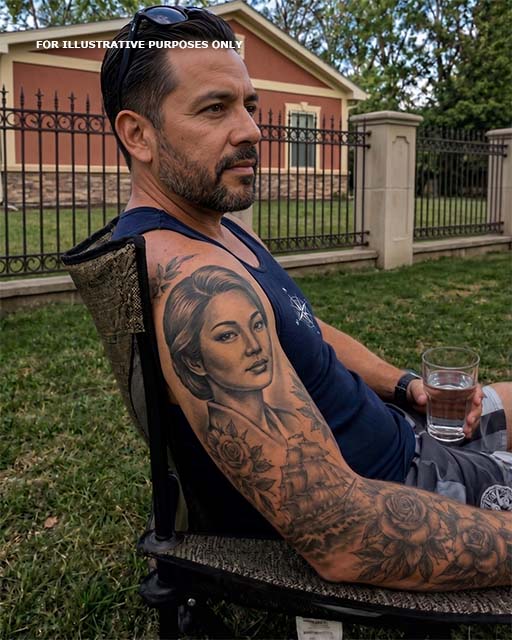
The first time I saw the tattoo was three weeks after I met Derek Calloway.
We were at a lake party with friends. Derek pulled off his shirt and jumped into the water.
That was when I noticed her.
A woman’s face covered most of his upper arm and shoulder.
Dark hair. Thoughtful eyes. A tiny beauty mark near her jaw.
The portrait was so realistic that it looked like a photograph.
When Derek climbed back onto the dock, I pointed toward it.
“Who’s that?”
His smile faltered for the briefest moment.
“Nobody.”
I laughed.
“No one gets a giant portrait tattoo of nobody.”
“Long story.”
That was all he said.
At the time, I didn’t push. Everyone had a past.
I assumed I would eventually hear the truth.
I never did.
Over the years, I asked several more times.
His explanation changed every time.
A friend is practicing portrait tattoos. A random photo from the internet. A drunken bet. An old mistake.
The details never matched.
The lie always remained.
That bothered me because Derek wasn’t normally dishonest.
Except when it came to her.
After we got married, the mystery became harder to ignore.
Not because I was jealous.
Because it felt impossible.
Nobody permanently tattoos a stranger’s face on their body, especially not with that level of care.
One night, seven years into our marriage, I suggested covering it.
Not removing it.
Just changing it.
A landscape. A compass. A wolf. Anything.
His reaction surprised me.
He looked genuinely distressed.
“No.”
The answer came immediately.
“Why?”
For several seconds, he stared at the floor.
Then he quietly said, “Because I need to remember.”
The answer made no sense.
Remember what?
But something in his expression stopped me from pressing further.
So I let it go.
At least outwardly.
Inside, I never stopped wondering.
Twelve years after our wedding, everything changed in a bakery.
The woman ahead of me in line turned slightly.
My stomach dropped.
I knew that face.
The same eyes. The same beauty mark. The same expression.
Older now, but unmistakably her.
For a moment, I thought I was imagining things.
Then she turned farther.
No.
It was definitely her.
My pulse started racing.
I stepped forward.
“Excuse me.”
She turned politely.
“This is going to sound strange, but do you know someone named Derek Calloway?”
Everything changed.
The color drained from her face.
Her eyes immediately moved toward the door, then toward the windows, as though checking every exit.
The reaction unsettled me.
“Are you alright?”
Several seconds passed.
“Derek?” she whispered.
I nodded.
Her expression softened slightly.
Then she asked a question I never expected.
“Is he okay?”
The concern in her voice caught me completely off guard.
“Yes.”
A visible wave of relief crossed her face.
Nothing about this made sense.
“Why are you asking about him?”
I swallowed.
“My husband has your face tattooed on his shoulder.”
For a moment, she simply stared.
Then she sat down.
“What?”
“You didn’t know?”
She slowly shook her head.
“No.”
The shock looked genuine.
That somehow made everything worse.
Because it meant she had no idea why her face was there.
Finally, she stared down at her coffee.
“If Derek still hates me, I understand.”
The sentence hit me like a brick.
Hates her?
Why would he hate her?
Why would he carry her face on his body for years if he hated her?
Nothing fit.
Nothing.
I opened my mouth to ask another question.
But she stood.
“I should go.”
“Wait.”
She hesitated.
“Who are you?”
For the first time, sadness appeared in her eyes.
Then she said quietly, “That’s the wrong question.”
“What?”
She looked directly at me.
“The question isn’t who I am.”
A pause.
“It’s why hearing his name still scares me after twenty years.”
My pulse quickened.
Scares her?
Before I could respond, she added, “When someone helps destroy your life, you don’t forget it.”
Then she walked away, leaving me standing there in stunned silence.
I barely remember driving home.
My thoughts kept circling the same sentence.
When someone helps destroy your life.
By the time I reached our house, my hands were shaking.
Derek was sitting on the porch.
The moment he saw me, he smiled.
I didn’t.
His smile vanished.
“What happened?”
I walked directly toward him.
“I met her.”
Every trace of color disappeared from his face.
The same fear I’d seen in the bakery.
For several seconds, he said nothing.
Then, “Where?”
“The bakery downtown.”
His eyes closed.
Not like a guilty husband caught cheating.
Like a man watching a nightmare come true.
“You spoke to her?”
“Yes.”
His next question stunned me.
“Did she seem okay?”
What did she say?
How did you find her?
I stared at him.
“Who is she?”
For several moments, he said nothing.
Finally, “Her name is Lydia Rowan.”
“Who is Lydia?”
He looked away.
For a long time, he remained silent.
Then he whispered, “She’s connected to the worst thing I’ve ever done.”
That night, the truth began to emerge.
Slowly. Painfully. Incomplete at first.
22 years earlier, Lydia had accused Derek’s father, Harold Calloway, of serious misconduct.
At the time, Derek was 16.
His father was a beloved teacher and coach.
Practically a local hero.
Nobody wanted to believe Lydia.
Including Derek.
Especially Derek.
“I thought she was lying.”
His voice was barely audible.
“So what happened?”
He swallowed.
“The town chose sides.”
The answer wasn’t enough.
I knew it.
He knew it.
“What did you do?”
For several seconds, he couldn’t meet my eyes.
Then he finally said it.
“I helped lead it.”
The room went silent.
Derek told me everything.
How he publicly defended his father.
How he spoke to reporters.
How he spread rumors.
How he m0ck3d Lydia at school.
How he encouraged others to turn against her.
How he watched her get hara2s3d and did nothing.
How he convinced himself he was protecting his family.
And how the entire town followed.
Within months, Lydia’s life became unbearable.
Her family moved away.
The hara2sm3nt continued even after she left.
Anonymous letters. Cruel phone calls. Online messages years later.

Most came from other people, not Derek.
But his actions had helped create the mob that followed her.
Years later, evidence surfaced.
Then more evidence.
Eventually, Harold Calloway confessed.
Lydia had been telling the truth from the beginning.
The town had destroyed an innocent girl.
And Derek had helped.
For a long time, I couldn’t speak.
The man sitting across from me felt unfamiliar.
Not because of what he’d done at sixteen.
Because he had hidden it for fourteen years.
That hurt most.
For the first time in our marriage, I wondered whether I truly knew him.
That night I slept in the guest room.
The next night too.
And the night after that.
Not because I thought Derek was dangerous.
Because I needed space to understand who he was.
And who he had become.
The conversations that followed were some of the hardest of our marriage.
There were tears. Anger. Questions. Long silences.
And more honesty than we had shared in years.
Slowly, painfully, trust began rebuilding.
Not because the truth was easy.
Because it was finally being told.
Weeks later, I asked the question that still haunted me.
“What about the tattoo?”
Derek stared at the portrait.
For a long moment, he said nothing.
Then, “After my father’s confession, I couldn’t stop seeing her face.”
His voice shook.
“I spent years pretending she wasn’t real.”
He looked down.
“I wanted to remember her face because I spent years refusing to see it.”
The words settled heavily between us.
Years after the confession, during a period of depression and self-loathing, he had walked into a tattoo studio carrying an old newspaper clipping.
Lydia’s photograph.
“I wasn’t thinking clearly.”
He laughed bitterly.
“I thought if I carried the reminder forever, maybe I’d never become that person again.”
For years, he had treated guilt as a punishment he deserved.
And the tattoo had become part of that punishment.
A month later, my phone rang.
It was Lydia.
We met in a quiet park.
For nearly two hours, we talked.
She wasn’t the saint I had imagined.
She wasn’t endlessly forgiving.
She wasn’t perfectly healed.
She was simply human.
At one point, she laughed and said, “Some days I still hate that town.”
A few minutes later, she admitted, “There are names from back then I still struggle to hear.”
Her honesty made her more real than any inspirational story ever could.
Eventually, I asked about the bakery.
“Why were you scared?”
She stared into her coffee.
“When I left town, some people wouldn’t let it go.”
My chest tightened.
She nodded.
“Letters. Calls. Messages.”
A pause.
“Derek wasn’t one of them.”
That surprised me.
“But hearing his name brought everything back.”
She looked away.
“Trauma doesn’t care about calendars.”
For the first time, her reaction made perfect sense.
Several weeks later, Derek asked if he could apologize.
Lydia didn’t answer immediately.
She took nearly a week before agreeing.
Even then, she made no promises.
I stayed in the car.
The conversation wasn’t mine.
Nearly three hours passed.
When Derek returned, his eyes were red.
We drove several miles before he finally spoke.
“I apologized.”
“And?”
He stared through the windshield.
“She listened.”
A pause.
“That’s all.”
Part of him looked disappointed.
Part relieved.
Neither of us expected more.
Two weeks later, Lydia called him.
They spoke for nearly an hour.
Afterward, he sat quietly in the living room.
“What happened?” I asked.
He smiled sadly.
“She said something I needed to hear.”
“What?”
For a moment, he stared at the tattoo.
Then, “She said I wasn’t the person she struggled to forgive.”
I frowned.
“What does that mean?”
His eyes filled with tears.
“She said my father was.”
Silence.
Then:
“She told me I was sixteen.”
A long pause.
“She said she hated what I did.”
His voice cracked.
“But she never expected me to spend the rest of my life punishing myself for it.”
I felt chills.
Because suddenly I understood.
For more than twenty years, Derek had been carrying a sentence Lydia herself had never imposed.
A month later, he scheduled an appointment to cover the tattoo.
For years, he had refused.
Now he wasn’t sure.
The night before, Lydia called again.
When he hung up, I asked, “What did she say?”
He laughed softly.
“She said keeping it or removing it changes absolutely nothing.”
I smiled.
“Sounds like her.”
He nodded.
“Then she told me to stop making every decision about guilt.”
The next morning, he canceled the appointment.
Not because he wanted punishment.
Not because he wanted to suffer.
Because for the first time, the tattoo wasn’t about self-hatred.
It was about remembering a lesson.
A costly one.
But a lesson all the same.
Several months later, a package arrived.
Inside was a photograph.
Not of Lydia.
Of a youth advocacy center she had helped build.
A place for teenagers facing difficult situations at home.
Counselors. Volunteers. Safe spaces. Resources she never had.
Attached was a short note.
No grand speech.
No perfect forgiveness.
Just one sentence:
I’m trying to build the kind of place I needed back then.
Derek framed it.
The photograph hangs in our hallway today.
The tattoo remains, too.
Strangely, I hardly notice it anymore.
Not because the story became less painful.
Because I finally understood it.
For twelve years, I thought the woman on my husband’s shoulder represented a secret romance.
Instead, she represented a terrible mistake.
A painful truth.
And a reminder that the hardest thing a person can do isn’t hiding from their worst moment.
It’s facing it honestly and choosing to become better than the person they once were.