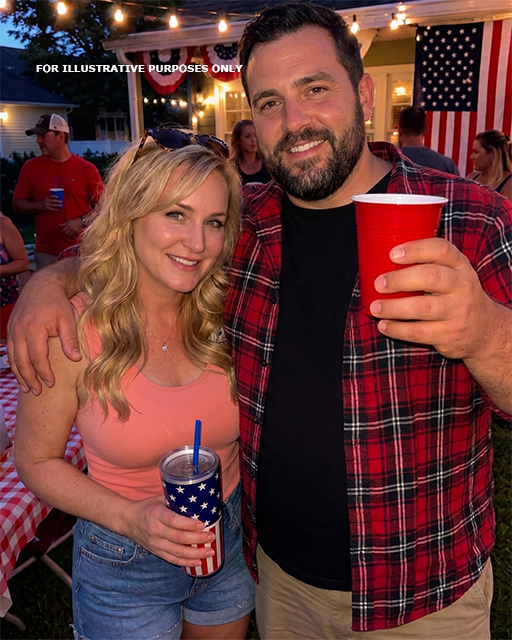
The sun was sinking behind the fence on the Fourth of July as I arranged paper plates on my mother’s picnic table, weighing them down with glass jars so the breeze would not carry them into her rosebushes.
At 62, I still felt safest when my hands were busy.
My mother, Joan, sat beside me with a thin quilt over her knees. She was 88 and moved slowly now, but she still insisted on hosting every family holiday in the house where my brother and I had grown up.
“Let the children help,” she said.
I glanced toward the driveway, where my daughter, Faye, and my son, Peter, were helping their children with small fireworks.
“Those children are both over 40.”
Near the grill, my older brother, Clifford, entertained our relatives while waving a spatula like a microphone.
“Marjorie!” he called. “Come get a burger before your real family arrives to collect you.”
Several relatives laughed.
I kept arranging the napkins.
Clifford had been making the same joke for more than 50 years. As children, he told everyone Mom had found me in a basket on the porch. At Christmas, he warned me not to grow attached to my presents because my “real parents” might return.
Once, during a thunderstorm, he locked me outside behind the screen door and told our cousins that strangers coming down the road were my real family. I stood barefoot in my nightgown while they laughed.
Our father, Edwin, eventually found me and carried me inside.
“That’s enough,” he told Clifford.
Dad had always defended me. He had passed away 11 years earlier, and without him, Clifford’s jokes had become even bolder.
“Clifford, please,” Mom said quietly.
He pretended not to hear her.
“He never listens when you say that,” I murmured.
Mom lowered her eyes.
“No,” she admitted. “He never has.”
I had always looked more like Dad than Clifford did. I had Edwin’s dark eyes and long fingers. Clifford was fair-haired, broad, and several inches taller.
Dad used to place my hand beside his.
“Piano fingers,” he would say. “You got those from me.”
I had never seriously doubted that I was his daughter. Still, Clifford’s jokes had made me feel as though I needed permission to belong.
When the burgers were finished, Clifford closed the grill and clapped his hands.
“Everyone gather around. My ancestry results came in this morning.”
The adults moved toward the table.
Clifford held up his phone.
“I haven’t opened them yet. I thought we could discover the proud Marino family history together.”
He looked at me and grinned.
“Then maybe Marjorie can take one and finally find out where her basket came from.”
Faye’s expression hardened.
Mom went completely still.
“Clifford,” she whispered. “Don’t.”
He tapped the screen.
“Let’s see. 38% Irish, 22% German, 17% Scandinavian…”
His voice faded.
The smile disappeared from his face.
“What is it?” I asked.
He stared at the screen.
“There’s a close family match.”
“What kind?” Faye asked.
“A woman named Teresa Hale. We share almost 25% of our DNA.”
Peter leaned forward.
“That could mean a half-sibling.”
“I know,” Clifford snapped.
He scrolled farther.
“There’s a message.”
His hand began to tremble as he read it silently.
“What does it say?” his wife, Caroline, asked.
Clifford looked at Mom.
“Teresa says her late father was Leonard Hale. She believes he may also have been my biological father.”
Mom covered her mouth.
Clifford saw her reaction.
“Who was Leonard Hale?”
Mom tried to stand but had to grip the table.
“Let’s go inside.”
“No.”
“Please, Clifford.”
“Who was he?”
Tears slid down her cheeks.
“He was the man I was engaged to before Edwin.”
The backyard fell silent.
“When I was 23, I became pregnant,” she continued. “Leonard promised we would marry, but when the pregnancy became real, he panicked. He left town before you were born.”
Clifford took a step backward.
“Edwin knew?”
“Yes.”
Mom’s voice shook.
“I told him everything. Edwin had loved me since high school. When he learned what had happened, he asked me to marry him.”
“And he knew I wasn’t his?”
“He knew.”
Clifford looked as though someone had struck him.
“He put his name on your birth certificate,” Mom said. “He held you the night you were born. He said you were his son because he had chosen to be your father.”
“Did Leonard know about me?”
“Yes.”
Mom closed her eyes.
“I mailed him a letter after you were born. He replied once and said he had started another life and did not want contact.”
Clifford stared at the phone.
“How could you hide this from me?”
“We planned to tell you when you were older,” Mom said. “But Edwin was afraid that learning Leonard had rejected you would only cause pain. Every year, the conversation became harder. Then your father became ill, and we kept putting it off.”
“You mean Edwin.”
“No,” Mom said firmly. “I mean your father.”
Clifford turned toward me.
“You knew.”
“I didn’t.”
“You must have suspected something.”
“I learned the truth when you did.”
“Then why aren’t you screaming?”
I set down the napkins.
“Because I’ve spent my whole life learning not to show what your words do to me.”
His face hardened.
“This has nothing to do with you.”
“You brought that test here to humi:liate me.”
“I was joking.”
“A joke ends when the person being m0:cked stops laughing.”
No one moved.
“You called me the basket baby at every holiday,” I continued. “You told friends and relatives I wasn’t truly part of this family. You made me feel like an outsider at my own table.”
Clifford glanced around, but no one defended him.
“So now you’re enjoying this,” he said.
“No. I know what it feels like to question whether you belong. I would not wish it on anyone.”
“Then what do you want?”
“For once, I want you to listen.”
He said nothing.
“Edwin knew the truth and chose you anyway. Every fishing trip, every school event, every time he helped you repair your house, he was choosing to be your father.”
“Stop.”
“A DNA test can tell you who contributed to your biology. It cannot erase the man who raised you.”
“Don’t be kind to me.”
“I’m not being kind. I’m done making myself small.”
Clifford grabbed his keys and hurried toward his truck.
Caroline followed him.
“Clifford, wait.”
He drove away before she could reach the passenger door.
The celebration ended soon afterward. The burgers went cold, and the unopened fireworks remained in their bags.
For the next two weeks, Clifford ignored every call, including Caroline’s. She eventually told us he had gone to his cabin near the lake and refused to speak to anyone.
One afternoon, I found Mom holding an old photo album.
“I need to talk to him,” she said. “But I can’t make that drive.”
I took the album from her.
“I’ll go.”
“After everything he has done to you?”
“I’m going for Dad.”
Clifford opened the cabin door after my third knock. He looked tired and unshaven.
“Come to gloat?”
“No.”
I handed him the album.
Inside were photographs of Edwin holding him as a newborn, teaching him to ride a bicycle, helping him repair his first car, standing beside him at his wedding, and teaching Clifford’s children to fish.
On the final page, Dad sat at our last Thanksgiving together. Clifford stood behind him with one hand on his shoulder. Both were laughing.
“Did he really know?” Clifford asked.
“Yes.”
“And he never treated me differently?”
“Not once.”
Clifford sat on the porch steps.
I sat beside him.
“I spoke to Teresa,” he said.
I waited.
“She found Mom’s letter among Leonard’s belongings after he passed away. He had kept it all those years.”
“What else did she tell you?”
“Leonard married her mother and had three daughters. He coached their teams, attended every graduation, and apparently became a wonderful father.”
The last words came out bitterly.
“To them.”
He stared across the lake.
“Why wasn’t I worth staying for?”
“I don’t know,” I said. “But his decision was never a measure of your worth.”
Clifford wiped his eyes.
“Edwin stayed,” I continued. “That is the answer you do have.”
He looked down at the album.
“I spent my whole life making you feel like an outsider.”
“Yes.”
“Maybe part of me always sensed Mom was hiding something.”
“Maybe. But that does not excuse what you did.”
“I know.”
His voice broke.
“I’m sorry, Marjorie. For the cookout. For every holiday. For the screen door. For all of it.”
I had never known he remembered that night.
“How can you forgive me?”
“I’m not sure I fully have.”
He nodded.
“But I’m willing to try,” I said. “I don’t want to carry your cruelty for the rest of my life.”
He looked at the photograph of Dad holding him as a baby.
“All those basket jokes,” he whispered. “And Dad was the one who chose to carry me.”
Then Clifford began to cry.
I did not tell him that one apology erased 50 years of hurt. It did not.
But when he reached for my hand, I let him hold it.
Over the next few months, Clifford worked to repair what he had damaged. He apologized to my children, reconciled with Caroline, and spoke honestly with Mom. He continued corresponding with Teresa, though neither of them pretended that shared DNA made them an instant family.
At Thanksgiving, we gathered again in Mom’s dining room.
Clifford stood at the head of the table with a glass in his hand.
I braced myself out of habit.
“To Marjorie,” he said. “The sister I spent years making feel unwelcome, even though she understood family better than I did.”
His voice thickened.
“Edwin chose me every day of his life. Marjorie chose to come after me when she had every reason to walk away.”
He raised his glass.
“To the sister who finally taught me what belonging means.”
Faye squeezed my arm. Peter nodded from across the table. Mom wiped tears from her cheeks.
Clifford pulled out the chair beside him.
I sat down.
At 62, I finally understood that belonging was not determined by a joke, a surname, or a percentage printed on a screen.
It came from the people who chose to hold you, the courage to claim your own place, and sometimes, the grace to leave a chair open for someone who was finally ready to change.