My name is Leo. Before I turned ten, I had lived a thousand lifetimes of silence, wrapped in the grey fog of a city that refuses to sleep yet often forgets to care. I was a ghost in the machine of New York City, a small shadow moving beneath the steel ribs of the Brooklyn Bridge.
I have no memory of the storm that birthed me into this life. The story, told to me in hushed, raspy tones by the only father I ever knew, was that I was found floating in a plastic basin, bobbing like a discarded cork on the turbulent waters of the East River. I was two years old, mute with terror, and entirely alone.
My savior was Old Jack.
Jack was not merely a homeless man; he was the curator of the streets, a philosopher of the gutters who wore his poverty like a heavy, woolen coat. He had found me shivering, blue-lipped, and silent. He told me later that I didn’t cry. I had already learned, at that tender age, that crying required an audience that cared, and the river had been indifferent.
Around my tiny, shivering wrist, there was only one tether to humanity: an old, frayed, braided red bracelet. It was cheap wool, the kind that itches and frays, knotted with a clumsy but desperate love. Tucked into it was a damp, dissolving piece of paper, the ink bleeding into oblivion.
“Please, let a kind soul take care of this child. His name is Leo.”
That was my inheritance. A name, a bracelet, and a legacy of abandonment.
Old Jack had nothing. No home, no money, no kin. His legs were swollen with the miles he walked, and his lungs wheezed like a broken accordion. Yet, he possessed a heart that defied the cruelty of our existence. He took me in. He raised me on stale baguettes scavenged from the back of bakeries at dawn, on soup from charity kitchens that smelled of boiled cabbage and sanitizer, and on the few cents earned from returnable bottles.
“Listen to me, Leo,” Jack would say, sitting by a fire made of trash in a rusted barrel, the orange light dancing on his weathered face. “If you ever find her… if you ever find the woman who tied this red thread around you, you must forgive her.”
I would stare at the fire, anger simmering in my small chest. Why? Why forgive the person who threw me away?
“Because,” Jack would whisper, coughing into his fist, “no one abandons their child without their soul bleeding. She didn’t leave you because she didn’t love you. She left you because she broke.”
I grew up between the roaring darkness of subway entrances and the freezing, starless nights of the city. I never knew what my mother looked like. My imagination painted a thousand portraits—sometimes she was a queen in exile, sometimes a beggar like us.
Old Jack only gave me two clues, holding them like sacred texts. The note had a faint stain of lipstick—a shade of deep berry—and entangled in the rough wool of the bracelet was a single, long black hair.
“She was young,” Jack theorized, examining the hair against the streetlights. “Perhaps too young. The world is terrified of young mothers with empty pockets, Leo. Never forget that.”
So, I kept the bracelet. As I grew, it became tight, cutting into my skin, a constant, chafing reminder of the woman who had set me adrift. I didn’t take it off. I couldn’t. It was the only proof that I hadn’t simply materialized from the river foam.
But survival is a cruel game, and time is a thief. The winter of my tenth year brought a cold that seemed to crack the pavement, and with it, the collapse of my sanctuary.
Old Jack fell.
It wasn’t sudden. It was a slow, agonizing descent. His cough deepened into a rattle that shook his frail frame. One morning, he simply couldn’t stand. The ambulance came—a rare mercy—and took him to the charity ward of St. Jude’s Hospital.
I was left alone on the concrete. The silence returned, deafening and absolute. Without Jack, I was just a stray dog. And I was starving.
The hunger of a ten-year-old boy is a physical entity. It is a claw in the stomach, a fog in the brain. For three days after Jack was admitted, I barely ate. The other street crews were territorial; without Jack’s protection, I was chased away from the prime begging spots near Grand Central.
I wandered to the outskirts, aiming for the wealthy suburbs where the trash cans sometimes held half-eaten treasures. It was there, huddled behind a bus stop, that I heard the chatter. Two women in heavy fur coats were waiting for a taxi, their breath pluming in the icy air.
“The wedding of the century,” one said, adjusting her diamond earrings. “At the Vanderbilt Estate. It’s obscene, really. The flowers alone cost more than my house.”
“And the food,” the other sighed. “They flew in a chef from Paris. Prime beef, foie gras, vintage champagne. It’s a feast for the gods.”
A feast.
My stomach gave a violent lurch. I looked at my reflection in the glass of the bus shelter—gaunt, dirty, eyes too big for my face. I thought of Jack, withering away in a hospital bed, eating flavorless mush. I thought of the unfairness of it all.
I decided then. I wouldn’t beg today. I would steal. Or at least, I would scavenge from the tables of the gods.
It took me four hours to walk to the estate. The sun was setting by the time I arrived, painting the sky in bruises of purple and gold. The Vanderbilt Estate was a fortress of limestone and manicured hedges, glowing with the light of a thousand fairy lights.
Cars that cost more than a lifetime of Jack’s earnings lined the driveway—Rolls Royces, Bentleys, Ferraris. The air smelled of expensive perfume and roasting meat. It was intoxicating. It was nauseating.
I bypassed the main iron gates, guarded by men in earpieces who looked like they were carved from granite. I found a gap in the perimeter fence, hidden by overgrown ivy, a trick Jack had taught me. Always look for the cracks, Leo. The rich build walls, but nature always makes a door.
I slipped through, tearing the sleeve of my oversized jacket. I crept through the gardens, moving from shadow to shadow, a ghost haunting the feast.
The reception was being held in a massive glass pavilion. Through the crystal walls, I saw them. The bespoke suits. The shimmering gowns that flowed like liquid metal. The laughter that sounded like tinkling glass.
And the food.
Tables groaned under the weight of it. Towers of shrimp, carving stations with beef that dripped juices, fountains of chocolate. It was a landscape of excess.
I made my way to the service entrance near the kitchens. The chaotic symphony of a catering crew in the weeds played out—shouting chefs, clattering pans, the hiss of steam.
I stood by the dumpsters, waiting for a chance to grab a discarded tray. My head spun. The smell was driving me mad.
“Hey! You!”
I froze. A young woman in a chef’s white uniform had stepped out for a smoke break. She spotted me huddled near the bins. I prepared to run, my legs tensing.
But she didn’t yell. She looked at my dirt-streaked face, my trembling hands, and the hollows of my cheeks. Her expression softened from annoyance to pity.
“Jesus, kid,” she muttered, tossing her cigarette. “You look like you’re about to faint.”
“I… I’m just hungry, miss,” I rasped. My voice sounded foreign to my own ears.
She looked over her shoulder, checking for the head chef. “Wait here.”
She vanished inside and returned ten seconds later with a hot plate covered in foil. “Prime rib and potato gratin. Sit in that corner behind the generator. Eat fast, kid. Don’t let anyone see you, or we’re both done for.”
“Thank you,” I whispered. “Thank you.”
I sat in the darkness, the hum of the generator warming my back, and uncovered the plate. It was the best thing I had ever smelled. I ate with my fingers, shoving the meat into my mouth, savoring the rich, buttery potatoes.
As I ate, I watched the party through a gap in the tent flaps. I watched the way these people moved—so confident, so assured of their place in the world.
I thought: Does my mother live in a place like this? Or is she starving like me? Did she throw me away to come here, or did she throw me away because she couldn’t even afford the basket I floated in?
Suddenly, the music changed. The ambient chatter died down. The Master of Ceremonies’ voice boomed over the speakers, echoing into the chilly night.
“Ladies and gentlemen… please rise. Here is the bride!”
I should have left. My belly was full. I had pressed my luck enough. But curiosity is a dangerous gravity. I stood up, wiping the grease from my mouth, and crept closer to the glass.
The music swelled—a live orchestra playing something soaring and triumphant. All eyes in the room turned toward the grand staircase adorned with cascading white orchids.
And there she was.
She was a vision. An immaculate designer dress hugged her frame, lace and silk swirling around her like mist. She had a serene smile, the kind you see on statues of saints. Her hair was magnificent—long, wavy, black as a raven’s wing, cascading down her back.
She was radiant. She was the queen of this castle.
I watched, mesmerized. I had never seen anyone so beautiful.
She reached the bottom of the stairs and took the hand of the groom. He was a tall man, handsome in a sharp tuxedo, with kind eyes and a strong jawline. They looked like a fairy tale ending.
But as she raised her hand to brush a stray lock of hair from her face, the lights from the chandeliers caught her wrist.
I froze. My heart hammered a frantic rhythm against my ribs, loud enough, surely, for the whole party to hear.
There, on her left wrist, clashing violently with the diamond tennis bracelet and the platinum engagement ring, was something that didn’t belong.
It was a red bracelet.
It wasn’t a designer piece. It wasn’t rubies. It was cheap, frayed, red wool.
I blinked, rubbing my eyes with grimy fists. No. It can’t be.
I stepped closer, pressing my face against the cold glass. I knew that weave. I knew that specific, clumsy knot at the end. I had stared at the twin of that bracelet on my own wrist every day for eight years.
It was identical. The same color. The same cheap material. The same wear and tear of time.
Why would a woman dripping in wealth wear a piece of garbage on her wedding day?
Unless…
Unless her soul was bleeding.
The realization hit me like a physical blow. The air left my lungs. The world narrowed down to that splash of red on her white skin.
The lipstick stain. The black hair. The note.
It was her.
My body moved before my mind could catch up. I found the side door of the pavilion. It was unlatched.
I pushed it open.
The warmth of the room hit me, smelling of lilies and expensive cologne. I stepped onto the plush carpet. My sneakers left muddy prints. I was a stain on a perfect canvas.
The guests nearest the door noticed me first. Gasps rippled through the crowd. A woman in a sequined dress recoiled, clutching her purse.
“Where is security?” someone hissed.
But I didn’t see them. I only saw her.
I walked forward. My legs were trembling so hard I thought I would collapse. I walked past the tables of champagne, past the horrified faces of the elite. I walked into the center of the room, into the spotlight.
The music faltered and stopped. The silence that followed was heavy, suffocating.
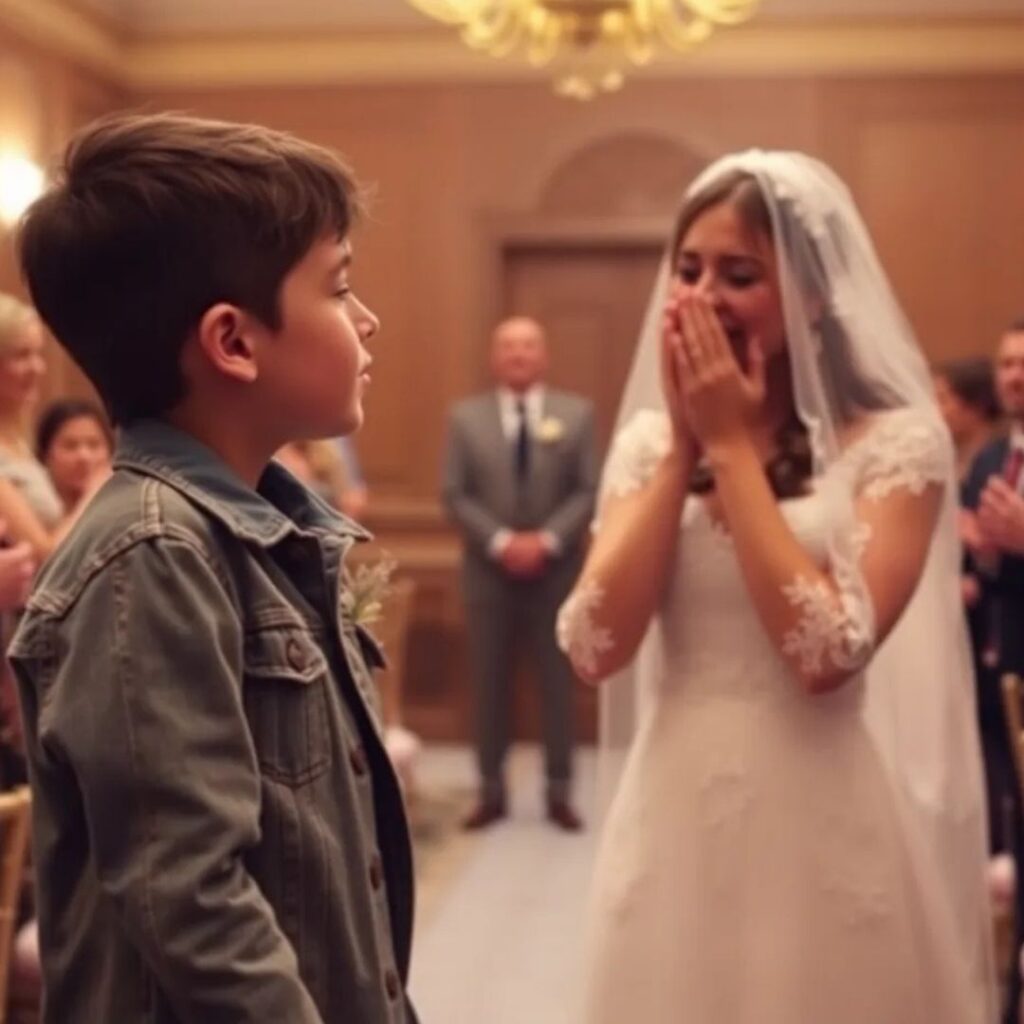
The bride turned. Her smile faltered. She looked at me—a filthy, ragged street urchin standing in the middle of her wedding. Confusion clouded her dark eyes.
Then, I raised my hand.
I pulled back the sleeve of my oversized, dirty jacket. I held up my wrist.
The red bracelet dangled there, mirroring hers.
Her eyes dropped to my wrist.
The color drained from her face so fast it looked like she had turned to marble. She gasped, a sound that was half-sob, half-scream. Her hand flew to her mouth, covering the lipstick that Old Jack had told me about.
“Ma’am…” I said. My voice cracked. It was rough from disuse, shattered by the weight of the moment. “This cheap bracelet…”
I took a step closer. The Groom stared at me, then at the bride, his brow furrowing.
“Are you…” I choked out, tears finally spilling over, hot and stinging on my cold cheeks. “Did you throw me away?”
The room fell into a silence so profound it felt like the vacuum of space. You could hear the ice melting in the glasses.
The bride—my mother—began to shake. It started in her hands and consumed her whole body. She looked as if she were being torn apart from the inside.
“Leo?” she whispered. The name came out like a prayer. “Leo?”
“You left me,” I accused, the anger finally breaking through the awe. “In a bucket. In the river. Why?”
She collapsed. She didn’t faint; she just crumbled, falling to her knees in her magnificent dress, not caring about the silk or the stains. She reached out toward me, her hands trembling.
“I didn’t… I didn’t throw you away,” she sobbed, the tears ruining her perfect makeup. “I… I lost you.”
The crowd murmured. Scandal. Horror. The whispers were like snakes hissing in the grass.
Then, the Groom moved.
He stepped forward. His face was unreadable. He was a powerful man, a man used to command. He looked at the weeping woman on the floor, and then he looked at me.
He walked up to me. He was towering. I flinched, expecting a blow. I expected security to grab me. I expected to be thrown back into the cold.
The Groom knelt down. He ignored the mud on my shoes. He ignored the smell of the street that clung to me. He brought his face level with mine.
He had terrifyingly cold blue eyes. He scanned my face, searching for something. Then, he reached out and gently took my wrist. He ran his thumb over the frayed red wool.
He looked back at the bride, who was sobbing into her hands.
“Elena,” the Groom said. His voice was calm, steady, and loud enough for everyone to hear. “Is this him? Is this the child?”
Elena nodded frantically. “I thought he drowned. The storm… the basket… I came back, and the river was so high… I searched for years, Alexander. I searched for years!”
So she hadn’t abandoned me. Not truly. She had been young, desperate, perhaps fleeing something terrible, and the storm had taken the choice out of her hands. And she had worn the bracelet every day, a penance, a memorial for a ghost.
Alexander, the Groom, looked back at me. The coldness in his eyes melted, replaced by an intensity that frightened me more than anger.
He stood up. He turned to the crowd of stunned guests—the bankers, the lawyers, the socialites.
“We have a change of plans,” Alexander announced.
He reached down and scooped me up into his arms. I was ten years old, too big to be carried, but I was malnourished and light. He held me against his tuxedo, not caring about the dirt.
He turned to Elena and extended a hand to help her up.
“The wedding is paused,” Alexander declared. “My wife has found her son. And I…” he paused, looking at me with a fierce protectiveness I had never known, “I have found a son, too.”
He looked at the crowd, daring anyone to object. Daring anyone to sneer at the street rat in his arms.
“If anyone has an issue with this,” Alexander said, his voice steel, “you may leave now. And do not return.”
No one moved.
Elena threw her arms around us both. The scent of her—lilies and mother—enveloped me. She kissed my dirty face, her tears mixing with the grime.
“I’m sorry,” she wept against my hair. “I’m so, so sorry.”
“It’s okay,” I whispered, remembering Old Jack’s words. Forgive her. “I’m here now.”
The wedding did happen, but it was different. I sat in the front row, freshly scrubbed, wearing a tuxedo jacket that was pinned to fit me. I ate prime beef. I drank sparkling cider from a crystal flute.
But the real story happened after the party.
When the guests had gone, I told them about Old Jack. I told them about the man who saved the boy they lost.
Alexander didn’t hesitate. That very night, he sent a private ambulance to the charity ward. He had Jack transferred to the best private clinic in the city. He hired specialists for his lungs.
Jack lived for another two years. He lived in a cottage on the estate grounds, surrounded by a garden where he grew tomatoes and sat in the sun. He never had to beg for bread again.
I am older now. The nightmares of the cold nights under the bridge have faded, though they never truly vanish. I went to school. I learned to speak with the eloquence of my stepfather and the heart of my mother.
I still wear the red bracelet. It has been re-braided, reinforced with gold thread so it won’t fall apart, but the original wool is still there at the core.
My mother wears hers, too.
It is a reminder. Life is a storm, and we are all just floating in fragile baskets. But if you are lucky—if you are truly, miraculously lucky—love is a red thread that can pull you back from the abyss, no matter how far you have drifted.
The soup kitchens taught me hunger. The bridge taught me cold. But the wedding? The wedding taught me that even a frozen heart can beat again if someone is brave enough to step into the light and claim it.
If this story touched your heart, please share it with your friends and family.