I swear the entire living room stopped breathing. The silence wasn’t just an absence of noise; it was a physical weight, a vacuum that sucked the oxygen right out of the air, leaving us all gasping. Even the cheap, porcelain angel on my mother-in-law’s mantle—usually staring judgmentally at my shoes—looked like it wanted to cover its ears.
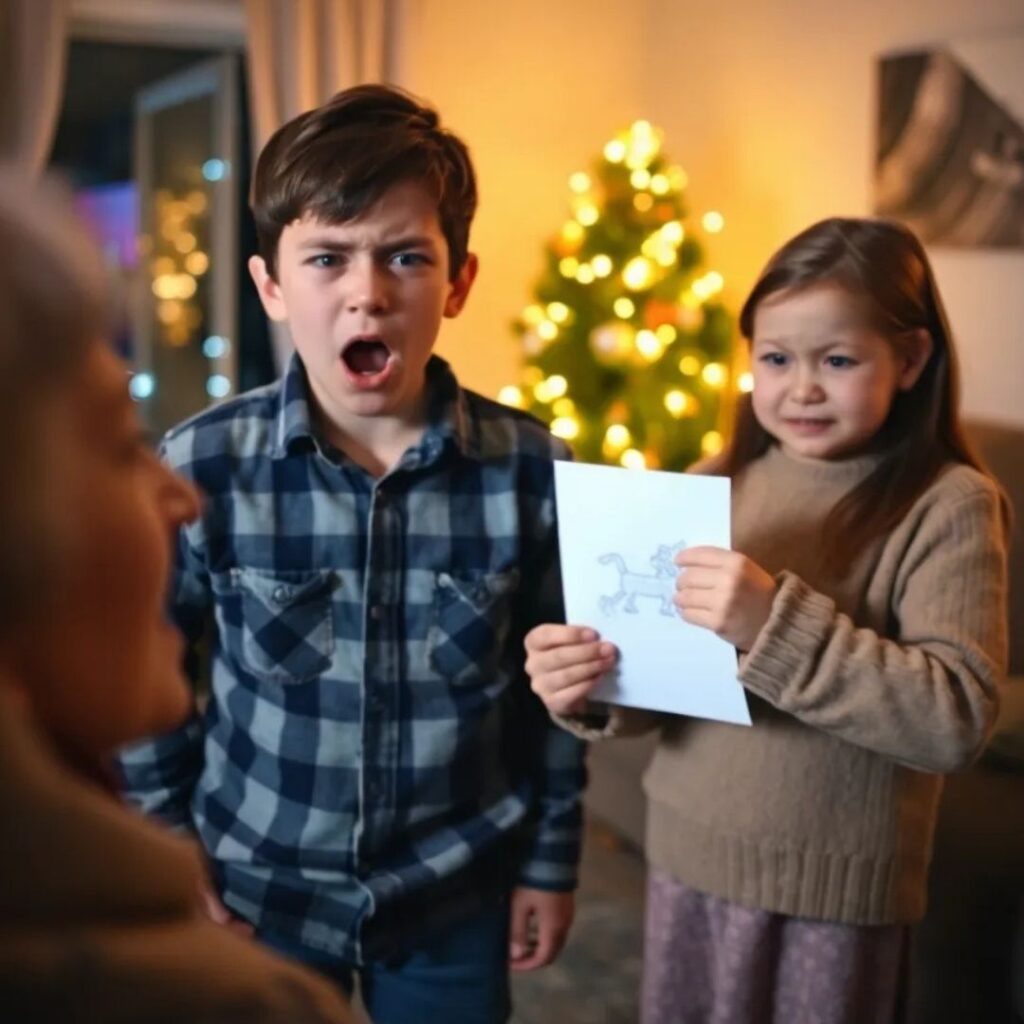
And me? I just stood there. I felt like someone had reached into my skull and unplugged my brain. My mouth opened, then closed, then opened again, mimicking a goldfish experiencing emotional trauma. My six-year-old daughter, Mia, didn’t understand the words—not fully, not yet—but she understood the frequency. She understood the rejection. Her face, usually so bright and resilient, crumpled like wet tissue paper left out in the rain.
That was when the dizziness hit me. I had to grip the back of a dining chair, my knuckles turning white. Not because I thought I might faint, but because I needed an anchor to keep me from launching myself across the coffee table at Sharon.
Everything had been so… normal a minute earlier. Or at least, Sharon-level normal. Which meant aggressively festive and deeply, disturbingly fake. Her tree twinkled with a manic intensity. The cinnamon candles were fighting a losing war for dominance against the smell of burnt ham drifting from the kitchen. Presents were stacked high, a monument to seasonal overspending and performative generosity.
And, of course, the favoritism had been flowing like boxed wine at a PTA mixer.
Bella went first. Bella, my sister-in-law Melanie’s daughter, the golden child of the in-laws, the chosen one. She handed Sharon a mug she’d decorated at school—a lumpy, glitter-encrusted ceramic disaster that looked like it needed immediate hospitalization.
Sharon shrieked. It was a sound usually reserved for lottery winners or religious epiphanies. She swept Bella into her arms, cooing about artistic genius, while my father-in-law, Lawrence, clapped like an animatronic grandfather programmed for maximum enthusiasm.
Then my older son, Noah, handed over his gift—a simple, heartfelt drawing of him and Sharon sledding. She squealed again, smoothing his hair, telling him he was such a talented little man. They handed him a box bigger than his torso. When he ripped it open, it was a remote-control car with flashing LEDs and wheels that looked capable of traversing the surface of Mars.
Then, it was Mia’s turn.
They had given her a small, plastic doll. The kind you find in a bargain bin, with hair so sparse it looked like it had survived a bleach accident. Sharon had smiled at her in that thin, strained way she used when she wished she were smiling at literally anyone else. But Mia didn’t notice. She was too excited, too innocent. My sweet girl had spent days working on her picture. She held it with both hands, eyes bright, bouncing on the balls of her feet like a puppy waiting for a treat.
She handed it over. And the world collapsed.
Sharon took the picture. She looked at it. She looked at Mia. Then she looked at me with eyes that were cold, hard flints. In the sweetest, most poisonous tone imaginable, she delivered the line that will echo in my skull until I die.
“Children from Mommy’s cheating don’t get to call me Grandma, honey.”
I felt every word like a physical slap. Mia froze. It was as if the sentence had hit a kill-switch inside her tiny body. Her mouth trembled. Her eyes filled. Then the first tear slid down, slow and heavy—the kind of tear a child cries when the universe suddenly stops making sense.
Lawrence shifted uncomfortably, staring at the carpet, but said nothing. Melanie looked like she wanted to smirk but knew better; she settled for a feigned shock that didn’t reach her eyes.
And my husband, Thomas? He looked like someone had shoved him underwater. His eyes were wide, stunned, his whole body rigid. He kept opening his mouth to speak, but the words were stuck in his throat.
I was vibrating. Rage crawled up my spine in hot, electric waves. I felt it in my teeth, in my fingertips, in the pounding of my pulse. But before I could speak, before I could unleash the scream building in my chest, Noah stood up.
My eight-year-old. The child they adored. The one who could do no wrong.
He stood up so fast his chair scraped violently across the hardwood, a harsh screech that made everyone flinch. He walked straight to Sharon, jaw clenched, eyes burning with a ferocity I had never seen in him before—something fierce and heartbreakingly adult.
He reached out and snatched back the picture he’d given her earlier—the sledding drawing she had gushed over. He grabbed it with small, shaking fingers. Then, he bent down and placed the giant remote-control car—the perfect, expensive, coveted gift—right back at her feet.
The room gasped. Even Melanie blinked, her mask slipping.
Then Noah spoke, his voice steady but fraying at the edges.
“If my sister can’t call you Grandma, then neither will I.”
Silence. A thick, stunned, suffocating silence. Bella stared. Melanie’s mouth fell open. Sharon reeled back as if she’d been struck across the face.
Noah turned to Mia and took her hand. He held it gently, as if she were made of something precious and breakable. Then he looked at me and said, “Mom, can we go? I don’t want to be here.”
It was not a question. It was a verdict.
Suddenly, everything in me snapped into place. The shock evaporated, replaced by cold clarity. “Yes,” I said. “We’re leaving.”
Thomas stood then, slowly, but with purpose. There was something in his face—shame, perhaps, or a dawning horror. Or maybe just the realization that his mother had just burned a bridge he could never rebuild.
No one stopped us. No one tried. We walked to the door, the four of us, holding onto each other like soldiers crossing a battlefield.
Just as I reached for the handle, I had the sharp, sickening feeling that this was only the beginning. That the real explosion hadn’t even started yet. A shadow fell across Sharon’s face. Melanie’s hand flew to her phone. Lawrence muttered something indistinct under his breath.
We stepped out into the biting December air, and the door closed behind us with the heavy, final click of a loaded gun cocking.
If you had told me years ago that Sharon would one day accuse me of infidelity in front of my six-year-old, I wouldn’t have believed you. Not because she wasn’t capable of cruelty—oh, she was an artist of passive-aggression—but because I didn’t think the universe would be quite that on the nose.
But looking back, the signs were all there. I just kept telling myself they weren’t.
Let’s start from the beginning. I met Thomas at a game night I wasn’t even supposed to attend. I’d had a terrible day—the kind where you start aggressively rethinking every life choice you’ve ever made—and a friend talked me into going out.
“There’ll be food,” she said. “Maybe someone cute.”
There was food. The “cute” part was debatable. I walked in and saw him: a tall, nervous-looking guy in a NASA t-shirt, sorting game pieces by color with the intensity of someone defusing a bomb. He looked up, pushed his glasses up the bridge of his nose, and said, completely deadpan, “The probability distributions in this game heavily favor the starting player.”
Reader, he had me.
Because underneath the awkward delivery and the statistics lecture, he was kind. He listened when I spoke. He cared about things deeply, just not in the loud, performance-based way most people do. It was refreshing. He wasn’t charming. He wasn’t smooth. But he was earnest in a way that made you believe every word he said.
Unfortunately, he was raised by people who viewed earnestness as a genetic defect.
The first time he took me to meet his parents, Sharon opened the door and looked at me like I was an overdue library book she hadn’t requested.
“Oh,” she said. “You’re Emily.”
“Yes,” I said, extending a hand. “And you’re—”
“Sharon?” Her smile tightened. “You’re shorter than I expected.”
“Right. Good. Off to an excellent start.”
Lawrence hovered behind her like a nervous pensioner waiting for permission to breathe. He shook my hand with all the confidence of a man who’d been trained never to initiate an independent thought.
Inside, the house was a shrine to Thomas’s academic excellence. Every wall was plastered with photos ranging from infancy to his PhD graduation, documenting the evolution of an award-winning lab specimen. That dinner was one long interrogation disguised as polite conversation.
“What do your parents do?”
“What are you studying?”
“Do you cook?”
“Are you good with money?”
“Thomas is very special, you know,” Sharon said over her salad, stabbing a cherry tomato. “He needs the right kind of wife.”
Under the table, Thomas squeezed my knee. Just endure, his touch said. It’s just one night.
I endured. Barely. What I didn’t know yet was that I wasn’t just auditioning for the role of wife; I was auditioning to compete with his family for his wallet.
I found out he was subsidizing them completely by accident. One day, early in our marriage, I walked past his laptop. A bank tab was open. I wasn’t snooping—my peripheral vision was simply doing its job.
There it was: a recurring payment to his parents’ mortgage company.
“Why are you paying their mortgage?” I asked. Subtlety is not a skill I possess.
He jumped. “It’s not—I mean, they just need a little help.”
“Thomas,” I said. “You’re a grad student. You’re one lab accident away from eating cereal for dinner every night.”
“I have a scholarship,” he protested weaky. “And the lab pays. And they really appreciate it.”
Spoiler: They did not.
Then I noticed another line item. A transfer to Melanie.
“Why are you paying your sister?”
“She’s between jobs.”
Melanie is always between jobs. It is her natural habitat.
I didn’t fight it then. I told myself it was his money, his family, his choice. I also told myself it was temporary, which was adorable in hindsight.
Fast forward. Thomas finished his master’s, entered a PhD program, worked seventy-hour weeks for the salary of a middle school babysitter, and still sent money home like he was sponsoring two ungrateful contestants on a game show. When he finally landed a well-paid job in applied science, I thought, Finally. We can breathe.
Instead, the requests escalated. Bella’s “special programs.” Melanie’s new degree that she never finished. His parents’ home repairs. A “temporary” monthly contribution that somehow lasted three years.
Every time I brought it up, Thomas looked pained. “They need help,” he’d say. “We’re doing okay.”
We were doing okay because we cut corners quietly while his parents enjoyed emergency upgrades to their master bathroom.
Then Noah was born, and everything else blurred for a while. My in-laws adored him instantly. “He looks just like Thomas,” they kept saying. “Our genes are strong.” Our, not mine. But I was too sleep-deprived to fight about pronouns.
Two years later, Mia arrived.
As she moved out of that newborn haze and her features started to take shape, I began catching flashes of someone I hadn’t seen in years—my late grandmother. The same gentle eyes, the same little half-smile, the same quiet softness in her face. It hit me in a way I wasn’t prepared for. My grandmother had been the safest place in my childhood—warm, steady, endlessly patient. Seeing pieces of her in Mia felt like getting a little bit of her back.
When my mother-in-law first saw Mia fully developed, she frowned.
“She doesn’t look like Noah.”
“She looks like my grandmother,” I said, beaming.
“Oh,” she replied, looking at the baby as if she were part alien. “Well, hopefully, she grows into the family. Like shoes.”
Then the “jokes” started.
“Are you sure she’s his?”
“We’re just teasing. Relax.”
“It’s just funny Noah is Mini-Thomas and Mia is—I don’t know where she came from.”
“She looks like my grandmother,” I said. Again. And again. And again.
They squinted at the photos, shrugged, and kept implying I’d somehow recreated my grandmother using the mailman’s DNA.
As Mia got older, so did the cruelty. Little comments at birthdays, whispered snipes at family dinners. “She really doesn’t look like our side. You might have to tell her the truth someday.”
The favoritism grew, too. Noah got the big gifts, the praise, the special outings. Mia got the bargain bin afterthought every time. She noticed. She always noticed. Once, Noah got a cupcake with a superhero topper and twice the frosting. Mia got the sad, plain economy version. Noah, bless his heart, calmly transferred half his frosting to her plate and gave her the superhero.
“There,” he said. “Better.”
I had to pretend to look at my phone so I wouldn’t cry in public. I tried telling Thomas. “It’s not intentional,” he said, ever the peacemaker.
But intentional or not, my daughter was learning she was less in that house. And on Christmas, she learned exactly how less Sharon thought she was.
So yes, when Sharon shoved Mia’s picture back at her, I wasn’t shocked. But I was done.
And as we drove home in silence, the streetlights flickering past like warning strobes, I realized I had no idea that the detonation she triggered was only the beginning.
By the time we got home from Christmas, I thought I was emotionally tapped out. Turns out, I was wrong.
I tucked Noah and Mia into our bed with a movie because I couldn’t bear the thought of them being more than six feet away from me. Then I walked down the hall, fully expecting to find Thomas pacing, spiraling, or silently imploding.
Instead, I found him sitting at his desk, still in his heavy wool coat, lit up by the cold, blue glow of the monitor. He was clicking buttons with a rhythmic, mechanical precision. Click. Click. Click.
“Thomas?” I said carefully. “What are you doing?”
He didn’t even look up. “Fixing something.“
It is exactly the tone a man uses right before he does something irreversible.
I stepped behind him. My heartbeat did a dramatic percussion solo against my ribs. His bank account was open. Recurring payments, transfers, auto-payments I knew nothing about. Tabs with labels like Mortgage Contribution, Melanie Monthly, and Bella School Fund.
And next to each one, he was hitting: CANCEL. CANCEL. CANCEL.
One click, another click, another artery cut.
“Wait.” I grabbed the back of his chair. “Are you… are you canceling everything?”
“Yes.”
That was it. One word. A guillotine of a syllable.
“You mean—your parents’ mortgage? Your sister’s stuff? Bella’s—all of it?”
He still wasn’t looking at me. His jaw was locked, shoulders stiff, like he’d been carved out of cold stone. My brain was frantically flipping through every version of Thomas I had ever known. Gentle, conflict-avoidant, apologetic Thomas. And none of them matched the man sitting here deleting payment methods like they owed him money.
“This is… sudden,” I said, which was the understatement of the decade.
He exhaled, finally leaning back in his chair. Not relaxed. Just… done.
“You know what hit me tonight,” he said, voice low, vibrating with suppressed fury. “My eight-year-old did what I should have done.”
He finally looked up at me. His eyes were red, furious, ashamed.
“It should have been me,” he said. “I should have defended her. I should have said something. I let them talk about you for years. I let them talk around Mia. But tonight? They said it to her face, and I froze.”
His voice cracked on froze. My stomach twisted. I wanted to grab him, reassure him, something. But he wasn’t done.
“Noah shouldn’t have been the one to stand up for her,” he said. “He shouldn’t have felt like he had to. That’s on me. And I’m not letting it happen again.”
He turned back to the screen and clicked another Remove Card.
“You have no idea,” he continued, “how many times I told myself it was helping them. How many times I thought it was temporary. That they’d appreciate it. That I was doing the right thing.” His laugh was short and sharp, devoid of humor. “They never saw me as helping them. They saw me as obligated. And tonight proved that.”
I sat on the edge of the desk because my legs weren’t prepared for this kind of emotional earthquake. “So you’re… done?” I asked quietly.
He nodded. “Done sacrificing our kids’ experiences so my mother can tell Mia she’s a mistake. Done paying Melanie’s bills so she can mock my daughter’s existence. Done being the wallet they kick whenever they’re bored.”
I swallowed hard. “Thomas? They’re going to explode.”
“Let them,” he said. “They’ve been detonating on us for years.”
He hit one last Confirm, and the page refreshed like he’d just exorcised a demon.
And then, of course, his phone buzzed. He stared at it like someone had texted him a death threat from inside the house.
“My mom,” he said.
Of course. He answered and put it on speaker, because apparently, we were embracing radical transparency now.
“Thomas!” she shrieked immediately. “We just got a notification that our mortgage payment method was removed! Did the bank screw something up? What is going on?”
“No,” he said calmly. “I removed it.”
Silence. Then a sound like she’d been dramatically slapped by invisible hands.
“What do you mean you removed it?” she demanded. “You can’t just—your father is panicking! You’ll have to pay it yourselves,” he said. “I’m not doing it anymore.”
“Are you kidding me? After everything we’ve done for you? We rely on that! We need that!”
I’m pretty sure my eyebrows hit the ceiling.
Thomas didn’t flinch. “I have my own family to support.”
“We are your family!” she screamed. “This is because of her, isn’t it? She’s turning you against us. She’s poisoning you!”
“Stop,” he said. “This isn’t Emily. This is me.”
I could have kissed him. Right on the mouth. Right there in the middle of the room with his mom screaming on speakerphone like a malfunctioning fire alarm.
“You told my daughter,” he continued, voice rising, “that she came from cheating. You shoved her gift back in her face. You humiliated her.”
“Oh, please,” Sharon snapped. “She’s six. She’ll forget.”
“Maybe,” he said, his voice turning into a blade. “But Noah won’t. And neither will I.”
Her voice went into full banshee mode. “You’re being dramatic! You’re destroying this family!”
“You already did,” he said. “You just didn’t expect me to notice.”
He hung up. Hung. Up. Thomas, the man who once apologized to a telemarketer for not being interested, hung up on his mother.
Before I could even make a comforting noise, the phone buzzed again. Melanie.
“Oh, no,” I muttered. “Level Two.”
He answered.
“What the hell, Thomas?” she snapped. “Mom just called me crying. You cut her off? And me? How am I supposed to pay for Bella’s classes?”
“That’s not my problem,” he said.
“You can’t do that!” she shouted. “All because Mom made a joke? She insulted my daughter,” he said, “and you backed her up.”
“Oh, for crying out loud,” Melanie groaned. “It was funny. Everyone thinks Mia looks nothing like—”
“Don’t,” he said. “Don’t finish that sentence.”
She did anyway. “You don’t even know if she’s yours.”
The silence that followed was thick enough to choke on.
“That’s it,” he said. “We’re done.”
“You’re throwing away your family!” she screamed.
“No,” he said. “I’m protecting mine.”
He hung up again. And then he leaned back, covered his face, and let out a breath that sounded like six years of holding everything in. I walked over and wrapped my arms around him. He didn’t pull away.
“I’m proud of you,” I whispered.
He didn’t speak for a moment. Just breathed. And I knew, deep in my bones, that this wasn’t the end. This was the fuse lighting.
If there’s one thing I’ve learned about people like Sharon, it’s this: They don’t lick their wounds. They sharpen their teeth.
The smear campaign began less than forty-eight hours after Thomas cut them off.
I was buttering toast for Mia when my phone buzzed with a message from a cousin I hadn’t talked to in two years.
Hey, uh, are you okay? Your MIL posted something… Intense.
That’s never a good sentence to wake up to. I opened Facebook. And there it was. A full-length tragic monologue written by Sharon, complete with dramatic line breaks and a sepia-toned picture of her holding baby Thomas like he was a fallen soldier.
According to her creative writing exercise, she had lost her son to a “manipulative woman,” been cut off financially by force, been alienated from her grandson through “brainwashing,” and was being punished for “speaking the truth everyone can see.”
Then came the stinger: We only ever expressed concern because Mia looks nothing like our family. We just wanted to protect our son. For that, we were exiled.
And then, as if summoned by the Devil’s group chat itself, Melanie swooped into the comments like a Walmart-brand hype woman. She’s using him. He’s blinded by love. This is what happens when you let the wrong woman take over.
There were screenshots of Noah and Mia side by side with circles around their faces like they were evidence in a crime scene.
My stomach turned.
“Emily?” Thomas asked from behind me. He had that tell-me-now-before-I-punch-a-hole-in-the-drywall tone.
I showed him the screen. He stared for a long moment. His jaw dropped, then clenched, then did something that looked dangerously close to a spasm.
“They’re telling people you cheated,” he said.
“Yes,” I said. “Welcome to the Sharon Experience, now with bonus public humiliation.”
He rubbed his face aggressively. “People are actually agreeing with her. This is insane.”
“Is it?” I said. “She’s been practicing this narrative for years. This is just the first time she’s had an audience.”
And then, as if the universe decided to spice things up, notifications started blowing up in real time.
Wow, I always wondered.
He should get a DNA test.
Poor Thomas. She’s obviously manipulating him.
That little girl looks nothing like him, I’m just saying.
My lungs felt too small. Thomas took the phone gently out of my hands and set it down before I threw it into the toaster.
“You don’t deserve any of this,” he said quietly. “Just tell me what you want to do. And I’m with you.”
I took a breath. I looked at my daughter, eating her toast, unaware that half her family was debating her genetics online.
“We’re getting a DNA test,” I said. “Let’s end this circus.”
Mia didn’t understand why someone swabbed the inside of her cheek, but Thomas explained it like it was a fun science club activity. Noah asked if he could get swabbed too. We told him maybe next time.
Waiting for the results felt like holding my breath underwater. Not because I doubted—never that—but because I knew what would happen when the truth hit daylight. And Sharon could not hide from daylight.
While we waited, I went to my mother’s house and pulled out the old photo boxes. My grandmother’s face stared back at me from every angle—smiling, serious, laughing with the same soft eye-crinkle Mia has when she’s genuinely happy. The resemblance wasn’t just uncanny. It felt like someone had stitched a piece of her soul into my daughter. And it was something Sharon would have known if she hadn’t spent the last decade pretending my family didn’t exist.
When the DNA email came, I opened it sitting next to Thomas on the couch, my leg bouncing like a nervous rabbit.
“Probability of paternity: 99.9999 percent.”
I exhaled. I didn’t realize I’d been holding my breath for that long.
“Congrats,” I said dryly. “You are, in fact, the father of the child you’ve been raising for six years.”
He snorted. “Send it to me.”
We didn’t respond to Sharon. We didn’t comment on her post. We didn’t tag or confront or message or argue. We simply made our own post.
A collage. Mia smiling. Thomas holding baby Mia. A picture of my grandmother. A picture of Mia next to my grandmother. And our caption.
For anyone who’s heard the rumors, here are the facts. Mia is Thomas’s biological child. DNA attached. She also looks exactly like Emily’s grandmother, which is something you’d know if you’d ever bothered to learn her family instead of questioning her fidelity for years. Someone told our six-year-old that she came from ‘mommy’s cheating’ and that she doesn’t get to call her grandma. This was said directly to her face. That is why we cut contact. That is why financial support ended. You do not speak to a child that way and still get access to them.
Thomas re-posted the same thing with one extra paragraph.
Since grad school, I’ve sent my parents and sister roughly five hundred to nine hundred dollars a month, whatever they asked for, whatever they said they couldn’t cover. When I finally totaled all of it, it was $80,940. I have every transfer receipt. And after all that, they accused my wife of cheating and told my daughter she isn’t mine. We’re done here.
We hit Post. Then we waited.
For about seven minutes, nothing happened. Then, everything happened.
The comments rolled in like a tidal wave.
I had no idea she said that to Mia. That’s disgusting.
Oh wow, the resemblance to your grandmother is undeniable.
I’m so sorry, no child deserves that.
Honestly, good for you for cutting them off.
And in the group chats? Silence. Then confusion. Then the quiet, satisfying crumble of people realizing they’d backed the wrong horse. One cousin messaged me privately: I’m so sorry. I didn’t know. I thought Sharon was exaggerating. This is awful.
Even better: Sharon had a big birthday coming up. One she’d been planning for months. Invitations had gone out to half the extended family, and one by one, everyone canceled.
Sorry, can’t make it.
Not attending after what I heard.
I’m uncomfortable supporting someone who talks to children that way.
She ended up with an overpriced cake, an empty room, and Lawrence trying to pretend he liked being alone with her. I won’t lie. I savored that image like a fine wine.
But the real twist came later that week, in the form of a phone call from an unfamiliar number.
“Is this Emily?” a voice asked. Older, sharper, polished.
“Yes.”
“This is Virginia,” she said. “Thomas’s aunt.”
I froze. We’d met twice. She was Sharon’s older sister, ten years wiser and ninety degrees less unhinged.
“I saw the posts,” she said. “I also got the unfiltered version from someone who actually has a spine.”
I didn’t dare laugh, but I wanted to.
“I just have one question,” she continued. “Did Sharon really say that to your daughter?”
“Yes,” I said. “Right to her face.”
“And the eighty thousand dollars? Accurate?”
“Down to the cent.”
I heard a long exhale. “Well,” she said, her voice turning crisp. “Then I’ve made a decision.”
My heart did a weird little kick. “What kind of decision?”
“The kind that involves lawyers,” she said. “And wills.”
I gripped the kitchen counter.
“I’ve removed my sister,” she continued. “Every cent she was expecting is now going to Thomas and the children. I’ve also established a trust fund that begins paying out immediately. I’d rather see my money help a family with integrity than reward cruelty.”
I didn’t speak. I couldn’t.
“And before you worry,” she added, “this is not charity. This is justice. Your children deserve better than to grow up under the shadow of Sharon’s bitterness.”
When I hung up, I stood there for a long moment, stunned, my heart pounding in my throat. Thomas walked in.
“Who was that?”
“Your aunt,” I said. “You’re going to want to sit down.”
Because suddenly, for the first time in years, the balance of power hadn’t just shifted; it had capsized. Not because we fought harder. Not because we screamed louder. But because someone finally saw the truth and decided enough was enough.
And the best part? Sharon couldn’t blame me for this one. She did it to herself.
Six months later, the silence is still blissful. My in-laws? Not so blissful. Once Thomas cut the financial cord, they spiraled fast. They had to sell their house, downsize, and, according to one cousin, finally admit that maybe relying on a future inheritance wasn’t a solid retirement plan. Especially since that inheritance went to us.
Thomas’s aunt—the one with the late millionaire husband—rewrote her will the same week the drama blew up. Turns out the substantial money Sharon had counted on her entire life now sits in a trust for our kids. And a very generous chunk for us, too.
Meanwhile, we’ve started traveling. Living easily for the first time ever. Breathing without a heavy weight on our chests.
So, looking back at the wreckage and the resurrection, I have to ask: Do you think we went too far? Or, knowing what you know now, did we not go far enough?