Sunday unfolded with the kind of deceptive calm that made me believe, for a few hours at least, that life was finally giving me a pause. I had promised my mother, Helen, a walk. Not a rushed appearance sandwiched between board meetings or a distracted lunch interrupted by the relentless vibration of my phone, but a real walk. Slow, deliberate, and grounded. We chose one of Denver’s oldest public parks, a place where the maple trees still carried the quiet dignity of having witnessed entire lives pass beneath their sprawling, rust-colored branches.
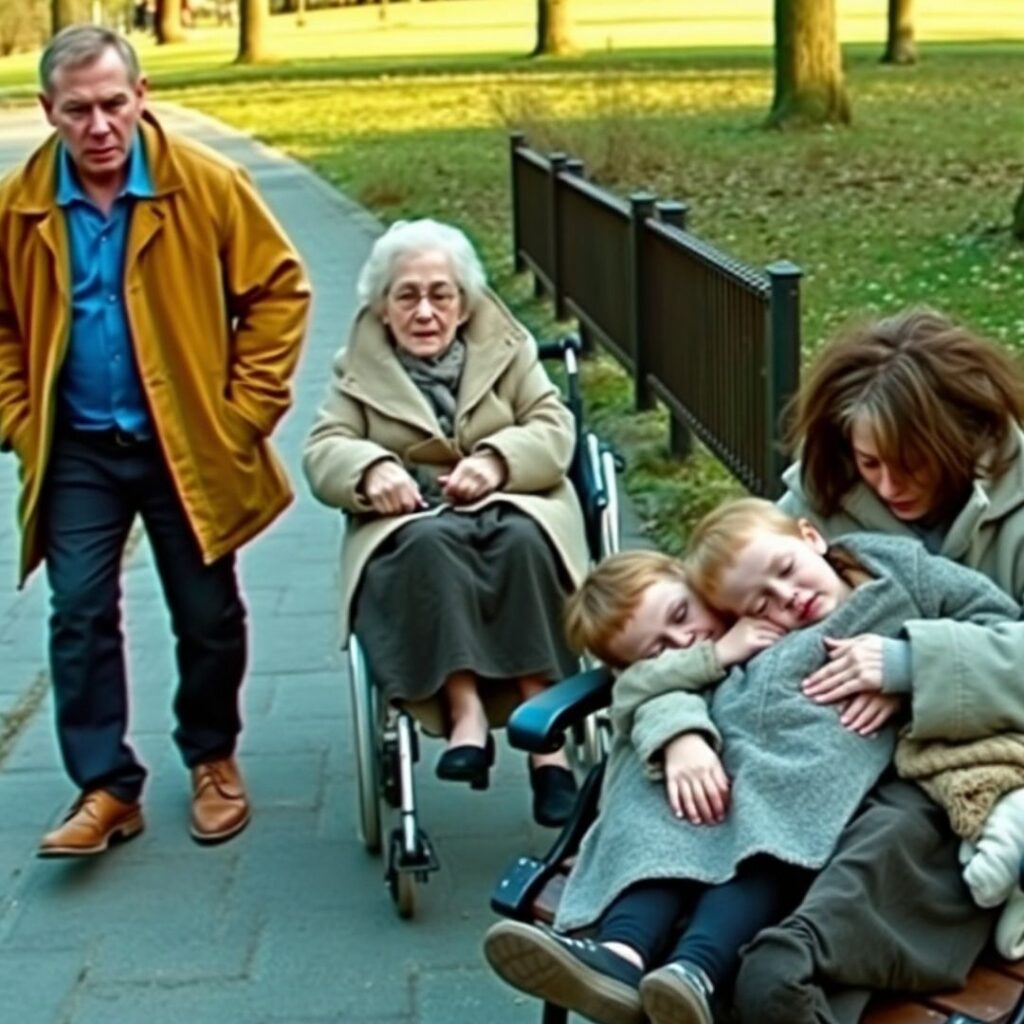
Helen walked beside me, her hand looped through my arm, her steps careful but steady. She spoke about ordinary things—the changing weather, the neighbor’s new fence, the way the ducks near the pond had grown bold enough to approach strangers for crumbs. I listened, nodded, and smiled when appropriate, yet inside me, there was a hollow space that no contract, acquisition, or quarterly achievement had ever managed to fill.
Six months earlier, my software firm had crossed a valuation threshold that few companies ever reach. Overnight, I had transformed into Matthew Calloway, the man whose name appeared in bold print on financial headlines and whose net worth invited curiosity and envy in equal measure. I owned properties I barely visited, I traveled without queues or delays, and I lived surrounded by conveniences designed to erase the very concept of discomfort.
Still, as I watched a young couple pass by pushing a stroller, their laughter mingling with the crisp autumn air, something tightened in my chest. It was a quiet ache, sharp and persistent, that had absolutely nothing to do with money. My marriage to Paige Sullivan had ended a year before. It hadn’t ended with shouting or betrayal, but with a slow, suffocating exhaustion. Silence had grown between us like weeds until there was no room left for affection. No amount of success had managed to convince me that the loss didn’t matter.
“You look far away, Matthew,” Helen said softly, adjusting her wool scarf against the breeze. “Success should not weigh this heavily on a person. You hold the world in your hands, yet you look as though you are carrying it on your shoulders.”
I gave a brief, dry laugh and tried to deflect the comment. “Just thinking about the merger, Mom. It never really stops.”
“It stops if you let it,” she countered gently.
Before I could formulate a defense, we rounded a sharp bend in the gravel path, and the world shifted on its axis. The sunlight seemed to waver, and the ambient noise of the park—the distant traffic, the rustling leaves—dropped away into a vacuum.
On a weathered wooden bench beneath a wide maple, a woman slept. She was curled slightly to one side, her posture protective, her face drawn with a level of exhaustion that looked painful even in sleep. Beside her stood a stroller, but not a standard one. It was a heavy-duty model built for three. Inside it, three infants slept with the untroubled surrender of babies who trusted nothing more than the rhythm of breath.
I stopped so abruptly that my mother nearly stumbled. Recognition didn’t wash over me; it hit me with the force of a physical blow. The woman was Paige.
Time didn’t freeze, but it slowed enough to make every detail unbearable. Paige had left for Europe after our divorce, determined to build something meaningful on her own terms. She wanted to escape the shadow of my career and find her own light. Seeing her here—thinner, her clothes worn, sleeping on a public bench beside three babies—shattered the story I had clung to in order to move on. This wasn’t the vibrant, ambitious woman I had said goodbye to. This was a woman on the edge of survival.
One of the infants stirred, letting out a soft, mewling cry that pierced the silence. Paige was pulled from sleep instantly. She blinked, disoriented, and reached instinctively into the stroller to soothe the child before she even fully opened her eyes. Only then did she look up.
When her eyes met mine, a cascade of emotion crossed her face—shock, shame, fear—ending in a quiet resignation that struck me harder than anger ever could.
“Matthew,” she said, her voice fragile, cracking like dry parchment. “I… I did not expect this.”
My mouth opened, but no sound came out. My corporate vocabulary, my negotiation tactics, my wealth—none of it gave me the words for this moment.
Helen, however, did not need words to understand suffering. She stepped forward, her gaze moving from Paige to the babies with disbelief and profound concern. “Child,” she said gently, ignoring the history, ignoring the divorce. “Are you alright?”
Paige hesitated, her pride warring with her reality. She lifted the crying baby from the stroller and held him close, rocking him with a practiced, weary rhythm. “They are adopted,” she explained, her tone steady despite the tremor I could see in her hands. “Their mother… she was young. She could not care for them. I could not leave them.”
Helen’s eyes softened into a look of fierce compassion. I felt something in my chest give way, a dam breaking behind my ribs. Questions crowded my mind—How? Why? When?—but what came out was simple and urgent.
“Where are you staying, Paige?”
She looked down at the baby’s head, avoiding my gaze. “Nowhere permanent. Not yet. I am waiting for space at a shelter. It’s… it’s complicated.”
That was enough. Helen straightened her spine with the authority of a woman who had raised a son alone and survived far worse than inconvenience. She tapped her cane on the pavement. “You are not staying on a bench with three babies. Not while I have breath in my body.” She turned to me, her eyes blazing. “Matthew has an apartment in Cherry Creek standing empty. He uses it for ‘guests’ who never come. He will not argue with me.”
I looked at Paige, at the dark circles under her eyes, at the three innocent lives huddled in that stroller. “You can stay,” I said quietly, my voice rough. “Please. Until you find something stable. No questions asked.”
Paige’s pride flickered one last time, then dimmed under the crushing weight of her exhaustion. She looked at the babies, then at me.
“For the children,” she whispered at last. “Only for them.”
I nodded, pulling my phone out to call for a car, but as I dialed, I noticed a man in a tailored suit watching us from the edge of the park. He held a phone to his ear, his eyes fixed on Paige with a predatory intensity. When I looked directly at him, he turned and vanished into the tree line.
A cold dread coiled in my gut. This wasn’t just bad luck. Paige was running from something.
The apartment in Cherry Creek was silent, pristine, and utterly soulless. It was a tax write-off, a place of marble countertops and designer furniture that had never known the warmth of a family dinner. Paige stepped inside as if afraid to leave footprints on the polished hardwood.
While I left to buy supplies—diapers, formula, clothes, food—Helen took charge with practical efficiency. She didn’t ask for explanations; she asked for towels and hot water. By the time I returned two hours later, laden with bags, the space had transformed. It smelled of warmed milk and lavender soap. The silence had been replaced by the soft coos of the infants and the low murmur of my mother’s voice.
I unpacked the groceries in the kitchen, watching Paige from the doorway. She was sitting on the plush rug, feeding one of the babies a bottle. Her hair was damp from a shower, and she was wearing one of my old sweatshirts I kept in the closet. She looked younger, softer, but the tension in her shoulders remained.
Later that night, with the babies finally asleep in makeshift cribs we had fashioned from blankets and pillows, the three of us sat in the living room. The city lights of Denver twinkled indifferently outside the floor-to-ceiling windows.
Paige held a mug of tea with both hands, staring into the dark liquid as if it held the secrets of the past year.
“I didn’t go to Europe to vacation,” she began, her voice low. “I went to build Project Sanctuary.”
I leaned forward. “The non-profit idea? The digital platform for single parents?”
She nodded. “I refined the code. I built the infrastructure. It was designed to connect single parents with shared resources, housing, and real-time legal support. It was going to change lives, Matthew. I poured every cent of my settlement money into it.”
“So what happened?” I asked.
“I met an investor. Franklin Shaw.”
The name landed in the room like a grenade. I knew Shaw. He was a shark in the venture capital world, known for stripping companies for parts and discarding the founders.
“He promised partnership,” Paige continued, her voice trembling with suppressed rage. “He promised global reach. I signed the contracts because I wanted the platform to help as many people as possible. But the contracts… they were a trap. Buried in the clauses was a transfer of intellectual property rights upon ‘restructuring.’ He triggered a restructuring two weeks after launch.”
She took a shaky breath. “He stole it, Matthew. He locked me out of the servers, froze the accounts, and rebranded it as a premium, subscription-only service for wealthy families looking for nannies. He took a tool for the desperate and turned it into a toy for the elite.”
“And the babies?” Helen asked softly.
“A woman I met while doing research for the platform,” Paige said, tears finally spilling over. “She was terminal. No family. She begged me. She said, ‘You are the only one who sees me.’ When she passed… I couldn’t let them go into the system. I used the last of my savings to secure the emergency adoption orders. Shaw found out. He knows I have them. He’s been threatening to report me for instability to Child Services if I try to sue him for the company. He wants me destitute so I can’t fight back.”
I stood up, walking to the window. The reflection of the room stared back at me—a successful man, a broken woman, and a wise mother. My blood was boiling, a cold, focused fury that I hadn’t felt in years. Franklin Shaw hadn’t just stolen a business; he had tried to erase a person. He had leveraged three innocent children to protect his bottom line.
“Do you still have the original source code?” I asked, not turning around.
“The backups? Yes. On an encrypted drive he couldn’t access. But I have no money for lawyers, Matthew. I have nothing.”
I turned to face her. “You have me.”
Paige looked at me, confusion warring with hope. “Matthew, this could ruin your reputation. Shaw is powerful.”
“My reputation is built on solving problems,” I said, my voice dropping to a dangerous register. “And Franklin Shaw just became my priority.”
I walked over to the table and picked up my phone. “I need those files, Paige. Not because of us. Not because of the past. But because what he did… it ends now.”
Just then, my phone buzzed. A text message from an unknown number.
‘Nice family reunion. Be a shame if the press found out the great Matthew Calloway is harboring a kidnapper. Back off.’
I stared at the screen. He was watching the apartment.
The next morning, the apartment ceased to be a home and became a war room. I called in my personal legal team, a group of sharks who made Shaw look like a bottom-feeder. I didn’t tell my board of directors what I was doing; they would have cautioned against getting involved in a domestic dispute. But this wasn’t domestic. This was corporate warfare.
Paige sat at the dining table, her laptop open, guiding my CTO through the backend of her original platform. The brilliance of her work was undeniable. It was elegant, compassionate code. Seeing her in her element, directing traffic, correcting my senior engineers, I remembered why I had fallen in love with her. She wasn’t just kind; she was brilliant.
But the pressure was mounting. A rival executive, an ally of Shaw’s named Marcus Thorne, leaked a story to the press that afternoon. “Tech Mogul’s Ex-Wife Investigated for Child Endangerment.” It was a warning shot.
“He’s trying to scare you,” Helen said, pacing the living room with Jude in her arms.
“It’s working,” Paige whispered, her face pale as she read the headline on her tablet. “If they take the children, Matthew… I can’t survive that.”
“They won’t,” I said, typing furiously. “I just bought the server farm hosting Shaw’s new database. He thinks he owns the cloud. He forgets I own the ground it rains on.”
We were making progress, tracing Shaw’s illegal transfer of assets, when the atmosphere in the apartment shifted from tense to terrified.
Jude, the smallest of the triplets, had been fussy all day. I assumed it was teething, but suddenly, his cry changed. It wasn’t a fuss; it was a high-pitched shriek of pain.
Paige rushed to the crib. “He’s burning up,” she cried, touching his forehead. “Oh god, he’s burning.”
She lifted him, and his small body went rigid, then began to convulse. A febrile seizure.
“Hospital. Now!” Helen commanded, already grabbing the diaper bag.
I scooped up the other two babies, abandoning the laptops, the lawsuit, and the vengeance. We ran for the elevator. In the chaos of the lobby, paparazzi were waiting, tipped off by Shaw. Cameras flashed in our faces, blinding and aggressive.
“Is it true you stole these children, Ms. Sullivan?” one shouted.
“Matthew, is this your new family?” another jeered.
I didn’t stop. I used my shoulder to check a photographer into the wall, shielding Paige and Jude with my body. “Get in the car!” I roared.
As we sped toward the hospital, Jude stopped crying. He went terrifyingly silent. Paige was sobbing, clutching him to her chest, whispering prayers. I reached over the console and took her hand. Her grip was so tight it hurt, but I didn’t pull away.
“He’s going to be okay,” I said, though I had no way of knowing.
“I can’t lose him,” she choked out. “I saved him. I promised him he would be safe.”
In that moment, looking at the terror in her eyes, the corporate battle felt insignificant. I realized that my empty apartment, my silent life, my vast wealth—it was all dust. This chaos, this fear, this love… this was real.
We burst into the ER, and doctors swarmed. They took Jude from Paige’s arms. The doors swung shut, leaving us in the sterile, fluorescent hallway.
Paige collapsed onto a plastic chair, shaking violently. I sat beside her and pulled her into my arms. She buried her face in my shoulder, and for the first time in two years, we held each other. Not as ex-husband and ex-wife, but as two people terrified of the dark.
“Mr. Calloway?”
I looked up. A man in a dark coat stood at the end of the hallway. It was Franklin Shaw. He looked out of place in the antiseptic glare of the hospital, holding a manila envelope.
“A tragedy,” he said smoothly, walking closer. “Sick children are such a liability. Especially when you don’t have legal custody.”
I stood up, gently detaching from Paige. “Get out of here, Franklin.”
“I’m just here to help,” he smiled, tapping the envelope. “Drop the investigation into the IP transfer. Sign a non-disclosure agreement. And I’ll make sure the authorities don’t receive this file detailing Ms. Sullivan’s… erratic mental state and financial ruin. You can keep your little family project. I just want the company.”
He was leveraging a dying baby.
I looked at the envelope, then at the doors where Jude was fighting for his life. I looked at Paige, who was staring at Shaw with pure hatred.
I walked up to him until we were nose to nose.
“You think this is leverage?” I asked softly.
“I think it’s checkmate,” Shaw replied.
I reached into my pocket and pulled out my phone. I pressed a button. “Did you get that?”
Through the speaker, the voice of the District Attorney—a woman I had gone to law school with—rang out clear as a bell. “Loud and clear, Matt. Extortion and blackmail. We’re issuing the warrant now.”
Shaw’s face drained of color.
“I didn’t just buy the server farm, Franklin,” I whispered. “I bought your security chief. He’s been recording your office for three days. I have everything. The theft, the bribes, and now… this.”
I turned my back on him. “Security will escort you out. The police are waiting at the exit.”
As Shaw was dragged away, shouting legal threats that sounded increasingly desperate, the ER doors opened. A doctor stepped out, looking tired but smiling.
“The fever broke,” she said. “He’s stable. He’s going to be fine.”
I felt Paige sag against me, a weight lifting that was heavier than the world.
The months that followed were not smooth, but they were honest.
With Shaw indicted and the rights to Project Sanctuary returned to Paige, the real work began. But it wasn’t just about the company. The apartment in Cherry Creek, once a museum of loneliness, had been colonized. Toys were scattered across the Persian rugs. The high-end blender was used exclusively for pureeing peas. Helen had moved into the guest suite “temporarily,” a term we all knew meant forever.
Paige and I navigated the strange waters of our new reality. We were co-parents to three children who weren’t biologically ours, business partners, and… something else. Something fragile and new growing out of the ashes of the old.
One evening, watching the children crawl across the living room floor in a chaotic race, I spoke the words I had been holding back since that day in the park.
“I want to do this for real,” I said.
Paige looked up from her laptop. “Do what? The IPO?”
“No,” I said, sitting down on the floor beside Jude, who grabbed my finger with his surprising grip. “This. Us. The family.”
I looked at her. “I’ve spent my life building things that don’t breathe. Companies. Portfolios. Towers. But when I saw you on that bench… and when we were in that hospital… I realized I was the one who was homeless. I want to be their father, Paige. Legally. Emotionally. In every way that matters. If you will let me.”
Paige went still. Her eyes searched mine, looking for the man who had prioritized meetings over dinners, the man who had let her drift away. But he wasn’t there anymore.
“You’re asking to adopt three babies and a complicated woman,” she said, her voice thick with emotion.
“I’m asking for a life,” I corrected.
She crawled over to me, ignoring the laptop, ignoring the work. She took my face in her hands. “Yes,” she whispered. “We choose each other again.”
A year later, the park looked different. The trees were the same, but the bench—the wooden bench where I had found my life waiting for me—was gone.
In its place stood a sleek, welcoming structure made of glass and wood: The Sullivan-Calloway Community Center. It was the physical headquarters of Project Sanctuary, a place where single parents could find food, legal aid, and childcare while they got back on their feet.
I stood on the patio, watching the grand opening. There were cameras, but this time they were there to celebrate Paige. She stood at the podium, confident and radiant, holding the microphone with one hand and balancing a toddler on her hip with the other.
Helen stood beside me, wiping a tear from her eye. “You did good, Matthew,” she said.
“We did good,” I corrected, looking down at the stroller where the other two were napping.
Paige finished her speech and looked across the crowd. She found me instantly. She smiled, and in that smile, I saw the past redeemed and the future wide open. We hadn’t just survived the storm; we had built a fortress within it.
The past had not disappeared, but it no longer defined us. We had built something new, not from perfection, but from persistence. And that, I finally understood, was what made it strong.
If you want more stories like this, or if you’d like to share your thoughts about what you would have done in my situation, I’d love to hear from you. Your perspective helps these stories reach more people, so don’t be shy about commenting or sharing.