My life felt almost perfect until the day we moved to my husband’s hometown.
It’s strange how one decision, something that seems so logical at the time, can quietly change everything. Even now, there are nights when I wake up long before dawn and lie there staring at the ceiling, replaying those months over and over again in my head.
I wonder how I didn’t notice sooner.
I wonder how something so disturbing could unfold right in front of me without me fully understanding it.
If someone had asked me back then whether I trusted my husband’s family, I would have said yes without hesitation.
I truly believed they cared about us.
I was wrong.
My husband, Ryan, and I had been married for 8 years. For most of that time, we lived in a small but cozy apartment in New York City with our twin daughters, Doris and Clara, who were five years old at the time.
Our apartment wasn’t large, but it was filled with life.
Toys were scattered across the living room floor, no matter how often I cleaned them up. Crayon drawings covered the refrigerator door. The girls had a habit of turning every ordinary evening into an adventure, whether they were building blanket forts or pretending the couch was a pirate ship.
Despite the chaos, I loved our life.
Ryan worked long hours as a financial analyst, but he was a devoted father. When he came home, he left his stress at the door and immediately focused on the girls.
He would read bedtime stories in silly voices, chase them around the living room, or help them draw pictures for their grandmother.
For a long time, our little family felt complete.
But gradually, the idea of moving away from the city began to creep into our conversations.
It started with practical concerns. The rent kept climbing higher every year. The city felt louder and more crowded as the girls grew older. Whenever Doris and Clara wanted to ride their bikes, I had to hover nervously beside them on the sidewalk, constantly watching for traffic.
One evening during dinner, Ryan brought it up again.
“The schools in my hometown are excellent,” he said thoughtfully, twirling pasta around his fork. “And it’s quiet there. Safe.”
I glanced toward the fire escape outside our kitchen window, where I drank coffee every morning.
“My parents are still living there,” he continued. “The girls could grow up around family.”
I hesitated.
“I know,” I admitted. “It’s just hard to imagine leaving the city.”
Ryan leaned back in his chair.
“We wouldn’t be losing anything,” he said gently. “We’d be giving them something better. Backyards, parks, room to run.”
When he said it like that, it sounded almost perfect.
Eventually, I agreed.
Within a few months, we packed our belongings and moved to Ryan’s hometown in Pennsylvania.
The town itself was small and quiet, the kind of place where neighbors waved from their porches and children played freely in the streets. On our first trip to the grocery store, the cashier greeted Ryan like an old friend.
At first, it felt charming.
But living in a small town comes with a different kind of closeness. People notice everything.
And nothing stays private for long.
Still, the town wasn’t the real problem.
The real problem was Ryan’s family.
His mother, Marina, began visiting almost immediately after we arrived. At first, I assumed she was simply excited to see her granddaughters more often after years of living far away.
But her visits quickly became constant.
She stopped by several times a week, sometimes without calling first.
“I was just in the neighborhood,” she would say, carrying a container of homemade cookies.
At first, I tried to appreciate the gesture.
But I soon noticed something about the way she behaved during those visits.
Marina didn’t just spend time with the girls.
She observed them.
She observed me.
“Did the girls eat vegetables today?” she asked one afternoon while peering into the refrigerator.
“Yes,” I replied. “They had carrots with lunch.”
“Cooked or raw?”
“Raw.”
She frowned slightly.
“Cooked vegetables are easier for children to digest.”
I forced a polite smile.
Ryan’s younger sister, Brianna, was even more unsettling.
She brought her phone everywhere.
And she used it constantly.
Every visit turned into a recording session.
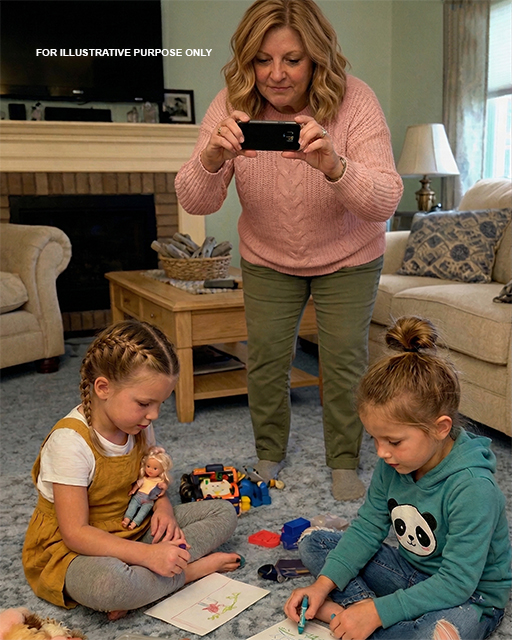
She took pictures of the girls while they were drawing at the kitchen table. She filmed them playing in the backyard. She even recorded short clips of them eating dinner.
At first, I assumed she was simply excited to capture family memories.
But eventually I noticed something strange.
She didn’t only record happy moments.
She recorded everything.
Once, Doris had a meltdown at the grocery store because I refused to buy her a giant chocolate bunny displayed near the checkout counter. As I knelt beside her, trying to calm her down, Brianna quietly snapped a photo.
“Oh, this one’s priceless,” she laughed.
Another morning, Clara came downstairs with tangled hair after refusing to let me brush it properly before school. Brianna recorded a short video.
“Kids really need routines,” she joked.
Each time it happened, a strange discomfort settled in my chest.
I mentioned it to Ryan one night while we were washing dishes.
“Your family takes a lot of pictures,” I said carefully.
Ryan shrugged.
“They’re just excited about the girls.”
“I know,” I replied slowly. “But sometimes it feels like they’re documenting everything.”
He chuckled.
“That’s what families do.”
Maybe he was right.
But the uneasy feeling never went away.
It stayed with me like a quiet warning I couldn’t explain.
The truth finally revealed itself on a Saturday evening.
Ryan had invited his parents, Brianna, and a few other relatives over for dinner. The house was filled with laughter and conversation.
Doris and Clara ran through the living room chasing each other with stuffed animals.
Marina sat at the dining table watching them.
Brianna stood nearby filming.
“Brianna,” I said gently, “maybe you could put the phone down for a bit?”
She smiled without lowering it.
“I’m just capturing memories.”
Later that evening, I realized we had run out of sparkling water, Ryan’s favorite drink. I offered to run down the street to the small convenience store.
Halfway down the driveway, I realized I had forgotten my wallet.
Sighing, I turned around and went back inside.
As soon as I stepped into the house, I heard voices coming from the kitchen.
Marina and Brianna.
They hadn’t noticed me.
I was about to announce myself when Marina said something that made me stop cold.
“Did you get enough pictures today?”
“I think so,” Brianna replied.
My heart skipped.
“I have the one from last week when she forgot Doris’s lunch,” Brianna continued. “And the video from this morning when Clara’s hair was a mess.”
“Good,” Marina said quietly.
Then she lowered her voice.
“Make sure we have proof. The lawyer said we need examples showing she’s overwhelmed.”
The words hit me like a punch.
Proof.
A lawyer.
They weren’t collecting memories.
They were collecting evidence.
Evidence against me.
My hands began to tremble.
They were building a custody case.
Before I could stop myself, I stepped into the kitchen.
“Proof of what?”
Both women jumped in surprise.
Marina’s face turned pale.
“Jenna,” she stammered. “I didn’t hear you come in.”
“What proof do you need?” I demanded.
Brianna tried to smile.
“We were just talking about—”
“Don’t lie to me.”
Marina crossed her arms.
“We’re concerned about the girls.”
“Concerned?” I repeated.
“You forget things,” Brianna said bluntly. “Lunches. School forms. You always look exhausted.”
“I forgot a lunch once,” I replied sharply.
Marina’s expression hardened.
“We’re just making sure the girls are safe.”
“From their own mother?”
“If necessary.”
At that moment, Ryan walked into the room.
The conversation ended immediately.
But the damage had already been done.
That night, I didn’t tell Ryan what I had heard.
I needed time to think.
And I needed proof of my own.
The following evening, I invited everyone over again.
Ryan didn’t question it.
By the time dinner ended, the house was full of relatives, neighbors, and friends.
Marina and Brianna were there.
And just like always, Brianna had her phone out recording.

After dessert, I stood up and tapped my glass.
“I’d like to show everyone something,” I announced.
Ryan looked confused.
I turned on the projector we used for family movie nights.
A video appeared on the wall.
It showed moments from the past year.
Me reading bedtime stories to the girls.
Doris is helping me bake cookies.
Clara is dancing around the kitchen.
The girls are laughing in the backyard.
The room grew quiet as everyone watched.
Then the video changed.
It showed the clip from the previous night.
Doris and Clara were clinging to me, crying when I asked what they would do if Mommy had to go away.
Their small voices echoed through the room.
“Don’t leave us!”
“We love you!”
I paused the video.
Then I turned toward Marina and Brianna.
“You wanted proof,” I said calmly.
“This is what love looks like.”
Ryan stood up slowly.
“What is she talking about?”
“Ask your mother,” I said.
Marina looked trapped.
“Tell him about the lawyer.”
Ryan’s face went pale.
“Lawyer?”
Brianna spoke quickly.
“We were just worried—”
“Worried enough to build a case against my wife?” Ryan interrupted.
Marina sighed heavily.
“We spoke to someone for advice,” she admitted.
“Advice about taking my children?” I asked.
“We were afraid you would move back to New York,” Marina said defensively. “We didn’t want to lose the girls.”
Ryan’s anger exploded.
“So you planned to prove Jenna is an unfit mother?”
Silence filled the room.
Finally, Ryan pointed to the door.
“You need to leave.”
Marina stared at him in shock.
“Ryan—”
“Now.”
Without another word, she and Brianna gathered their things and left.
The house fell silent.
Ryan turned to me, guilt written across his face.
“I’m so sorry,” he said quietly.
Three weeks later, we moved back to New York.
Doris and Clara adjusted quickly. They were thrilled to return to the parks and libraries they loved.
Our new apartment was bigger than the old one, and the girls finally had separate bedrooms.
Ryan cut off contact with his mother and sister for a long time.
Sometimes I still think about that moment in the hallway when I heard Marina whisper, “Make sure we have proof.”
But I remember something else, too.
Truth has a way of revealing itself.
And sometimes, the strongest proof of all is simply the life you live with the people who truly love you.