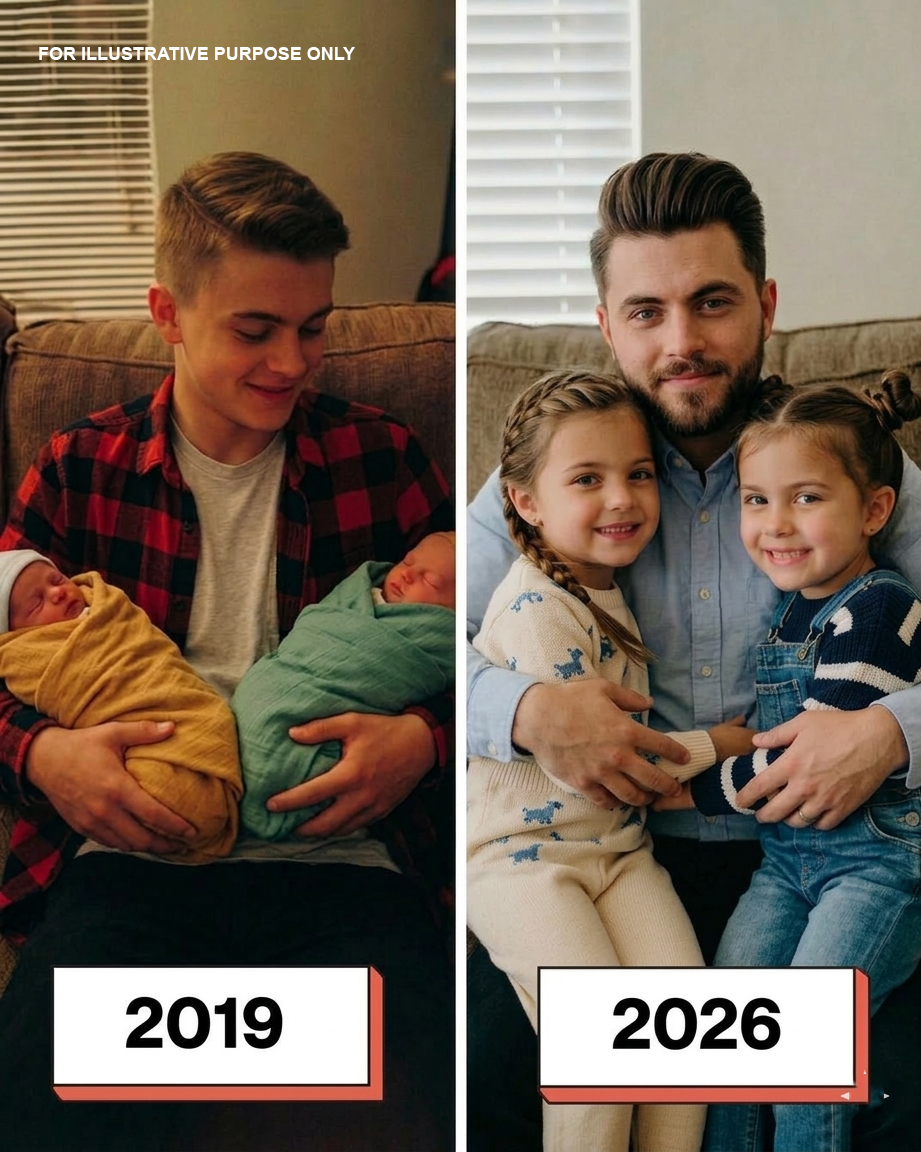
I am 25 years old now, and whenever people hear that I became a parent at eighteen, they usually jump to the same conclusion. They assume there must have been an accidental pregnancy, a rushed wedding, or some reckless teenage decision that forced me to grow up overnight.
But my story is different. Stranger. Heavier.
I never planned to raise children at all, and certainly not two newborn babies who were not technically mine. Yet life does not always ask for permission before it changes everything.
When I was 17, I lived in a cramped two-bedroom apartment with my mother, Carla. The place always smelled faintly of old carpet and cheap cleaning products. The walls were thin enough that we could hear the neighbors arguing almost every night.
Carla had always been unpredictable.
One day, she could be warm and affectionate, humming while she cooked dinner and asking about my classes like a perfectly normal parent. The next day, she would barely acknowledge my presence. She would sit on the couch with a glass in her hand, staring blankly at the television for hours.
Growing up with her felt like living in a house where the weather changed every few minutes. Sunny skies could turn into violent storms without warning.
I learned early how to read the signs.
If her voice sounded too cheerful, it usually meant something had already gone wrong. If she slammed cabinets in the kitchen, it meant I should stay in my room. If she sat quietly on the couch with that faraway look in her eyes, it meant she might explode if I said the wrong thing.
So I learned to keep my head down.
I did my homework. I stayed out of trouble. I asked for as little as possible.
During my senior year of high school, I had a plan for my life. My grades were decent, and a science teacher believed I could get into a pre-med program. I spent evenings reading about anatomy and dreaming about becoming a surgeon someday.
It was a quiet dream, but it meant everything to me.
Then one evening, Carla walked through the front door, tossed her purse onto the table, and announced that she was pregnant.
I remember staring at her, completely stunned.
She did not look happy. She did not look scared either.
She looked angry.
At the time, I made the mistake of believing this baby might give her something to hold onto. I thought maybe becoming a mother again would ground her somehow. Maybe it would bring stability to our chaotic lives.
I could not have been more wrong.
The pregnancy only seemed to make her more resentful. She constantly complained about the man who had disappeared as soon as she told him the news. She cursed him, cursed the situation, and sometimes even cursed the baby itself.
I asked who the father was exactly twice.
The second time, she slammed a cabinet so hard that the dishes rattled and told me to mind my own business. I never asked again.
Late at night, I would hear her pacing around the apartment, muttering to herself about how men always vanished when things got difficult. Sometimes I stood in the hallway listening, realizing that whatever future was coming would probably fall partly on my shoulders.
When the twins were finally born, I was eighteen.
Two tiny girls entered the world that day. They had soft, dark hair, wrinkled pink faces, and cries so small and fragile that it almost hurt to hear them.
Carla named them Lana and Mira.
For the first couple of weeks, she tried to act like a mother. At least sometimes.
She would change a diaper, then disappear into her bedroom for hours. She would warm a bottle and feed one baby halfway before falling asleep on the couch while the other screamed in the bassinet.
The apartment quickly became a blur of crying, dirty bottles, and exhaustion.
I tried to help as much as I could, even though I had absolutely no idea what I was doing.
I watched videos online about how to soothe newborns. I searched things like “how often do babies eat” and “why won’t my baby stop crying.”
Most nights, I barely slept.
I would finish homework with one baby balanced on my shoulder while the other lay beside me in a little portable crib.
Part of me kept thinking the chaos was temporary. I believed Carla would eventually settle into motherhood and things would improve.
But they never did.
One night, when the twins were about two weeks old, I woke up to the sound of sharp, desperate crying.
It was around three in the morning.
I stumbled out of my room, half asleep, expecting to see Carla on the couch or in the kitchen.
Instead, the apartment felt strangely empty.
Lana and Mira were crying in their bassinets, but everything else was quiet.
Carla’s coat was gone from the hook by the door.
Her shoes were missing.
Her phone charger was gone, too.
I checked the kitchen counter. There was no note.
I checked my phone. There were no messages.
She had simply disappeared.
I stood there in the dim kitchen light, holding Mira while Lana cried behind me, and a heavy realization settled into my chest.
There was no adult coming to fix this.
No one else was stepping in.
If I did not take care of these babies, no one would.
People sometimes ask if I ever considered calling social services or putting the twins up for adoption. The truth is that the thought crossed my mind more than once during those early days.
But every time I imagined someone taking them away, I pictured them growing up wondering why nobody stayed.
I could not let that happen.
So I stayed.
My dream of medical school quietly disappeared. The college brochures that once sat on my desk slowly gathered dust until I finally threw them away.
Instead, I found work.
Any work.
I took overnight shifts at a warehouse stacking boxes until my back ached. During the day, I delivered food, sometimes with a baby carrier strapped to my chest because I could not afford childcare.
Weekends meant extra shifts wherever I could find them.
Life became a constant balancing act between exhaustion and responsibility.
I learned how to stretch thirty dollars into a week’s worth of groceries. I learned which thrift stores sold the cheapest baby clothes. I memorized the schedules of local assistance programs and community food banks.
Most of all, I learned how to be a parent.
Slowly, the twins grew.
Their cries turned into giggles. Their tiny hands began reaching for my face. The first time one of them wrapped her fingers around my thumb and refused to let go, something inside me shifted.
They were not just my responsibility anymore.
They were my family.
When they started talking, they struggled with my name.
My name is Kelvin, but toddlers do not always pronounce things correctly. Somehow “Kelvin” turned into “Kel-Bee,” which eventually became just “Bee.”
The nickname stuck.
Soon, the neighbors were calling me Bee. Their preschool teachers called me Bee. Even doctors and babysitters started using it.
At some point, I stopped correcting people.
Bee felt right.
Life was still hard, but we found a rhythm.
In the evenings, we would sit on the old couch watching cartoons while the girls curled up beside me. Sometimes they would hand me crayon drawings labeled “Bee, Lana, Mira, home.”
In those pictures, the three of us always stood under a bright yellow sun.
For a while, I believed we had survived the worst.
Seven years passed.
Then one afternoon, everything changed again.
It was a Thursday. I had just picked the girls up from school when someone knocked on our door.
I opened it without thinking.
At first, I did not recognize the woman standing there.
She looked polished and confident. Her long coat looked expensive, and her makeup was flawless. Gold earrings glinted in the sunlight.
She smelled like expensive perfume.
Nothing about her resembled the woman who had vanished from our apartment years earlier.
Then she said my name.
“Kelvin.”
Her voice was softer than I remembered, almost uncertain.
Suddenly, I knew exactly who she was.
Carla.
My stomach dropped.
Before I could even respond, the girls ran into the hallway behind me, curious about the visitor.
Carla’s expression changed instantly when she saw them.
Her eyes lit up, and she crouched down with a bright smile.
“I brought you something,” she said as she reached for several glossy shopping bags.
Inside were things I had never been able to afford. A brand-new tablet, designer clothes, and a delicate necklace shaped like a small star.
Lana and Mira stared at the gifts with wide eyes.
Children want to believe the best about their parents, even when those parents have given them every reason not to.
Carla began visiting regularly after that.
First, once a week.
Then twice.
She took the girls out for ice cream. She laughed loudly at their jokes. She asked about school and homework as if she had always been part of their lives.
She told me she had “turned things around.” She talked about business opportunities, investments, and the successful life she had built.
But something about it all made me uneasy.
Her attention felt too rehearsed. Too polished.
And every time she left, I noticed how quickly her warmth faded the moment the girls were out of sight.
The truth arrived a few weeks later in the form of a thick envelope.
Inside was a letter from a lawyer.
The words were cold and formal.
Petition for legal guardianship.
Custody evaluation.
Best interests of the minors.
My hands trembled as I read it.
Carla had not come back to reconnect.
She had come back to take them.
When I confronted her, she barely seemed bothered.
She sat calmly at our kitchen table and told me it was time to do what was “best for the girls.”
“You’ve done enough,” she said.
Her tone sounded almost dismissive, as if I had been babysitting for too long.
She spoke about private schools, connections, opportunities, and the kind of life she could provide now.
Then she said something that made my chest tighten.
“I need them.”
Not “I love them.”
Not “I missed them.”
Just that.
The girls overheard part of the conversation when they walked into the room.
Everything fell apart after that.
Lana burst into tears. Mira clung to my arm as if she was afraid someone might pull her away.
“Bee is our dad,” Mira cried.
Carla’s face hardened, not with heartbreak but with irritation.
She stood up, grabbed her purse, and told me her lawyer would be in touch.
Then she left.
That night, after the girls finally fell asleep, I sat at the kitchen table staring at the custody papers.
For a long time, I felt terrified.
Carla had money now. She had lawyers.
All I had was a small apartment and a history of part-time jobs.
But fear slowly turned into something else.
Determination.
I contacted a lawyer through a local legal aid program. Then I began gathering every piece of evidence I could find.
Medical records with my name listed as guardian.
School forms I had signed for years.
Statements from teachers, neighbors, and doctors.
Proof that I had been their sole caregiver since infancy.
The courtroom battle was brutal.
Carla’s attorneys tried to paint me as unstable and manipulative. They argued that I had stolen her children and poisoned them against her.
I stayed calm and told the truth.
When the judge finally asked Lana and Mira who they wanted to live with, neither of them hesitated.
“With Bee,” Lana said.
“Always with Bee,” Mira added.
The courtroom fell silent.
The judge’s ruling came later that afternoon.
Custody remained with me.
Carla was ordered to pay monthly child support.
When we walked out of the courthouse together, Lana slipped her hand into mine.
“Does this mean we’re staying home?” she asked quietly.
“Yes,” I said.
“For good?”
“For good.”
For the first time in years, something inside me finally relaxed.
Life did not suddenly become easy after that. I still worked long hours. Bills still piled up.
But the fear was gone.
The girls were safe.
Late at night, after they went to sleep, an old dream slowly began to return.
I started taking night classes at a community college.
Progress is slow, and sometimes I am still exhausted, but I am moving forward again.
Maybe one day I will still become a doctor.
Maybe not.
Either way, I know something important now.
I did not choose the life that found me.
But when the moment came, I showed up.
And sometimes that makes all the difference.