My name is Gina, and I’m the mother of an 8-year-old boy named Milo. For the past two years, it has been just the two of us in a small, sunlit house that creaks in the winter and smells like cinnamon in December.
If you had asked me five years ago what my life would look like, I would have described something entirely different. I thought I had a steady marriage. It was nothing extraordinary, but it felt solid in the way quiet things often are. I believed in routine, in shared dinners, and in the comfort of knowing someone would always be there at the end of the day.
I believed in Owen.
Then the late nights started. At first, they came with explanations. He mentioned deadlines, clients, and unexpected meetings. I did not question it. Trust, once built, makes you generous with excuses.
But the truth has a way of surfacing, even when you are not looking for it. It came to me in fragments. There was an unfamiliar perfume lingering on his shirts. He became suddenly protective of his phone. There was a distance in his voice that no amount of small talk could bridge.
Eventually, those fragments formed something undeniable.
Owen left us two years ago. He left me for his assistant, Jessica, who was younger and polished, always looking as though she had just stepped out of a lifestyle magazine. When she got pregnant, everything accelerated. The divorce papers were filed, signed, and finalized before I could fully process what was happening.
Within months, they were married and living in a sprawling gated house across town. It had stone pillars at the entrance and a driveway long enough to make visitors feel small before they even reached the door.
Milo and I stayed behind in the home we could afford. It was modest, warm, and entirely ours.
Somehow, in the narrative that formed around us, I became the bitter ex-wife. It did not matter that I kept my head down, worked hard, and focused on raising our son. Perception is often louder than truth.
I was granted full custody, and Owen had Milo on weekends. At least, that was the arrangement on paper. In reality, those visits felt more like obligations than moments of genuine connection.
Each time Milo returned, something in him seemed just a little dimmer.
The first time I noticed it clearly, he came home unusually quiet. It was not the comfortable quiet of a tired child, but the kind that sits heavy in the air.
He dropped his backpack by the door, slipped off his shoes, and sat at the kitchen table. He traced the grain of the wood with his finger.
“How was your weekend?” I asked gently.
“Fine,” he said.
There is a particular way children say “fine” when it is not true. It sounds softer and thinner, like a word that does not quite hold its shape.
That night, as I tucked him into bed, he hesitated before pulling the blanket up to his chin.
“Mom,” he whispered, “Jessica says you don’t like working.”
The words hit harder than I expected. Not because they were clever, but because they were meant to confuse him.
I sat down on the edge of his bed. “What do you think?” I asked.
He shrugged. “I think you work a lot.”
I smiled faintly. “You’re right. Work just doesn’t always look the same for everyone.”
I kept my voice steady, even as something inside me tightened. I explained it in a way he could understand. Providing a home, showing up every day, and loving him consistently are all forms of work that matter.
He seemed to accept that, at least on the surface.
But it did not stop there.
Another time, he came home and told me Jessica had laughed at his sneakers. She said they were “cheap” and that I had poor taste. He repeated the words carefully, as though testing whether they fit.
Each comment was small on its own. Together, they began to form something sharper and more deliberate.
I swallowed my anger for Milo’s sake. I told myself that reacting would only make things worse and that stability mattered more than confrontation.
Then, two weeks before Christmas, everything changed.
Milo walked through the front door pale and quiet. His hands trembled as he took off his coat.
“Mom,” he said, barely above a whisper, “she did it again.”
I knelt in front of him and brushed his hair back from his forehead. “What happened?”
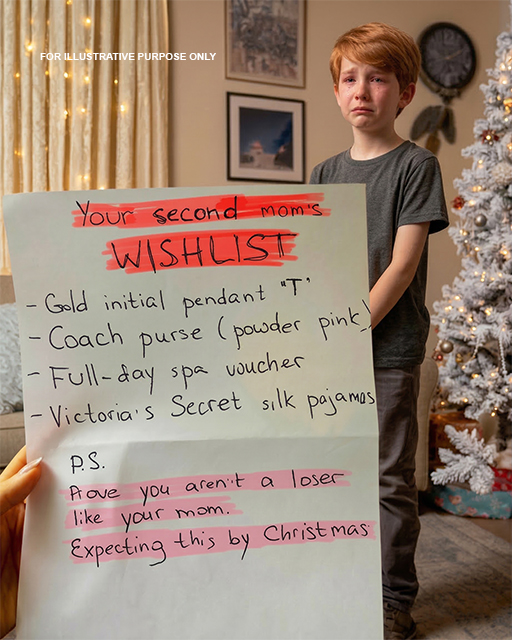
He reached into his pocket and pulled out a crumpled piece of paper. It smelled faintly of expensive perfume, sharp and artificial.
“She said I’m a grown man now,” he murmured. “She said I should have my own money. And since she’s my second mom, I owe her a Christmas gift.”
My stomach dropped.
“She said if I don’t bring something from the list, I can’t use the game room anymore,” he continued. “And I’ll have to sleep on the couch.”
I unfolded the paper slowly.
The list was written in elegant handwriting on thick stationery. It looked like something taken from a boutique display rather than handed to a child.
A designer handbag. A luxury spa day. Silk pajamas. A gold pendant.
Each item included a note, thinly veiled insults wrapped in polished language.
At the bottom was a final line:
“Prove you’re not a disappointment.”
Something shifted inside me then. It was not a burst of anger, but something colder and clearer.
Milo watched my face carefully. “Am I bad for not having enough money?” he asked.
That question settled everything.
I pulled him into my arms and held him tightly. “No,” I said firmly. “Not even a little.”
I could have stormed over there. I could have confronted Owen, demanded explanations, and created a scene.
But I knew Jessica was waiting for that. She wanted a reaction she could twist into something else.
So I chose something different.
I smiled.
“You know what?” I said lightly. “We’re going to get her those gifts.”
Milo blinked in surprise. “We are?”
“Yes,” I said. “But we’re going to do it our way.”
Over the next two weeks, we planned.
This was not about revenge. It was about clarity. It was about showing Milo that dignity does not come from money or appearances, but from truth.
We wrapped the boxes beautifully, using thick paper, satin ribbons, and perfectly tied bows. They looked exactly like the kind of gifts Jessica would expect.
Milo practiced what he would say, and his voice grew steadier each time.
On Christmas morning, we drove to Owen’s house. It looked like something out of a magazine, with lights perfectly arranged and a towering tree visible through the windows.
Owen opened the door with a drink in his hand. His expression shifted from surprise to confusion.
“We came to drop off Jessica’s gifts,” I said pleasantly.
Jessica appeared almost immediately. Her eyes lit up at the sight of the packages.
She settled into an armchair and crossed her legs with practiced elegance. “Well,” she said smoothly, “it seems someone finally understands respect.”
Milo stepped forward and held out the first box.
She opened it quickly, anticipation written across her face.
Then she froze.
Inside was a worn iron horseshoe tied with twine. A small card rested against it.
“What is this?” she demanded.
“Read the card,” Milo said politely.
She did.
Her expression shifted from confusion to anger.
“Open the next one,” I said calmly.
The second box revealed an old mesh grocery bag stuffed with receipts. Another card explained that these were therapy expenses, costs incurred because of her treatment of a child she claimed to care about.
Owen’s expression changed. His confusion sharpened into something more focused.
“What therapy?” he asked.
Jessica’s composure began to crack.
The third gift, a stained work jumpsuit with a pointed message, became the breaking point.
“Get out,” Owen snapped, his voice rising.
But I did not move.
“No,” I said evenly. “Not yet.”
I reached into my bag and placed a plain envelope on the table.

“This is the real gift.”
Owen opened it slowly.
Inside were printed stills and transcripts from security footage. The evidence was clear and undeniable.
Jessica’s voice echoed from the pages. Milo stood small in front of her, hearing words no child should ever hear.
The room fell silent.
“Is this true?” Owen asked, his voice unsteady.
Jessica tried to deflect. She attempted to minimize and shift the narrative. But the evidence sat in his hands, impossible to ignore.
“I’ve already sent copies to my lawyer,” I said. “We’ll be revisiting custody.”
There was nothing left to argue.
Milo and I left together, and the cold air outside felt cleaner somehow.

In the car, he sat quietly for a moment before letting out a small breath.
“The horseshoe was kind of funny,” he said.
I laughed softly, and the tension finally eased.
That night, back home, we sat by our tree with mugs of hot chocolate. The lights flickered gently and reflected in the window.
We talked, not about Jessica or Owen, but about something more important.
We talked about self-respect, about kindness that is not conditional, and about the difference between people who demand things and people who earn them.
Milo listened carefully, his small hands wrapped around his mug.
And I realized that, in the end, this was never about proving anything to my ex or his new wife.
It was about making sure my son understood his worth, clearly, firmly, and without apology.
Because that is something no one gets to take from him.