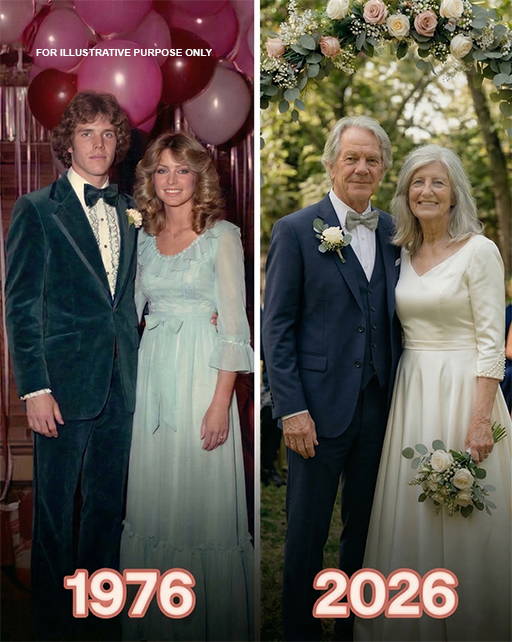
The first time I saw Edgar again, he was standing under a jacaranda tree. Its purple blossoms drifted down around him like a memory trying too hard to be beautiful. I almost did not recognize him, not because he had changed so much, but because time had softened the sharp edges of the boy I once knew into something steadier and quieter.
And then he smiled.
It was the same smile that had once made me skip class. The same smile that had made me believe in forever, before I understood how fragile forever really was.
I was sixty-seven years old when I married my first love.
If you had told me that at twenty, I would have laughed. At forty, I would have shaken my head. At sixty, I would have said it was too late.
But life has a way of circling back on itself when you least expect it.
We first met when we were seventeen, in a cramped classroom with peeling paint and a teacher who smelled faintly of chalk dust and peppermint. Edgar sat behind me, tapping his pen against the desk in a rhythm that somehow never annoyed me.
One day, he leaned forward and whispered, “You always tuck your hair behind your ear when you are concentrating.”
I turned, startled. “And you always tap your pen when you are bored.”
He grinned. “So we have been studying each other.”
That was how it started. Light, easy, inevitable.
We spent the last year of school inseparable. We talked about everything: the places we wanted to go, the lives we wanted to build, and the kind of people we hoped we would become. He wanted to design buildings that would outlive him. I wanted to teach, to leave something quieter behind.
We made plans. Big ones. The kind only young people make, without knowing how easily life can rearrange them.
But life did.
His family moved across the country the summer after graduation. We promised to write, to call, to visit. For a while, we kept those promises. Letters filled with longing. Late-night phone calls that stretched into silence because neither of us wanted to hang up.
Then the distance grew. Not just miles, but something else. Responsibilities. New people. New paths.
One day, the letters stopped.
And that was that.
Or so I thought.
I married at twenty-six. His name was Abel, and he was kind in a way that felt like home. He made me laugh when I needed it most, and he never once tried to compete with the memory of a boy I rarely spoke about but never truly forgot.
We had a good life. A real one.
Two children. A small house that always smelled like coffee and cinnamon. Holidays are filled with noise and warmth. Arguments that never lasted long, because we both understood that love was not about winning.
When Abel passed away after forty years of marriage, the silence he left behind was unbearable. It was not just that he was gone. It was that the rhythm of my life had been built around him, and suddenly, there was no rhythm at all.
I learned how to be alone again.
It took time.
Years, if I am honest.
And then, one afternoon, I walked into a bookstore I had never been to before.
And there he was.
Edgar.
He stood by a shelf of travel guides, flipping through a book with the same absentminded focus I remembered from decades ago. I would have walked right past him if he had not looked up at that exact moment.
We stared at each other.
There was no dramatic music, no sudden realization. Just a quiet recognition that settled between us like something long misplaced and finally found.
“Marina?” he said, his voice softer than I remembered.
“Edgar.”
We both laughed, a little awkward, a little amazed.
We went for coffee. Then dinner. Then long walks that stretched into evenings filled with stories we had never had the chance to tell each other.
He had married, too. Her name was Elara. He spoke about her with a tenderness that made it impossible not to respect the life they had shared. She had passed away five years before we met again.
We did not rush into anything.
At our age, you do not.
We moved carefully, not out of fear, but out of respect. Respect for the people we had loved, for the lives we had built, and for the years we had lost.
But love has a way of finding its shape again.
And when it did, it felt different this time. Not the wild, consuming fire of youth, but something steadier. Deeper. A quiet certainty that did not need to prove itself.
When he proposed, it was not with a grand gesture.
We were sitting on a park bench, watching the world move around us.
“I do not want to spend whatever time I have left wondering ‘what if’ again,” he said simply. “Do you?”
I shook my head, tears blurring my vision.
“No,” I whispered. “I do not.”
So we got married.
A small ceremony. Close friends, family, our children, and grandchildren. Laughter. Music. The kind of joy that feels earned, not given.
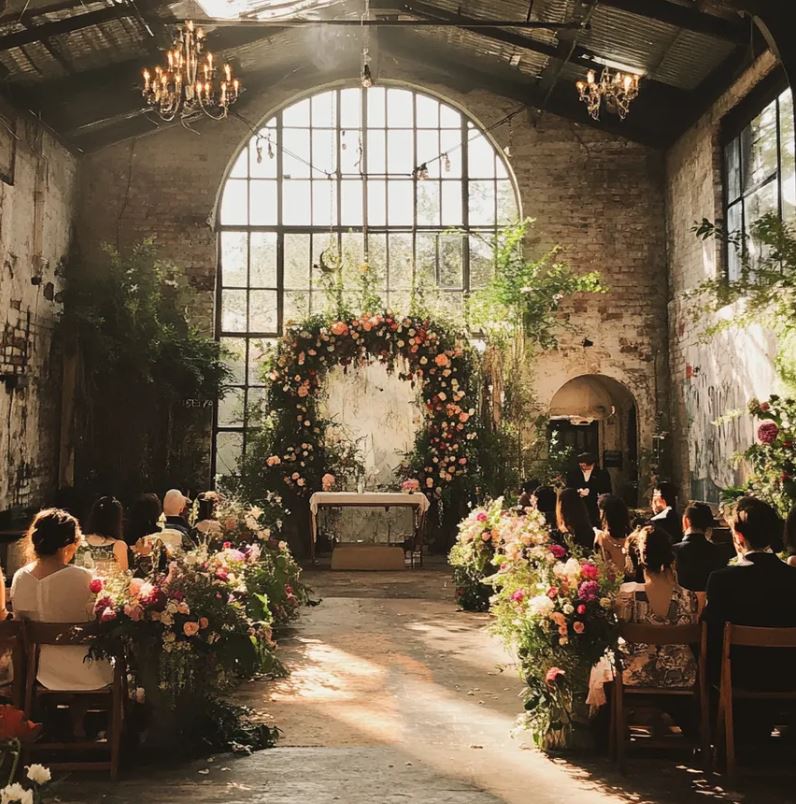
I remember standing there, looking at him, thinking how strange and beautiful it was that life had brought us back to this moment.
That, after everything, we had found our way to each other again.
The reception was held in a sunlit hall, filled with the hum of conversation and the clinking of glasses. I was halfway through a story with my granddaughter when I noticed a young man standing near the edge of the room, watching us.
He looked out of place.
Not because of what he was wearing. He was dressed well enough. It was the way he held himself. Tense. Uncertain. As though he did not quite belong there, but had forced himself to come anyway.
Our eyes met.
He hesitated, then began walking toward me.
Something about him made my chest tighten, though I could not have said why.
“Excuse me,” he said when he reached me. His voice was polite, but there was something underneath it, something urgent. “Are you Marina?”
“Yes,” I said slowly. “And you are…?”
He glanced briefly toward Edgar, who was across the room laughing with my son. Then he looked back at me.
“My name is Eric,” he said. “And I am sorry to do this today, of all days, but you need to know something about your husband.”
The word husband still felt new, unfamiliar in the best way.
“What about him?” I asked, my voice steady despite the unease curling in my stomach.
Eric hesitated, as if choosing his next words carefully.
“He is not who you think he is.”
For a moment, the noise of the room seemed to fade.
I stared at him, searching his face for some sign that this was a misunderstanding.
“What are you talking about?” I asked.
He exhaled slowly. “I did not come here to cause trouble. But I could not stay silent either.”
“Say what you came to say,” I told him.
His gaze flickered toward Edgar again.
“Edgar is my father.”
The words landed, but they did not make sense.
“That is not possible,” I said immediately. “He never had children.”
“That is what he told you,” Eric replied gently.
My heart began to pound.
“There must be some mistake,” I insisted. “Edgar would have told me.”
“He did not know,” Eric interrupted. “Not until recently.”
I blinked.
“What?”
“My mother never told him,” he said. “They were together briefly, a long time ago. She found out she was pregnant after he had already left, and she chose not to tell him.”
I felt as though the ground had shifted beneath me.
“When did he find out?” I asked.
Eric’s expression softened slightly.
“A few months ago.”
The timeline settled into place with sickening clarity. Before the wedding. Before the proposal.
“You are saying he knew,” I said slowly, “and he did not tell me.”
Eric swallowed. “I think he was afraid.”
“Afraid of what?”
“Losing you.”
I turned to look at Edgar.
He was still laughing, completely unaware of the conversation happening just a few feet away.
For a moment, I saw him as I always had. The boy under the jacaranda tree. The man who had come back into my life when I needed him most.
And then I saw something else.
A man who had kept a secret.
“Why are you telling me this?” I asked, turning back to Eric.
“Because I just found him,” he said. “And I know what it is like to feel like a part of your life has been hidden from you. I did not think it was right for you to go into this marriage without knowing the truth.”
I studied him carefully.
There was no malice in his expression. No satisfaction.
Just honesty.
“Does he know you are here?” I asked.
Eric shook his head. “No.”
I took a deep breath.
“Thank you,” I said finally.
He nodded, relief flickering across his face.
“I am sorry,” he added quietly.
Then he stepped back, giving me space.
I stood there for a long moment, trying to gather my thoughts, my emotions, and the pieces of a day that had suddenly become something else entirely.
Then I walked toward Edgar.
He saw me approaching and smiled.
“There you are,” he said. “I was just telling your son about the time you—”
“Edgar,” I interrupted gently.
Something in my tone must have shifted, because his smile faded.
“What is it?” he asked.
“We need to talk.”
We stepped outside into the late afternoon light. The air was warm, and laughter drifted faintly through the doors behind us.
I looked at him, really looked at him.
“Do you have a son?” I asked.
The question hit him like a physical blow.
For a moment, he said nothing.
Then he closed his eyes.
“Yes,” he said quietly.
The word settled between us.
How long have you known?
“A few months.”
“Before you proposed?”
“Yes.”
I felt something twist inside my chest.
“Why did you not tell me?”
He opened his eyes, and there was something raw in them I had never seen before.
“Because I was afraid,” he said. “I had just found you again, Marina. After all those years. And I thought, what if this changes everything? What if you see me differently? What if it complicates things in a way that makes you walk away?”
“So you decided for me,” I said.
“No,” he replied quickly. “I just needed time to understand it myself. To process it. I was going to tell you. I swear I was.”
“But you did not.”
Silence.
“I should have,” he admitted. “I know that.”
I took a step back, trying to create some distance, some clarity.
“His name is Eric,” I said.
Edgar’s head snapped up.
“He is here?”
“Yes.”
Emotion flickered across his face. Shock. Hope. Fear.
“I did not know if he would ever want to meet me,” he said.
“He does,” I replied. “That is why he came.”
Another silence, heavier this time.
“I am sorry,” Edgar said finally. “Not for having a son, but for not telling you. You deserved to know.”
I studied him for a long moment.
At twenty, this would have been a betrayal I could not forgive. At forty, it might have broken something fundamental.
But at sixty-seven, I understood something I had not back then.
Life is complicated.
People are flawed.
And love, real love, is not about perfection. It is about choosing each other, even when things are not simple.
“You hurt me,” I said honestly.
“I know.”
“But I also understand why you were afraid.”
Hope flickered in his eyes.
“I do not want secrets between us,” I continued. “Not now. Not ever again. We do not have the luxury of time to waste on things like that.”
“You are right,” he said. “You are absolutely right.”
I took a deep breath.
“Let us fix it, then.”
“Fix it?” he repeated.
“Start with the truth,” I said. “All of it. Together.”
For a moment, he just stared at me.
Then he nodded.
“Together,” he echoed.
We went back inside.
Eric was still there, standing near the same spot, as though he had not yet decided whether to stay or leave.
Edgar approached him slowly.
“Eric?” he said.
The young man turned.
And in that moment, I saw it. The resemblance. Not just in their features, but in the way they looked at each other. A mixture of curiosity, uncertainty, and something deeper.
“Yes,” Eric said.
Edgar swallowed.
“I am your father.”
Eric let out a small, breathless laugh.
“Yeah,” he said. “That is what I have been told.”
There was a pause.
Then Edgar stepped forward.
“May I?” he asked carefully.
Eric hesitated, then nodded.
They embraced. Awkward at first, then tighter, as though both were trying to make up for lost time in a single moment.
I stood there watching them, feeling something shift again, but not in a way that unsettled me.
In a way that felt right.
Life had not gone the way any of us had planned.
It rarely does.
But somehow, in all its unpredictability, it had brought us here.
To second chances.
To unexpected truths.
To a love that had survived time, distance, and even secrets.
Later that evening, as the reception wound down and the sky turned a soft shade of gold, Edgar found me again.
“Thank you,” he said quietly.
“For what?”
“For staying,” he replied.
I smiled.
“I did not come this far to walk away now,” I said.
He took my hand, his grip warm and steady.
As we stood there, surrounded by the remnants of a day that had been far from perfect but somehow exactly what it needed to be, I realized something.
Love is not about who someone was.
It is not even about who you thought they were.
It is about who they choose to be, every single day, moving forward.
And as long as we kept choosing each other, honestly and completely, that would be enough.
For whatever time we had left.
For the first time in a very long time, I felt certain of that.