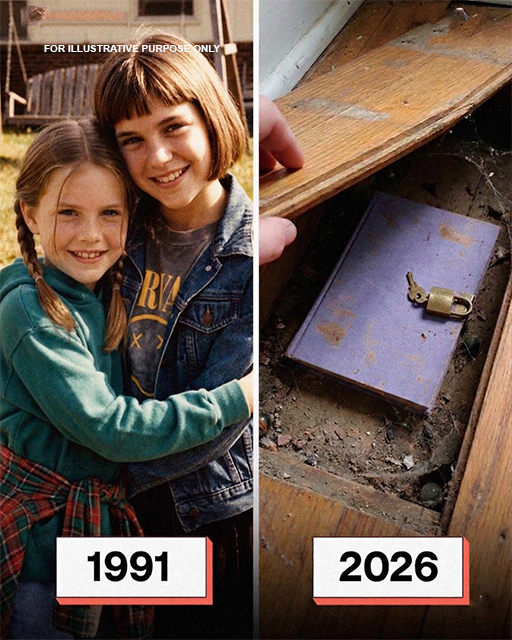
My sister vanished before I had even turned ten, leaving behind a silence that settled into every corner of our lives. For years, that silence was filled with questions no one could answer. Then, thirty-five years later, I found something that finally revealed the truth about what happened that morning.
My sister’s name was Lillian. I’m Caroline, and I was eight years old when she disappeared.
That Tuesday began like any other. In hindsight, that normalcy makes it even more unsettling. There was no warning, no shift in the air to suggest that anything was about to change.
Lillian came downstairs with her backpack slung over one shoulder, grumbling about a math test she had stayed up late preparing for. She looked tired. Her hair was only half-brushed, and her movements were distracted. Our mother, Helena, handed her a lunchbox she had packed the night before.
Lillian barely paused. She grabbed a piece of toast, mumbled something that might have been goodbye, and walked out the door.
That was the last time any of us saw her.
At eight years old, I didn’t understand how someone could simply disappear. I thought people only went missing in stories or on the news, not in ordinary homes like ours. Even then, I remember what came next with painful clarity.
Our parents didn’t sleep. For days, then weeks, they moved through the house like ghosts. They left late at night to search the streets and returned at dawn empty-handed. They knocked on doors, questioned her friends, spoke to teachers, and followed every lead, no matter how small or unlikely.
Lillian’s photograph appeared everywhere. It was taped to storefront windows, pinned to telephone poles, and printed in newspapers. Strangers studied her face as if memorizing it might somehow bring her back.
The community came together in ways I hadn’t known were possible. Volunteers organized search parties. People combed through parks, alleys, and abandoned buildings. Teachers stayed after school to coordinate efforts. Even those who had never met her joined in.
Then the police became more involved. At first, that gave everyone hope. It meant something was being done. It meant answers were coming.
But days turned into weeks, and weeks turned into months.
Eventually, the energy faded. Search groups dissolved. Posters curled and peeled away from the walls. Conversations shifted in tone. People stopped saying “when she comes back” and began speaking about her in the past tense.
The police told my parents what no one wanted to hear: it was unlikely she was still alive.
Something in our home broke after that.
My parents never said they gave up, but they stopped expecting her. They stopped listening for footsteps that never came. They stopped watching the street for passing cars.
Still, her absence never left us.
Years passed. Then decades. Thirty-five years, to be exact.
The house changed. The neighborhood changed. I grew up, moved away, and built a life of my own. But Lillian’s absence remained, like a shadow that never quite faded.
Then, a few days ago, my mother called.
Her voice sounded smaller than I had ever heard it.
“Your father is gone,” she said.
I drove to the house that same afternoon.
Grief had aged her in a way time alone never could. She moved slowly, as though carrying something heavy no one else could see. I stayed to help with everything: the funeral arrangements, the paperwork, the endless small decisions that come with loss.
The truth was, I couldn’t bring myself to leave her alone in that house. Not yet.
On the second night, after she had gone to bed, I found myself wandering upstairs.
I hadn’t planned to go there, but I stopped in front of Lillian’s room. The door was closed.
For a long moment, I just stood there.
Then I reached out and pushed it open.
Nothing had changed.
My mother had preserved the room like a memory frozen in time. The bed was still slightly unmade, just as Lillian used to leave it. Books were stacked on the desk. A sweater hung over the back of a chair.
It was as if she had stepped out for a moment and might return at any second.
I stepped inside, my chest tightening.
That’s when I heard it.
A sharp creak beneath my foot.
I froze, then shifted my weight and stepped again.
The same sound.
I looked down and noticed that one of the floorboards seemed slightly raised. Something about it felt off.
Kneeling, I pressed against it. It moved.
My pulse quickened as I carefully lifted the board.
Beneath it was a small hidden space.
Inside, wrapped in faded fabric, was a notebook.
My hands trembled as I pulled it out. It had a cheap metal lock, but it didn’t take much to pry it open with a pair of scissors I found nearby.
The moment I flipped it open, I recognized the handwriting.
It was Lillian’s.
At first, the entries were exactly what you would expect from a teenage girl. Complaints about school, notes about friends, and small frustrations with our mother. Ordinary things.
But as I turned the pages, something changed.
The entries became shorter. More careful.
The tone shifted.
She started writing about going somewhere before school. The same place, over and over again: a bus stop at the edge of town.
Then she mentioned someone.
She never wrote the person’s name, only fragments.
“She listens.”
“She doesn’t rush me like everyone else.”
“She says I have options.”
A chill crept through me.
This wasn’t casual conversation.
This was planning.
Then I reached the entry from the night before she disappeared.
“I packed a small bag, but I hid it. I don’t know if I’ll use it. I keep thinking about what he said. I wish I hadn’t heard it.”
My chest tightened.
What had she heard?
I turned to the final page.
The handwriting was rushed and uneven, as though she had been writing in a hurry.
“I’m going back there before school. I need to decide. She said she could help me hide, just for a little while. I don’t think I can stay here if it’s true.”
The last line was underlined twice.
“If I don’t go today, I never will.”
I stared at the words, my mind racing.
I had no idea what had been happening in her life.
Before I could fully process it, I was grabbing my jacket, my keys already in my hand.
I drove straight to the bus stop mentioned in her diary.
It was still there, though it looked forgotten. The paint was chipped, and the bench was worn down by time.
I stepped out of the car and stood there, trying to imagine her.
Fourteen years old. Alone. Standing exactly where I was.
What had she been thinking?
What had she been about to do?
Across the road, a small grocery store stood, old enough to have been there back then.
I walked inside.
An elderly man stood behind the counter, flipping through a newspaper. He looked up as I approached.
I hesitated, then spoke.
“I’m looking for information about someone who used to come here. A long time ago.”
He studied me for a moment.
“My sister,” I added. “She used to wait at that bus stop. About thirty-five years ago.”
He frowned slightly, thinking.
“A teenage girl?” he asked. “Dark hair? School bag?”
My breath caught.
“Yes.”
“I remember her,” he said slowly. “She didn’t talk much.”
My heart began to pound.
“Was she alone?” I asked.
“Not always. There was a woman. She’d pull up in an old car. They’d talk. Sometimes your sister left with her.”
“Do you know who the woman was?”
He shook his head.
“I don’t remember her name. But I remember where she worked. A youth center across town.”
That was enough.
I thanked him and left, heading straight for my car.

The drive felt endless.
When I arrived, the building looked plain, almost easy to miss.
Inside, it was warm. Quiet voices echoed down the hall.
A woman at the front desk greeted me. When I explained why I was there, she called for someone else.
An older woman with gray hair appeared a few minutes later.
“What’s your sister’s name?” she asked.
“Lillian.”
She didn’t hesitate.
“I remember her.”
My heart skipped.
“She came here a few mornings before school. We talked.”
“About what?”
The woman studied me carefully.
“This may be difficult to hear,” she said gently. “Your sister talked about leaving home.”
The words hit me like a weight.
“She felt like she didn’t belong,” the woman continued. “At first, I thought it was typical teenage frustration. But then she told me what she had overheard.”
My mind flashed back to the diary.
“She heard your parents arguing,” the woman said. “Your father said he was tired of raising her because she wasn’t his child. That she was adopted.”
I felt the air leave my lungs.
“She didn’t understand it,” the woman said softly. “Everything she thought she knew about her life suddenly felt uncertain. She was scared.”
I could barely speak.
“She came here one last time,” the woman went on. “She had a small bag. She said she was ready to leave, just for a while, to think.”
“What happened that day?” I asked.
“She asked to use the phone,” the woman said. “She made a short call. I only caught the name ‘Helena.’”
My mother.
“And then?”
“She left,” the woman said. “She didn’t say where she was going.”
I stood there, stunned.
Not taken.
Not lost.
She had walked away.
I drove home in silence.
My mother was in the kitchen when I returned.
I placed the diary in front of her.
“I know what happened to Lillian,” I said.
Her hands froze.
“She didn’t disappear,” I continued. “She left.”
I held her gaze.
“She called you that morning, didn’t she?”
Her face crumpled.
“She heard what Dad said,” I said. “About her being adopted.”
Tears filled her eyes.
“She called me,” my mother admitted. “She asked if it was true. I told her everything. I told her it didn’t change anything.”
“But it did,” I said quietly.
“She said she needed time,” my mother whispered. “Just a few days. She said she would call me when she was ready to come home.”
But she never did.
I sat there, the truth settling in.
For decades, we had believed something terrible had been done to her.
But the truth was different.
She had left because she believed she didn’t belong.
I picked up the diary, running my fingers over its worn cover.
“She didn’t leave because she didn’t love us,” I said. “She left because she thought she had no place here.”
My mother broke down, years of guilt finally spilling over.
I let her cry.
For the first time in decades, we had an answer.
But it didn’t bring peace.
It only changed the shape of the pain.
“This changes everything,” I said finally.
And it did.
I stayed for the funeral.
After that, I left the house, and everything tied to it, behind.
For the first time in my life, I knew what had happened to my sister.
But knowing the truth didn’t bring her back.
It only made her absence feel more real than ever.