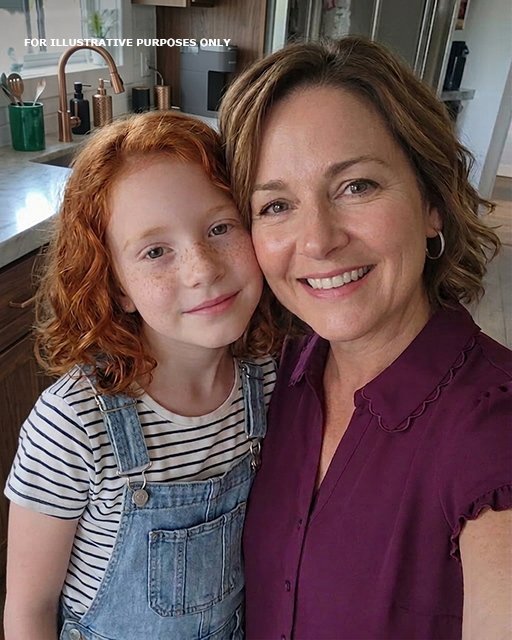
After nearly a decade of infertility, I thought the deepest pain my husband and I would ever experience was the silence of a house without children.
For nine years, our lives revolved around fertility clinics, medications, blood tests, and disappointment. Every month began with cautious optimism and ended with grief. I became skilled at smiling through other people’s baby showers before crying alone in my car afterward. I stopped wandering through children’s clothing aisles. I packed away the tiny knitted blanket my mother had made years earlier “for someday.”
Eventually, the sadness settled into something quieter but heavier.
One rainy evening, after another failed treatment, my husband Grant sat across from me at the kitchen table while our untouched dinner grew cold.
“What if,” he asked softly, “our child is already out there somewhere waiting for us?”
I looked at him for a long moment before tears finally spilled down my face.
That conversation led us to foster care and adoption.
The process took nearly a year—classes, home inspections, interviews, fingerprinting, background checks, and enough paperwork to fill entire drawers. By the time we visited a children’s home two counties away, we were emotionally exhausted but cautiously hopeful.
We brought books, stuffed animals, puzzles, and candy for the children. The younger kids rushed toward us immediately, laughing and tugging at our sleeves. Grant ended up sitting cross-legged on the floor, helping two boys build a tower from plastic blocks while I handed out coloring books.
Then I noticed her.
She sat quietly beside a window at the edge of the room, watching the others without joining them. She looked older than most of the children there—around ten years old—with dark hair pulled neatly behind her ears and hands folded carefully in her lap.
There was something unusually restrained about her.
I walked over and crouched beside her.
“Hi,” I said gently. “Don’t you want to pick something too?”
She glanced toward the younger children.
“They should go first,” she replied politely. “The little kids get upset more easily.”
Her voice sounded calm and mature, but beneath it I heard exhaustion no child should carry.
“What’s your name?” I asked.
“Sadie.”
“Well, Sadie, I think there’s enough for everyone.”
She offered me a tiny smile but still didn’t move.
Across the room, Grant looked up at us. Our eyes met for only a second.
Yet somehow, in that instant, we both knew.
Six weeks later, Sadie arrived at our home through a foster-to-adopt placement.
I expected the adjustment to be difficult, but what surprised me most was how careful she was. She folded her clothes into perfect stacks. She apologized constantly. She asked permission before taking food, turning on lights, or opening cabinets.
The first time she took an apple from the refrigerator, she froze halfway through and nervously asked, “Was I allowed to do that?”
My heart cracked a little.
One evening, I served spaghetti and garlic bread for dinner. Sadie finished quickly but kept glancing toward the remaining bread.
“You can have more,” I told her.
“Really?”
“Sweetheart,” I said gently, “you never have to ask permission to eat in your own house.”
She stared at me like she didn’t fully understand the sentence.
Then quietly, she whispered, “Oh.”
That single word haunted me for days.
Grant struggled too, though differently from me. One night after Sadie had gone to bed, I found him sitting alone in the garage staring at an old bicycle he had quietly bought months earlier.
“I keep thinking I’m going to do something wrong,” he admitted. “What if she never really feels safe here?”
A few weeks later, while helping him plant flowers in the backyard, Sadie accidentally called him “Dad.”
The word slipped out so naturally that she froze in horror afterward.
But Grant’s eyes immediately filled with tears.
“You don’t have to say it again,” he told her gently. “Once was enough for me.”
A month later, Grant and I invited our extended family over so everyone could meet her properly. Sadie spent nearly an hour deciding what to wear before finally settling on a pale blue dress.
“What if they don’t like me?” she asked nervously while smoothing invisible wrinkles from the fabric.
I touched her cheek.
“Then they’ll answer to me.”
That finally made her laugh.
The evening began beautifully. My cousins adored her immediately. My aunt kept offering her extra dessert. My teenage niece, Chloe, promised to show Sadie the upstairs game room if she needed a break from the noise.
For the first time since arriving, Sadie truly looked relaxed.
Then my father arrived late.
He entered carrying a bottle of wine and apologizing loudly about the traffic.
“Sorry, I’m late,” he called.
“You’re fine,” I said. “Come meet Sadie.”
I led him into the living room.
Sadie stood politely the moment she saw him.
“Nice to meet you, sir,” she said.
My father looked at her face.
Then his eyes shifted downward toward her wrist.
The wine bottle slipped from his hand and shattered across the hardwood floor.
Everyone jumped.
“Dad?” I rushed toward him. “What happened?”
He had gone completely pale.
Not confused.
Terrified.
He kept staring at Sadie as though he had seen a ghost.
“I need to talk to you,” he whispered hoarsely. “Now.”
The room fell silent.
Grant stepped forward immediately. “Chloe, can you take Sadie upstairs for a minute?”
Chloe nodded gently and led Sadie away, though Sadie looked frightened and confused.
I pulled my father into the kitchen and shut the door behind us.
“What is wrong with you?” I demanded. “You scared her.”
My father pressed trembling hands against the counter.
“I know that bracelet,” he said quietly.
A chill crawled through me.
“What bracelet?”
“The silver bracelet with the flower charm.”
Sadie always wore it. I had noticed it dozens of times, though she never removed it.
“You’re imagining things,” I said.
But my father shook his head firmly.
“No. Five years ago, I volunteered at a chapel that handled funeral services for unclaimed children in state care. There was a little girl around Sadie’s age. Hardly anyone attended the burial—just me, the funeral director, and a social worker.”
My stomach tightened.
“She wore that exact bracelet,” he continued. “I remember because the charm was damaged. One tiny flower petal was bent inward. The social worker tried for several minutes to unclasp it before the service, but eventually decided to leave it on her.”
I felt suddenly cold.
“The child’s name,” my father whispered, “was Ivy.”
I barely slept that night.
The next morning, I sat carefully on the edge of Sadie’s bed while she read beneath her blanket.
“Can I ask you something?” I said softly.
She nodded.
“That bracelet… where did it come from?”
Her hand instinctively covered it.
“I’ve always had it.”
“Can I see it?”
She hesitated before holding out her wrist.
Tiny silver chain.
Flower charm.
Bent petal.
And inside the clasp, barely visible, was an engraved letter.
I.
Not S.
My pulse quickened.
“What does the I stand for?” I asked gently.
“I don’t know.”
Within an hour, I was calling the children’s home demanding Sadie’s full records.
At first, the director sounded defensive.
“We already provided all placement documentation.”
“I need everything,” I insisted. “Every intake file. Every transfer report. Every previous name connected to her.”
There was a long pause.
Then her tone changed completely.
“You should come in person.”
Grant drove while I combed through the paperwork we already had. This time I noticed details I had previously overlooked.
Missing dates.
Incomplete transfers.
Reports copied from different systems.
And one partially crossed-out name.
Ivy Monroe.
At the children’s home, the director closed her office door before speaking.
“When Sadie arrived here three years ago,” she admitted quietly, “I noticed serious inconsistencies in her records. I reported them to the county office, but I was told the previous facility had shut down and many files had been lost.”
“What happened to the facility?” Grant asked.
The director sighed heavily.
“It was under state investigation for neglect and abuse. During a severe flu outbreak, the county ordered an emergency evacuation. Children were transferred overnight to different facilities while staffing collapsed. Several employees quit immediately. Paper records were damaged after a pipe burst during the shutdown, and part of the digital archive was corrupted.”
She paused before continuing.
“Because the emergency transfers involved multiple counties already overwhelmed during the outbreak, several children were processed temporarily under paper documentation before full digital verification occurred. By the time the systems were finally updated, some files no longer matched correctly.”
“Who told you to stop asking questions?” I asked.
“A social worker named Vanessa Cole.”
My father went rigid.
“That’s the woman from the funeral.”
Two days later, we hired an attorney.
The investigation stretched across nearly a year.
County agencies reopened archived dependency records while state investigators reviewed failures connected to the closed children’s home. Grant and I spent endless hours in government offices while Sadie attended therapy sessions arranged through our attorney.
And eventually, we found it.
Five years earlier, during the outbreak at the collapsing facility, a critically ill unidentified girl had di3d after several medical charts were accidentally mixed between overcrowded emergency wards.
In the confusion, Ivy Monroe’s file had mistakenly been marked deceased instead.
Three months later, a child named Sadie appeared in another county under an inactive case file connected to a long-closed placement.
Same birth year.
Same intake photograph.
Same scar beneath her chin.
When Sadie finally saw the photo herself, she whispered shakily, “That’s me.”
A trauma specialist later explained that prolonged instability, illness, repeated displacement, and emotional shock had likely fractured many of Sadie’s early memories. Children exposed to chronic trauma sometimes detach from painful parts of their identity simply to survive emotionally.
Suddenly, her fragmented memories made heartbreaking sense.
Our attorney eventually tracked Vanessa to a small apartment above a laundromat nearly three hours away.
But it took months.
There were d3ad ends, outdated addresses, old employment records, and disconnected phone numbers before investigators finally located her through housing records tied to a previous county payroll system.
I still don’t know whether bringing Sadie with us was the right decision, but after years of adults making choices over her life, I couldn’t bear excluding her again.
When Vanessa opened the door and saw Sadie standing beside us, all the color drained from her face.
“You shouldn’t be here,” she whispered.
“She deserves the truth,” Grant replied firmly.
At first, Vanessa denied everything.
Then she broke down completely.
Years earlier, the children’s home had descended into chaos during the outbreak. Children were moved between counties so quickly that records became dangerously disorganized.
“You corrected it afterward, right?” I asked.
Vanessa burst into tears.
“No.”
My father stared at her in disbelief.
“You left a living child legally d3ad?”
“At first I planned to fix it,” Vanessa sobbed. “But the state investigation exploded. Supervisors changed. Records disappeared. Every month, it became harder to admit what I’d done.”
She covered her face.
“The longer I waited, the worse it became. At first, I was afraid of losing my career. Later, I was afraid of prison. Then I was afraid Ivy would lose the only stable placement she had left.”
“You still erased her,” I said quietly.
Vanessa nodded miserably.
Then she finally explained the rest.
Ivy’s mother had temporarily lost custody because of homelessness and financial instability—not abuse. Vanessa knew reunification had originally been planned once the mother secured stable housing.
But after the outbreak, Vanessa convinced herself the system would fail Ivy completely if the truth surfaced during the investigation.
So she made a catastrophic decision.
She attached Ivy’s records to an abandoned inactive file belonging to another child named Sadie, whose case had long been closed.
The unidentified girl who died was buried under Ivy’s name.
“That part,” Vanessa whispered through tears, “is what I will regret for the rest of my life.”
The silence afterward felt unbearable.
Then Sadie spoke quietly.
“What was my real name?”
Vanessa looked at her with red-rimmed eyes.
“Ivy. Your mother named you Ivy.”
Sadie blinked several times.
“I had a mother?”
That question shattered something inside me.
“Yes,” Vanessa whispered. “And she loved you very much.”
Everything changed after that.
Our dining table disappeared beneath stacks of files, timelines, legal documents, and handwritten notes. Sadie helped too, offering fragmented memories whenever something resurfaced.
“A yellow kitchen.”
“A woman singing while cooking.”
“Red shoes.”
“A song about sunshine.”
One memory eventually led investigators to an elderly former neighbor who remembered Ivy’s mother vividly because she worked double shifts at a diner and always wore bright red work shoes.
Her name was Brooke Monroe.
But finding her took nearly three more months.
Our attorney followed old housing applications, employment records, and assistance paperwork across two states before finally locating her at a roadside diner outside Columbus.

I went alone first.
I didn’t know how to tell a woman that the daughter she had mourned for five years might still be alive.
Brooke approached my booth carrying a coffee pot, looking exhausted from years of hard living.
Then I showed her Sadie’s photograph.
The coffee pot nearly slipped from her hands.
When I showed her the bracelet, she covered her mouth and began shaking.
“They told me she di3d,” she whispered.
“I know.”
Two days later, Brooke met Sadie.
It wasn’t dramatic like movies.
Nobody ran into anyone’s arms.
Sadie stayed close beside Grant and me, tense and uncertain.
Brooke stood several feet away, crying silently.
“I’m not here to take you away,” she said immediately. “I just wanted to see your face again.”
Sadie studied her carefully before asking one heartbreaking question.
“Did you look for me?”
Brooke broke completely.
“Every day,” she sobbed. “Every single day. Until they convinced me there was nowhere left to search.”
Sadie started crying too.
So did I.
But unlike fairytales, things did not suddenly become easy.
The legal battle lasted almost another year.
There were investigations, hearings, psychological evaluations, reopened dependency cases, and media attention surrounding the collapsed children’s home. Vanessa eventually faced criminal charges related to falsified records and negligence.
Meanwhile, Sadie struggled deeply.
Some nights she cried because she didn’t know whether she was Sadie or Ivy.
Other days, she became angry and refused to speak to anyone.
She worried Brooke might take her away permanently. Then she felt guilty for worrying about it.
At times, she lashed out at Grant and me for “not finding out sooner,” even though we ourselves had only recently learned the truth.
Therapy became central to all our lives.
And Brooke struggled too.
There were moments she wanted to fight for full custody. She admitted that openly during one difficult conversation.
“Every selfish part of me wants my daughter back,” she whispered one evening. “I already lost five years with her.”
I cried after she left because I understood completely.
But Brooke also saw how deeply Sadie loved us—and how terrified she was of losing stability again.
A court-appointed child psychologist testified that forcibly removing Sadie from the only stable home she truly remembered could retraumatize her after years of institutional instability and identity disruption.
Most importantly, Sadie herself was finally old enough to have a voice.
During the final hearing, the judge asked gently, “Where do you feel safest?”
Sadie looked at all of us for a long moment before answering quietly:
“With all of them.”
There wasn’t a dry eye in the courtroom.
Given the state’s documented failures, Sadie’s age, Brooke’s support of the placement, and unanimous psychological recommendations emphasizing stability, the court approved an unusual arrangement centered entirely around Sadie’s emotional well-being and wishes.
Then came the final question.
“What name would you like on your corrected records?” the judge asked.
Sadie sat silently for several seconds.
Finally, she said softly, “I want to stay, Sadie.”
My chest tightened.
Then she added:
“But I want Ivy too.”
So Ivy became her middle name.
Sadie Ivy Carter.
The first time she signed it herself, she smiled for nearly an hour afterward.
Over time, our complicated, painful, beautiful family slowly settled into something real.
Brooke visits often now. Sometimes Sadie spends weekends with her. They’re rebuilding years stolen from both of them, little by little.
My father apologized repeatedly for frightening Sadie that first night. Later, he built her a wooden memory box by hand.
Inside, she keeps the bracelet, copies of her corrected records, photographs, therapy letters, and handwritten notes from everyone who loves her.
But healing is not linear.
Even now, there are difficult days. Sometimes Sadie still asks questions no one can fully answer. Some wounds heal slowly. Others leave scars forever.
We can never recover the years stolen from Sadie and Brooke. Nothing will erase what happened to the unnamed little girl buried under the wrong identity, either.
But slowly, together, we are learning how to build something honest from what remains.
A year later, Grant and I took Sadie back to the same children’s home where we first met her.
This time, she didn’t sit quietly by the window.
Instead, she walked directly toward an older boy sitting alone while younger children crowded around the toys.
“Why aren’t you getting anything?” she asked him.
He shrugged awkwardly.
“I’m too old. The little kids should go first.”
Sadie smiled knowingly and placed a stuffed bear into his hands.
“That’s what I used to think too,” she said softly. “But sometimes the thing meant for you is still waiting for you.”
I stood in the doorway holding Grant’s hand while watching her.
For years, I thought becoming a mother meant giving birth.
Then I thought it meant choosing a child.
Now I understand something entirely different.
Sometimes love is recognition.
Sometimes your heart finds someone long before your mind understands why.
And sometimes the child you were meant to love has been searching for you, too.