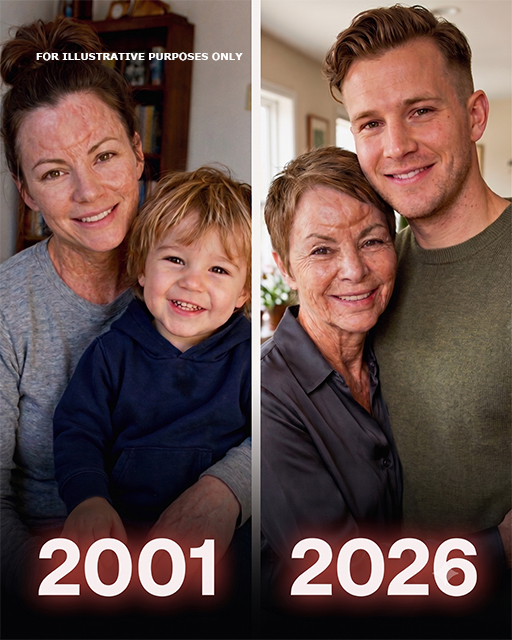
I was thirty-two years old when my father knocked on my mother’s front door for the first time in thirty years.
By then, he was a stranger. Not because I had forgotten him, but because there was almost nothing to remember.
No birthdays. No Christmases. No school events.
No phone calls. No letters. For three decades, he existed only as a story my mother rarely told.
Then, on my birthday, he showed up asking for help. And I told him I would give it to him.
On one condition.
The reason I’m alive today is because my mother carried me out of a burning house.
I was two years old. The fire started in the middle of the night after a gas leak in our kitchen ignited.
My father was away on a business trip. Only my mother and I were home.
She woke to the smell of gas moments before the explosion. The blast shattered windows and filled the house with smoke and flames.
Most people would have run.
My mother ran toward me.
She grabbed me from my crib, wrapped me in a blanket, and forced her way through the smoke. By the time she reached the front yard, she collapsed.
The firefighters found her unconscious. I survived without a single injury.
She didn’t.
The burns scarred one side of her face, ran down her neck, and marked part of her shoulder. I don’t remember the fire.
I remember the scars.
Growing up, I asked about them more than once. She always gave the same answer.
“The house caught fire. I got you out.”
Nothing more.
But eventually I learned the rest.
My father returned home after she was released from the hospital. Most people would have been grateful.
His wife had nearly died saving their child.
Instead, he looked at her scars and saw only what had been taken from him.
Years later, my mother finally told me what he had said.
He told her he couldn’t live with the reminder of the fire. He told her he still had time to build a different life with someone he could admire.
Then he packed a bag and left.
Just like that.
No custody battle. No attempt to stay involved. No effort to be a father.
One day he was there.
The next day he wasn’t.
And he stayed gone.
My mother never spent years poisoning me against him. She never had to.
His absence spoke for itself.
Whenever people asked about my father, she would simply shrug.
“Some people only stay while life is easy.”
Then she would go to work.
For years she worked double shifts at a diner. During the day she attended appointments and treatments she could barely afford.
At night she came home exhausted and still found energy to help with homework, cook dinner, and listen to whatever was happening in my life.
She never treated saving me like a sacrifice.
To her, it was simply what mothers do.
When I turned sixteen, I got a part-time job at a department store.
She was furious.
“You should be studying.”
“I am studying.”
“You don’t need a job.”
I grinned.
“The grocery store disagrees.”
She tried not to laugh.
Failed.
And after that, she stopped arguing.
I stayed in retail after high school. I learned everything I could.
Sales. Management. Inventory. Customer service.
I worked hard and saved harder.
By twenty-nine, I opened my own clothing store. It wasn’t a massive success story.
It was simply a good business built slowly and honestly.
Most importantly, it allowed my mother to finally rest.
For the first time in my life, she wasn’t constantly exhausted. Watching that happen meant more than any profit margin ever could.
Three years later, on my thirty-second birthday, we celebrated quietly at her house.
Burgers on the grill. Corn on the cob. Lemonade.
Nothing fancy.
Just peace.
The kind of peace people earn.
Then someone knocked on the front door.
“You expecting anyone?” Mom asked.
“No.”
I went inside and opened the door.
A thin man stood on the porch. His clothes were worn.
His shoes looked nearly finished. His face carried the weight of hard years.
At first, I didn’t recognize him.
Then I saw his eyes.
My eyes.
The realization hit immediately.
Behind me, I heard my mother stop walking.
The silence told me she knew too.
The man swallowed.
“Hey.”
I stared at him.
“Dad?”
He nodded.
The years had not been kind.
Standing on the porch, he explained everything.
His business had failed. He’d gone bankrupt.
His second wife had left him. Most of his friends had disappeared.
He’d sold nearly everything he owned.
Now he had nowhere left to go.
Finally, he looked at me.
“I need help.”
My mother immediately turned away.
“I’m going inside.”
“Alyssa, wait.”
She didn’t.
The door closed behind her.
I stayed on the porch.
“How did you find us?”
He hesitated.
Then he admitted the truth.
He found my business online. Found my name.
Found the town. Found the address.
He hadn’t been looking because he missed us.
He’d been looking because he needed something.
Oddly enough, that didn’t surprise me.
Not anymore.
“I’ll help you,” I said.
Relief appeared on his face instantly.
Too instantly.
Then I added, “But I have one condition.”
“Anything.”
“Don’t answer yet.”
The relief vanished.
I told him where we were going the next morning.
His expression hardened.
“No.”
“Then we’re done.”
He blinked.
“What?”
“I said we’re done.”
“This is ridiculous.”
“Maybe.”
“I came here for help.”
“And I’m offering it.”
We stared at each other.
Finally, he asked, “What if I refuse?”
I shrugged.
“Then you leave.”
For a moment I thought he would.
Instead, he lowered his eyes.
“I’ll go.”
Convincing my mother was harder.
Much harder.
That evening I found her sitting alone on the back porch.
The sun had already set.
“I don’t want to go back there,” Alyssa said before I could speak.
“I know.”
“I spent years trying to move past that place.”
I sat beside her.
“Mom…”
“No.”
Her voice cracked.
“Please don’t ask me.”
I stayed quiet for a moment.
Then I said the only honest thing I had.
“I’m not asking for him.”
She looked at me.
“I’m asking for me.”
Her expression softened slightly.
“Why?”
“Because I need him to see what you survived.”
Neither of us spoke.
The night sounds filled the silence.
Finally, she sighed.
“One trip.”
I nodded.
“One trip.”
The next morning we drove to the old property.
The house was long gone. A small rental stood in its place.
The porch sagged. The fence leaned.
The yard looked neglected.
An older man was working outside.
His name was Calvin.
After introductions, he studied my mother’s face for several seconds.
Then his eyes widened.
“Were you the woman from the fire?”
She nodded.
Calvin rested both hands on his rake.
“My wife and I bought this property years ago. People still talked about what happened here.”
He hesitated.
“Actually… there may be something that belongs to you.”
Years earlier, workers renovating the property had discovered a metal recipe box buried near the foundation.
Calvin had kept it.
Not because he knew who it belonged to.
Because he suspected it had once meant something important to someone.
“I thought about trying to find the family,” he admitted. “But I didn’t know any names. By the time finding people became easier, decades had already passed.”
A few minutes later, he returned carrying a faded blue metal box decorated with flowers.
My mother’s eyes immediately filled with tears.
“I buried this.”
After Brandon left, Alyssa returned to the property one final time before demolition.
Inside the box, she had placed photographs, family keepsakes, and a letter she never mailed.
Then she buried it.
Not because she wanted to forget.
Because she needed somewhere to leave her grief.
She opened it carefully.
Inside were smoke-stained photographs, recipe cards, old memories, and an envelope.
Brandon’s name was written across the front.
I handed it to him.
“Read it.”
The letter wasn’t angry.
That was what surprised me most.
There was no begging. No accusations. No demands.
She simply wrote that her son was alive because she carried him through the fire.
She wrote that if he no longer loved her, he still had a responsibility to love the child whose life she had saved.
Then she ended with one sentence:
I will not spend my life waiting for a coward to become a decent man.
Brandon read it twice.
Then he sat heavily on the porch step.
For the first time since arriving, he looked genuinely ashamed.
“I’m sorry.”
I believed him.
At least in that moment.
But being sorry wasn’t enough.
I looked around the property.
Then at Calvin.
“You still need help fixing this place?”
Calvin laughed.
“Always.”
Brandon immediately understood.
“No.”
I turned toward him.
“No?”
“I came here for help.”
“Then leave.”
He stared.
“What?”
“You heard me.”
The silence stretched.
“I said I was sorry.”
“Good.”
I pointed toward the porch.
“That’s where sorry starts.”
For several long moments, nobody spoke.
Then he looked down at the letter.
The fight slowly left him.
“What do I have to do?”
For the next week, Brandon worked.
Not for sympathy. Not for appearances.
He worked because that was the condition.
He replaced rotting boards. Reset fence posts.
Cleared brush. Repaired damaged steps.
Painted railings.
Every evening, he left exhausted.
Every morning he came back.
Alyssa refused to visit for the first two days.
On the second evening, she asked me a question.
“How’s he doing?”
I looked up from dinner.
“Working.”
She nodded.
Nothing more.
Two days later, she showed up carrying a pitcher of iced tea.
Without looking directly at him, she placed a glass nearby.
“Check the support beam before you cover it.”
He frowned.
“The support beam?”
“Rotten wood doesn’t get stronger because you hide it.”
Then she walked away.
The message wasn’t about the porch.
Everyone knew it.
Especially him.
By the end of the week, the property looked different.
The porch stood straight. The fence was secure.
The yard was clean.
Brandon sat heavily on the steps.
“I did it.”
“Yes.”
“So now what?”
I took a deep breath.
“I’ll give you one month.”
His eyebrows rose.
“One month?”
“A room above my store. Food. Time to find work.”
“And after that?”
“After that, you’re responsible for yourself.”
He looked disappointed.
Maybe he’d hoped for more.
But he nodded.
I wasn’t giving him a second chance.
I was giving myself the chance to walk away without becoming bitter.
There was a difference.
Three weeks later, Brandon found work at a warehouse.
Before the month ended, he moved into a small apartment.
We didn’t become a family.
We didn’t suddenly make up for thirty years.
Whether he changed completely, I honestly don’t know.
People rarely transform that neatly.
But for the first time in my life, I saw him trying.
And that mattered.
Several weeks later, Alyssa and I visited the property one final time.
The repairs were holding.
The porch looked solid.
The yard looked cared for.
We stood there quietly.
Finally, she smiled.
“I’m glad something good came from this place.”
On the drive home, I asked a question I’d been carrying for weeks.
“Do you forgive him?”
She thought for a long time.
“No.”
The answer wasn’t angry.
It wasn’t bitter.
It was simply honest.
Then she looked out the window and smiled softly.
“But I don’t carry him anymore.”
I stared at her.
At the woman who had carried me through fire.
The woman who rebuilt her life from ashes.
The woman who refused to let someone else’s failure define her future.
And in that moment, I understood something.
Too many people confuse regret with repair.
They aren’t the same thing.
Regret is feeling sorry.
Repair is doing the work.
And redemption, if it exists at all, begins there.