My husband gave me the most beautiful bracelet I had ever owned on our twenty-sixth wedding anniversary.
Three days later, I found proof that he had bought an identical one for another woman.
For nearly an hour, I sat in my car, convinced my marriage was over.
I was wrong.
The truth was far more painful and far more complicated than an affair.
For most of our marriage, my husband had been many things.
Reliable. Loyal. Hardworking.
Terrible at gifts.
Over 26 years, I had received a snow shovel, a coffee maker, a set of tire chains, and, on one memorable anniversary, a toolbox.
His explanation had always been the same.
“They’re useful.”
Romance was not Ryan’s language.
Which was why I nearly dropped my coffee mug when he handed me a velvet jewelry box on our anniversary morning.
I stared at it. Then at him.
“Did you hit your head?”
He laughed.
“Just open it.”
I lifted the lid.
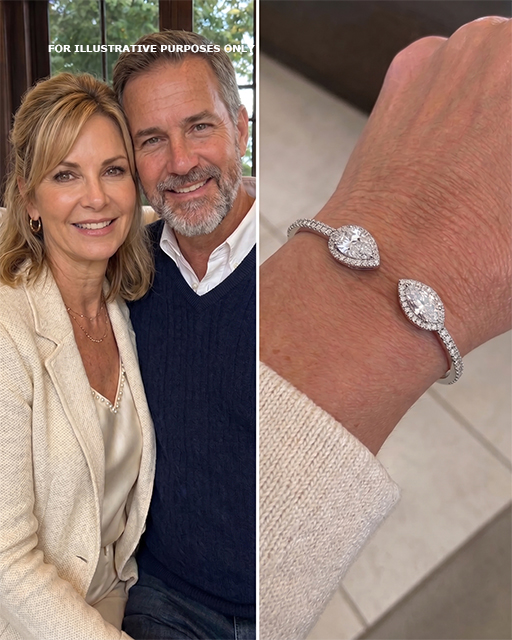
The bracelet inside stole my breath.
White gold. Tiny diamonds.
Elegant enough to belong in a display case instead of on my wrist.
For a moment, I looked at it. Then at him.
“Ryan, this must have cost a fortune.”
His smile was small but genuine.
“You deserve it.”
I slipped it on.
It fits perfectly.
And for the first time in years, I saw something lighter in his eyes.
Hope.
At the time, I thought the bracelet was the surprise.
I had no idea the real surprise was still waiting.
Ten years earlier, our daughter Ava died in a car accident.
She was sixteen years old.
Nothing that happened afterward mattered as much as that single sentence.
Parents are not supposed to outlive their children.
The world doesn’t teach you how.
Some people grieve loudly.
Others quietly.
I cried.
Ryan disappeared into himself.
Neither approach saved us.
For years, we moved through the same house carrying separate grief.
We still loved each other, but there was a distance neither of us knew how to cross.
We stopped talking about Ava because every conversation ended with one of us in tears.
Eventually, silence became our survival strategy.
The problem was that silence grows.
Year after year, it built walls between us.
Walls neither of us noticed until they were already there.
Three days after our anniversary, I decided to register the bracelet’s warranty online.
The jewelry store had included all the paperwork in the box.
I sat at the kitchen table with my laptop and typed in the purchase information.
Then I noticed something strange.
The receipt listed two item numbers.
Not one.
Two.
Same bracelet. Same price. Same purchase date.
I stared at the screen.
My pulse quickened.
At first, I thought it had to be an error.
Then I checked again.
No mistake.
Ryan had purchased two identical bracelets.
The room suddenly felt too quiet.
I found myself replaying the previous six months.
The occasional phone calls.
The distracted expression.
The unexplained trips across town.
The way he sometimes seemed somewhere else entirely.
A terrible possibility began forming in my mind.
I hated it.
But I couldn’t stop it.
When Ryan came home that evening, I was waiting.
The receipt sat on the table between us.
He saw it immediately.
The color drained from his face.
That was the moment I knew there was a secret.
Not necessarily an affair.
But a secret.
And sometimes those are worse.
For a long moment, neither of us spoke.
Finally, I asked the question.
“Who received the second bracelet?”
Ryan closed his eyes.
When he opened them again, they were filled with something that looked like fear.
Not guilt.
Fear.
“There isn’t an easy way to explain this.”
“Try.”
He sat down heavily.
Then he spoke a name I had never heard before.
“Naomi.”
My stomach dropped.
“Who is Naomi?”
He looked down at his hands.
And began telling me a story I should have heard years ago.
Eight months after Ava died, Ryan reached his breaking point.
Not because he loved her less than I did.
Because he loved her just as much.
One evening, he drove to a riverside park and sat alone for hours.
He wasn’t planning to harm himself.
But he admitted later that he also didn’t care much about what happened next.
A woman walking her dog noticed him sitting there.
She almost kept going.
Then she changed her mind.
That woman was Naomi.
She had lost her son years earlier.
They talked.
Mostly about grief.
Mostly about survival.
Mostly about the children they missed every day.
After that, they occasionally stayed in touch.
A phone call every few months.
Coffee once or twice a year.
Nothing secretive in the beginning.
In fact, Ryan said he intended to tell me about her.
Then months passed.
Then years.
The longer he waited, the harder it became.
Eventually, embarrassment became shame.
And shame became silence.
By the time he realized how wrong that was, he no longer knew how to fix it.
I listened quietly.
Part of me believed him.
Part of me was furious.
Both feelings existed at the same time.
Then he told me the rest.
Six months earlier, Naomi had called.
She had terminal pancreatic cancer.
The doctors had given her very little time.
After years of only occasional contact, Ryan started visiting her again.
Driving her to appointments.
Helping with errands.
Keeping her company.
That was when he decided the secret had gone on long enough.
He planned to tell me everything after our anniversary.
Not because he was forced to.
Because he was finally ashamed of hiding it.
The bracelets had been part of that plan.
One for me.
One for Naomi.
A thank-you gift.
A goodbye gift.
Then fear got the better of him again.
He kept postponing the conversation.
One week. Then another.
Until the receipt found me first.
That night, I slept in the guest room.
Not because I thought he’d cheated.
Because I didn’t know what to think.
The next morning, I woke up angry.
By evening, I felt guilty for assuming the worst.
The following day, I was angry again.
Grief and betrayal are messy.
Nothing about them moves in a straight line.
For nearly two weeks, Ryan and I existed in limbo.
Talking only when necessary.
Avoiding the real conversation.
Then one evening, I finally asked something that had been haunting me.
“Why could you talk to her but not me?”
Ryan’s answer hurt.
Because part of it was true.
“I wasn’t the only one who stopped talking, Brooke.”
The words stung because I knew they were true.
After Ava died, I started leaving the room whenever conversations became too painful.
I had buried myself in work, in routines, and in distractions.
I wasn’t solely responsible for our silence.
Neither was he.
But we had both helped create it.
And neither of us had known how to stop.
A few days later, I drove to meet Naomi.

Part of me wanted to resent her.
Instead, I found a tired woman sitting beside a sunny window.
Cancer had reduced her physically, but not emotionally.
Her eyes were warm. Kind. Sad.
She looked relieved to see me.
“I’ve wanted to meet you for years.”
I blinked.
“Why?”
A weak smile crossed her face.
“Because I got tired of telling Ryan to stop hiding me.”
That surprised me.
Apparently, I wasn’t the only one.
“He never listened.”
“Not very well.”
“No.”
We both laughed.
The first genuine laugh I’d had in weeks.
Then Naomi disappeared into another room.
When she returned, she carried a thick notebook.
She placed it in front of me.
“I think this belongs to you.”
I opened it.
And immediately felt tears sting my eyes.
Every page was filled with memories of Ava.
Thousands of them.
Tiny details. Big moments.
Stories. Observations.
Things I had forgotten.
Things Ryan had refused to forget.
Naomi explained that years earlier, Ryan had started writing memories whenever he worried one was fading.
Restaurant conversations.
Family vacations.
School plays.
Birthday parties.
Everything.
When Naomi became sick, he had given her the notebook for safekeeping because reading it had become too painful.
She helped organize his scattered journals into one volume.
Then she pointed to a page near the back.
“You should read that one.”
I did.
The entry was dated only three months earlier.
The handwriting trembled.
If Brooke and I ever find our way back to talking about Ava, maybe we’ll find our way back to each other too.
I had to stop reading.
The tears were coming too fast.
For years, I had believed Ryan was trying to forget.
Instead, he had been fighting every day to remember.
That evening, I drove to the cemetery.
I sat beside Ava’s grave until sunset.
Reading. Crying. Laughing. Remembering.
One entry described the way Ava sang off-key in the car and insisted she sounded exactly like the singer on the radio.
Another recalled the time she convinced us to adopt a stray kitten by hiding it in the laundry room for two days.
Another simply said:
Today I forgot the sound of her laugh for a few seconds. It terrified me.
I closed the notebook and pressed it against my chest.
For ten years, I had mistaken Ryan’s silence for forgetting.
In reality, he had been carrying Ava with him every day.
Just as I had.
We had simply carried her differently.
When darkness finally arrived, I stood and touched the cool stone of her headstone.
“I miss you, sweetheart,” I whispered.
The words felt strange after so many years of avoiding them.
But they also felt right.
For the first time in a decade, saying her name didn’t feel like reopening a wound.
It felt like honoring her.
When I got home, Ryan was sitting at the kitchen table.
Waiting.
The notebook rested in my hands.
His eyes immediately found it.
Neither of us spoke.
I walked past him into the hallway.
There, on a small shelf, sat Ava’s photograph.
Years earlier, during one especially difficult winter, Ryan had turned it face-down.
Neither of us had ever turned it back.
Slowly, I picked it up.
And faced it toward the room again.
Ryan inhaled sharply.
I looked at my daughter’s smiling face.
Then at my husband.
“Ava,” I said softly.
The name hung in the air.
Beautiful.
Painful.
Necessary.
Ryan’s eyes filled with tears.
“Ava,” he whispered.
For a long moment, neither of us moved.
Then he reached for my hand.
And this time, I let him.
We weren’t healed.
We weren’t suddenly fixed.
Twenty-six years of marriage and ten years of grief don’t resolve themselves in a single evening.
There would be difficult conversations ahead.
Honest ones.
Overdue ones.
But for the first time in a decade, we were finally having them together.
Ryan squeezed my hand and glanced at Ava’s photograph.
“I should have told you,” he said quietly.
“Years ago.”
“Yes,” I replied.
His eyes lowered.
“And I’m sorry.”
I nodded.
Then, after a long pause, I squeezed his hand back.
“And I’m sorry we stopped talking about her.”
The tears returned to his eyes.
Mine too.
For years, we had each believed we were protecting the other.
Instead, we had been grieving alone.
No marriage survives loss without scars.
But scars aren’t the same as endings.
Sometimes they’re proof that something survived.
Ryan stood and wrapped his arms around me.
For a moment, neither of us said anything.
We simply stood there beneath our daughter’s smiling photograph.
Together.
Not cured.
Not finished grieving.
But finally facing the same direction again.
And after ten years of silence, that felt like the beginning of finding our way home.