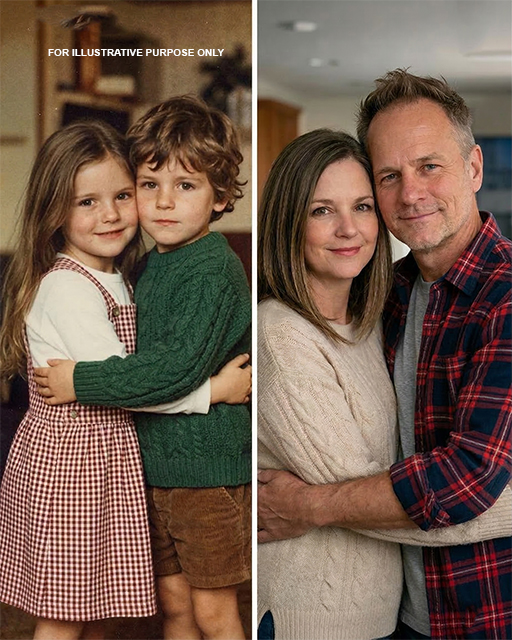
My name is Fiona, and for most of my life, I believed I understood the man I married.
I had known Luke since we were five years old. Our mothers used to joke that we learned how to walk in the same backyard. Our houses stood side by side, separated only by a narrow strip of grass and a low wooden fence we climbed over so often that no one bothered fixing it anymore. We shared everything back then. Summers that felt endless, scraped knees, secrets whispered under blankets with flashlights, and dreams that seemed simple enough to reach.
When we were teenagers, people started assuming we would end up together. At the time, I used to roll my eyes at that idea, but somewhere along the way, it stopped feeling like an assumption and started feeling like the only possible outcome.
We married at twenty.
Looking back now, I can admit that we were young. But it didn’t feel reckless. It felt inevitable. We didn’t have much money, but we didn’t need much either. We had routines, shared jokes, and a quiet certainty that whatever came next, we would face it together.
Years passed the way they tend to when life is steady. We had a daughter, Holly, and two years later, a son, Owen. We bought a modest house in the suburbs with a creaky staircase and a kitchen that always smelled faintly of coffee. We took one vacation a year, usually somewhere within driving distance. The kids would argue in the backseat, asking how much longer, and Luke would make up ridiculous answers just to make them laugh.
It wasn’t extraordinary, but it was good.
So good, in fact, that I never thought to question it.
That was my first mistake.
We had been married thirty-five years when I noticed the money.
Owen had sent us a few thousand dollars to repay part of a loan we had given him years earlier. I logged into our joint account one afternoon, planning to move the money into savings. It was something I had done countless times before without a second thought.
But when I saw the balance, my stomach dropped.
The deposit was there, exactly as expected. But the total amount was far lower than it should have been. At first, I assumed I had miscalculated. I checked again, more carefully this time, tracing every number.
That was when I saw the transfers.
They weren’t random. They were consistent, spaced out over several months, each one large enough to matter but small enough that, on their own, they might not raise immediate suspicion. Together, though, they added up to thousands.
I remember whispering to myself, “That can’t be right,” as if saying it out loud might somehow fix it.
That evening, I brought my laptop into the living room and placed it on the coffee table in front of Luke while he watched the news.
“Did you move money out of checking?” I asked.
He barely glanced at the screen. “I paid some bills.”
“How much?”
“A couple thousand. It evens out.”
Something about his tone unsettled me. Too casual. Too practiced.
“Where did it go?” I pressed, turning the laptop so he could see the transactions.
He rubbed his forehead, his eyes still fixed on the television. “The usual things. House expenses. I move money around sometimes. You know that.”
I did know that. We had shared finances for decades. But this felt different.
“This is a lot, Luke.”
“It’ll come back,” he said dismissively.
I wanted to argue. I wanted to demand specifics, to push until I got real answers. But after a lifetime with him, I recognized the signs. He was closing off. Pushing harder in that moment would only make him retreat further.
So I waited.
A week later, something small broke the fragile calm I had been trying to maintain. The remote control stopped working in the middle of a show, and I went to Luke’s desk to look for batteries.
I wasn’t searching for anything else.
But when I opened the drawer, I found a neat stack of receipts tucked beneath a pile of old mail.
Hotel receipts.
At first, I felt a flicker of relief. Luke occasionally traveled for work. But that feeling vanished the moment I saw the location.
Massachusetts.
He had never mentioned traveling there.
I sat down slowly, the receipts trembling in my hands as I read through them. Every single one was from the same hotel. The same room number. The dates stretched back months.
Eleven trips.
Eleven times, he had gone somewhere without telling me.
I tried to think of reasonable explanations. A work project. A favor for a friend. Something—anything—that would make sense of what I was seeing.
But nothing fit.
My chest tightened as I picked up my phone and dialed the hotel number printed at the top of one of the receipts.
“Good afternoon, how may I assist you?” a cheerful voice answered.
I forced my voice to remain steady. “Hi, I’m calling on behalf of Luke. I’m his new assistant, and I need to book his usual room.”
There was no hesitation.
“Of course,” the receptionist said warmly. “He’s a regular guest. That room is practically reserved for him. When would he like to check in?”
The room seemed to tilt around me.
“I’ll call back,” I muttered, ending the call before my voice could betray me.
That night, I laid the receipts out on the kitchen table and waited.
When Luke walked in, he stopped the moment he saw them.
“What is this?” I asked.
He looked at the papers, then at me, his expression tightening. “It’s not what you think.”
“Then tell me what it is.”
For a long moment, he said nothing. Just stood there, staring as though the answer might appear if he waited long enough.
“I’m not doing this,” he said finally. “You’re blowing it out of proportion.”
“Out of proportion?” My voice rose despite my efforts to stay calm. “There’s money missing from our account, and you’ve been staying in the same hotel, in another state, for months. You’re lying to me. What is going on?”
“You’re supposed to trust me,” he replied.
“I do trust you,” I said, my voice breaking. “But you’re not giving me anything to trust.”
He shook his head. “I can’t talk about this right now.”
“Can’t or won’t?”
He didn’t answer.
That silence was louder than anything he could have said.
I slept in the guest room that night. The next morning, I tried again. I asked him to explain, to give me something, anything that would make sense of the situation.
He refused.
“I can’t live like this,” I told him. “I can’t pretend everything is fine when it isn’t.”
He nodded once, as if he had already accepted what was coming.
“I understand,” he said.
And that was the end of it.
Two weeks later, we sat across from each other in a lawyer’s office, dividing a life we had spent over three decades building. Luke was distant, detached. He didn’t argue, didn’t try to explain, didn’t even look at me.

He signed the papers without hesitation.
It felt surreal. Thirty-six years reduced to signatures and stamped documents.
After the divorce, there was no dramatic revelation. No other woman appeared. No explanation surfaced. Luke continued his life quietly, and I continued mine, though it felt like walking through something unfinished.
We saw each other occasionally at family gatherings. We were polite. Careful. Strangers pretending to remember how to be familiar.
He never told me the truth.
And I never stopped wondering.
Two years later, Luke di3d.
It was sudden. A heart attack, they said.
Holly called me from the hospital, her voice shaking. Owen drove for hours but didn’t make it in time.
I wasn’t sure if I had the right to attend the funeral, but I went anyway.
The church was full. People spoke about Luke as though they had known every part of him. A good man. A devoted father. A reliable friend.
I stood there, accepting condolences, feeling like an outsider in a story that used to be mine.
Then his father, Harold, approached me.
He was eighty-one and clearly drunk. His steps were unsteady, and the smell of whiskey clung to him as he leaned in too close.
“You don’t even know what he did for you, do you?” he slurred.
“This isn’t the time,” I said quietly.
He shook his head, his eyes glassy but intense. “You think I don’t know? The money. The hotel. Same room every time.” He let out a bitter laugh. “He thought he was being so careful.”
My heart began to pound.
“What are you talking about?”
Harold gripped my arm. “He told me. At the end. Said if you ever found out, it had to be after. After it couldn’t hurt you anymore.”
The room felt too bright, too loud.
“There are lies,” he continued, his voice dropping, “that don’t come from wanting someone else.”
Before I could respond, my children intervened, guiding him away.
But his words stayed with me.
They followed me home. Sat with me in the quiet of my kitchen. Echoed in my mind as I replayed every moment, every unanswered question.
Three days later, I received a letter.
I recognized Luke’s handwriting immediately.
I sat down before opening it, my hands trembling as I unfolded the paper.
I need you to know this plainly: I lied to you, and I chose to.
I swallowed hard and kept reading.
I was getting medical treatment. Not locally, and not for something simple. I didn’t know how to tell you without changing the way you saw me. I was afraid that once I said it out loud, I would stop being your partner and become your responsibility.
Tears blurred the words, but I forced myself to continue.
So I paid for the rooms. I moved the money. I answered your questions poorly. And when you asked me directly, I still didn’t tell you. That was my failure.
My chest ached.
This was never about another person. It was about fear. About not wanting you to watch me become someone weaker than the man you married.
A tear slipped down my cheek.
You made your decision with the truth you had. I don’t blame you for that. I only hope that one day, you can understand why I couldn’t say the words out loud.
At the bottom, his signature.
I loved you the best way I knew how.
I sat there for a long time after I finished reading.
The truth didn’t undo what had happened. It didn’t erase the lies or the years we lost. But it reshaped them, gave them a different weight.
He hadn’t been choosing someone else.
He had been choosing silence.
And that silence had cost us everything.
I folded the letter carefully and placed it back in the envelope. Then I set it on the table and stared at it, thinking about the boy I had met in a backyard, the man I had built a life with, and the stranger he had become in the end.
I lost him twice.
Once in a secret.
And once in a while.
If he had trusted me enough to share his fear, perhaps our story would have ended differently. Perhaps we would have faced it together, the way we had faced everything else.
Or perhaps not.
That is the part I will never know.
But as I sat there in the quiet, I realized something that brought me a small, unexpected sense of peace.
We had both made choices with the understanding we had at the time.
And sometimes, even a lifetime of love isn’t enough to overcome the things left unsaid.