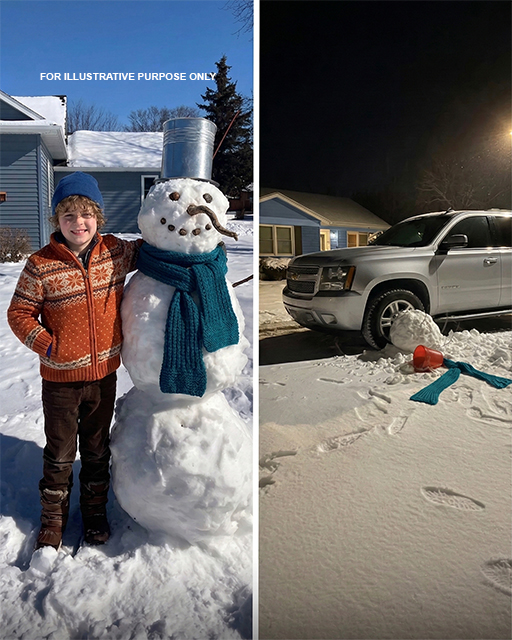
I’m 35 years old, and my 8-year-old son, Andrew, loves winter more than anyone I’ve ever known.
Some kids like sledding or snowball fights. Andrew likes snowmen.
Not just one or two.
An entire community of them.
That winter, our front yard slowly transformed into what looked like a snowy village. Every afternoon after school, Andrew would burst through the front door with his backpack bouncing against his shoulders and his cheeks glowing pink from the cold.
“Mom!” he would shout before he even got his boots off. “Can I go outside? I have to finish today’s one.”
“Today’s one?” I would ask.
He would stare at me as if I had asked the most ridiculous question imaginable.
“Today’s snowman.”
Andrew treated each snowman like a tiny project with its own personality.
He would drop his backpack in the hallway, tug his boots on in a hurry, and struggle into his coat while his scarf twisted around his neck. Half the time, his knit hat slipped down over one eye.
Whenever I tried to fix it, he shrugged me off.
“I’m fine,” he would mumble. “Snowmen don’t care what I look like.”
Then he ran outside.
Our front yard became his workshop.
He always built them in the same corner of the yard, near the edge where our grass met the driveway. Technically, it was still our property, though it was close to the street.
Andrew would start by rolling giant snowballs across the yard, grunting dramatically as they grew bigger.
“Construction underway!” he would shout.
He used pebbles for eyes, sticks for arms, and whatever random objects he could find to give them personality. One day, it might be a crooked carrot nose. Another day, it could be bottle caps.
Every single snowman received the same accessory.
A faded red scarf that Andrew insisted made them “official.”
He also gave each one a name.
“This one is Miles,” he explained seriously one afternoon. “He likes science documentaries.”
The next day, he introduced another.
“This is Commander Frost. He’s in charge of protecting everyone.”
He would step back, hands on his hips, admiring his work.
“Yeah,” he would say proudly. “That’s a good one.”
I loved watching him through the kitchen window.
Eight years old and chatting with snowmen like they were coworkers.
What I didn’t love were the tire tracks.
Our neighbor, Mr. Randall, had lived next door long before we moved in.
He was probably in his late fifties. Gray hair, stiff posture, and a permanent expression that suggested the entire world annoyed him.
He had a habit of cutting across the corner of our lawn when pulling into his driveway.
Technically, it only saved him a couple of seconds of driving time.
But his tires always crossed that exact corner.
The same corner where Andrew built his snowmen.
At first, it wasn’t a problem.
Until the first snowman di3d.
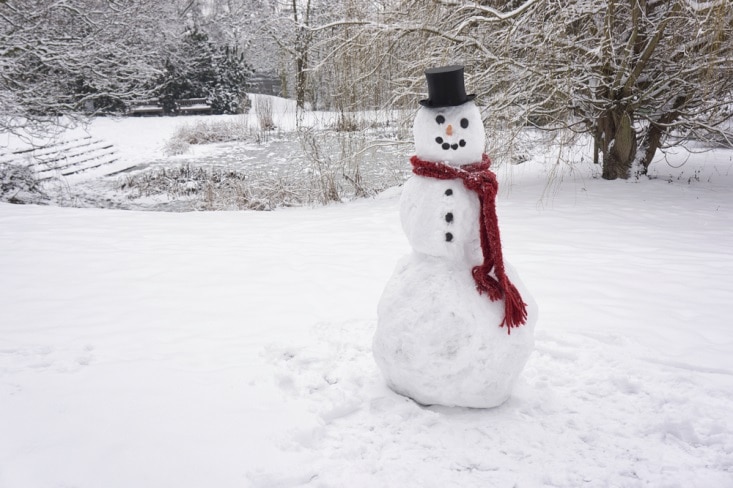
Andrew came inside that afternoon, unusually quiet. Snow clung to his gloves as he peeled them off slowly.
“Mom,” he said softly.
Something in his voice made my stomach drop.
“What’s wrong?”
He sniffed.
“Mr. Randall drove over him.”
“Over who?”
“Finn,” he whispered.
Tears welled in his eyes.
“His head came off.”
I pulled him into a hug, his coat cold against my face.
“I’m so sorry, sweetheart.”
“He looked right at him,” Andrew said quietly. “And then he drove anyway.”
That night, I stood at the kitchen window staring at the flattened pile of snow.
I told myself maybe it was an accident.
But the next one was destroyed too.
And then the next.
Each time Andrew came inside with the same mixture of sadness and frustration.
Sometimes he cried.
Sometimes he just stared out the window silently, his jaw tight.
I decided to speak with our neighbor.
The next evening, when I saw Mr. Randall getting out of his car, I walked outside.
“Good evening,” I called.
He turned slowly.
“Yes?”
“I wanted to ask if you could stop driving across this corner of the lawn,” I said, pointing toward Andrew’s latest snowman. “My son builds snowmen there every day. It really means a lot to him.”
Mr. Randall glanced at the snowman.
Then he rolled his eyes.
“It’s snow,” he said flatly.
“It’s also our yard,” I replied calmly.
He shrugged.
“Tell your kid not to build where cars drive.”
“That isn’t the street,” I said. “It’s our lawn.”
“Snow melts,” he replied dismissively.
“It’s not about the snow,” I said. “He spends time building them. It hurts his feelings when they’re destroyed.”
Mr. Randall made a small scoffing sound.
“Kids cry,” he said. “They get over it.”
Then he walked inside.
The next snowman di3d the following afternoon.
Andrew came in quieter than usual.
“He did it again,” he said.
A week later, I tried talking to Mr. Randall one more time.
“Please stop cutting across the lawn,” I told him.
“It’s dark,” he replied. “I don’t see them.”
“That doesn’t change the fact that you’re driving on our property.”
He folded his arms.
“You going to call the police over a snowman?”
“I’m asking you to respect our yard,” I said.
“Then tell the kid not to build things where they’ll get crushed.”
With that, he walked inside again.
That night, I complained to my husband Felix while we were in bed.
“He’s doing it on purpose,” I said angrily. “I can tell.”
Felix sighed.
“People like that eventually face consequences,” he said.
I didn’t know how right he was.
A few days later, Andrew came inside with snow in his hair and a strange look on his face.
Not sad.
Excited.
“Mom,” he said, kicking off his boots. “It happened again.”
I braced myself.
“Which one this time?”
“Robert,” he said.
Then he leaned closer and lowered his voice like we were sharing a secret.
“But it’s okay.”
“Why?”
“Because you don’t have to talk to him anymore.”
My stomach tightened.
“What do you mean?”
Andrew smiled.
“I have a plan.”
I immediately felt nervous.
“What kind of plan?”
“It’s a secret,” he whispered.
“Andrew,” I said carefully, “your plan cannot hurt anyone. And it can’t break anything on purpose. Understand?”
“I know,” he said quickly. “I’m not trying to hurt him. I just want him to stop.”
“What are you going to do?”
“You’ll see.”
I should have insisted he explain.
But he was eight.
In my mind, his plan probably involved a cardboard sign or writing STOP in the snow.
The next afternoon, he rushed outside again.
I watched from the living room window.
Instead of building in his usual spot, Andrew walked toward the edge of the yard where the grass met the street.
Right next to the bright red fire hydrant.
He began packing snow around it.
At first, I didn’t think much of it.
From the house, it just looked like a slightly bigger snowman.
“Everything okay out there?” I called through the door.
“Yep!” Andrew shouted. “This one’s special!”
“How special?”
“You’ll see!”
I did notice something odd.
The base looked bulky.
Occasionally, I could see flashes of red through the snow.
But I shrugged it off.
Kids build strange snowmen sometimes.
That evening, I was in the kitchen starting dinner when I heard a sound outside.
A horrible crunch.
Then a metallic shriek.
Followed by someone shouting.
“YOU HAVE GOT TO BE KIDDING ME!”
My heart jumped.
“Andrew?”
“Mom!” he yelled from the living room. “Come here!”
I ran to the window.
And froze.
Mr. Randall’s car had slammed nose-first into the fire hydrant.
The hydrant had burst open, sending a powerful jet of water shooting high into the air like a fountain. Water rained down across the street and yard.
At the base of the hydrant lay a mangled pile of snow.
Andrew’s “special” snowman.
The realization slowly clicked into place.
Hydrant.
Snowman.
Oh no.
Outside, Mr. Randall was slipping in the spreading water while shouting in frustration.
“Andrew,” I whispered. “What did you do?”
He didn’t take his eyes off the window.
“I put the snowman where cars aren’t supposed to go,” he said quietly.
Outside, Mr. Randall looked from his dented bumper to the hydrant, then toward our house.
Our eyes met through the glass.
He stomped across the yard and began pounding on our front door.
I opened it before he could hit it again.
Water dripped from his jacket and hair.
“This is your fault!” he shouted.
“Are you hurt?” I asked calmly.
“I hit a hydrant!” he barked. “Because your kid hid it with a snowman!”
“So you admit you were driving on our lawn,” I said.
He blinked.
“What?”
“The hydrant sits on our property line,” I explained. “You would only hit it if you were off the street.”
His mouth opened, then closed.
“He built that snowman there on purpose!” he yelled.
“Yes,” I said. “On our lawn, where he plays.”
“You set me up!”
“No,” I said calmly. “You chose to drive through our yard again.”
His face turned bright red.
“You’re going to pay for this!”
“I think the city might have something to say about damaging public property,” I replied.
He glared at us before storming back toward his car.
I called the city water department and the police non-emergency line.
Within minutes, flashing lights filled the street.
The officers inspected the tire tracks across our lawn.
“So he was cutting across here?” one officer asked.
“Yes,” I said. “I’ve asked him multiple times to stop.”
The officer nodded slowly.
“Well, ma’am, he’ll be responsible for the hydrant damage.”
When everything was finally shut off and the trucks left, our yard looked like a muddy disaster.
Later that night, Felix came home and stared at the mess.
“What happened here?” he asked.
Andrew ran up excitedly.
“Dad! My plan worked!”
After hearing the whole story, Felix covered his mouth trying not to laugh.
“That is honestly impressive,” he said.
Andrew looked worried.
“Am I in trouble?”
Felix shook his head.
“The only person who did something wrong was the grown man driving across someone else’s yard.”
From that day forward, Mr. Randall never drove across our lawn again.
Not once.
He made wide, careful turns into his driveway, keeping both wheels firmly on the pavement.
He never waved.
But he never crushed another snowman either.
Andrew continued building them for the rest of the winter.
Some melted.
Some leaned sideways.
Some lost their arms during windy nights.
But none of them were ever crushed under a car again.
Every time I look at that corner of our yard now, I think about my eight-year-old son standing there with a pile of snow, a red scarf, and a surprisingly strong understanding of what a boundary really means.