My name is Scott Parker, and every Sunday my son and I take a walk.
It’s a small ritual, but it means everything to us.
My son, Jason, is eight years old. Ever since his mother died two years ago, those Sunday walks have been the one thing in our lives that never changes.
No matter how busy the week becomes.
No matter how exhausted I feel after work.
No matter how many unanswered emails pile up on my laptop.
On Sundays, we walk.
Just the two of us.
At first, I told myself the walks were for Jason. After losing his mom, the world had become a confusing place for him. He jumped at sudden noises. He asked questions I didn’t always know how to answer.
Sometimes he would look at me with a quiet, searching expression that made my chest ache, as if he were afraid I might disappear too.
But if I’m being honest, I needed those walks just as much as he did.
Some mornings, I still wake up and reach across the bed, expecting to feel my wife beside me. For a split second, I forget she’s gone.
Then reality comes crashing back.
Those moments feel like getting punched in the chest.
I never let Jason see that part of me.
The truth is that I’m thirty-six years old and still trying to figure out how to be both a father and a mother to a boy who deserves far more stability than I can sometimes offer.
So we walk.
That Sunday started like any other.
The sky was pale blue, washed out as if someone had diluted the color with water. A few joggers circled the lake in the park near our house, earbuds in and faces focused. Families pushed strollers along the path. Couples walked dogs that strained at their leashes.
Everything felt ordinary.
Until it didn’t.
Jason suddenly stopped so abruptly that I nearly walked straight into him.
“Whoa,” I said, steadying myself. “What’s going on, buddy?”
He didn’t answer.
Instead, he stared down into the tall grass beside the path as if he had spotted buried treasure.
Then he crouched.
His small hand reached into the weeds and pulled something free.
“A teddy bear,” he said softly.
I stepped closer and immediately grimaced.
That bear was disgusting.
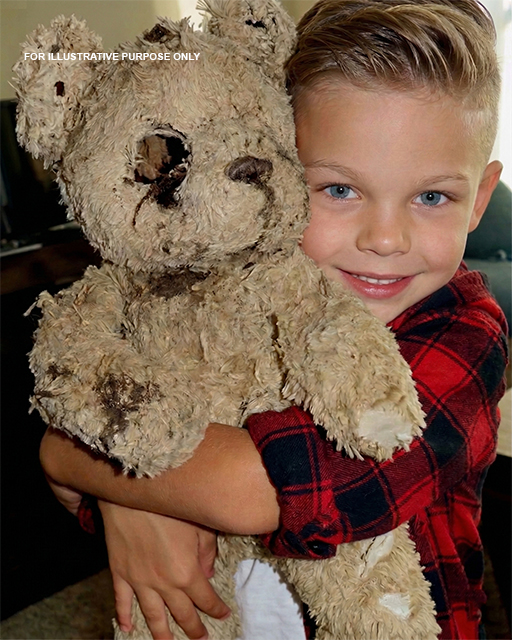
Its once-brown fur had turned a muddy gray, stiff with dirt and what looked like old grass stains. One eye was completely missing, leaving behind a dark, empty hole in the fabric. A long tear stretched across its back, and clumps of yellowed stuffing bulged out through the rip.
It looked like it had been sitting outside for months, maybe longer.
“Jason,” I said carefully, crouching beside him, “that thing is really dirty. Let’s leave it here, okay?”
But Jason had already pulled the bear close to his chest.
His fingers tightened protectively around it.
“We can’t leave him,” he said quietly.
“Him?”
“The bear,” Jason replied. “He’s special.”
I recognized the look on his face instantly.
His breathing had changed. His eyes were shiny, as if he were trying very hard not to cry.
And when Jason tries not to cry, it breaks my heart every single time.
I sighed.
“Alright,” I said gently. “We’ll take him home.”
Jason’s face lit up with relief.
Cleaning that bear took far longer than I expected.
When we got back to the house, I set everything up in the kitchen sink while Jason hovered nearby like an anxious supervisor.
“Will he be ready tonight?” Jason asked for the third time.
“You really want to sleep with that thing?” I asked.
Jason nodded.
“Then we’ll make sure he’s clean.”
Normally, I would have soaked the bear in hot water for a while. But if Jason wanted to cuddle it that night, I needed it to dry quickly.
So I worked carefully.
I scrubbed the fur with soap and warm water, gently loosening layers of dirt that had hardened over time. After that, I used the wet-dry vacuum to pull out as much moisture and grime as possible.
It took several passes before the bear started to resemble something halfway decent.
Finally, I sprayed it lightly with rubbing alcohol to disinfect it.
The last step was fixing the tear.
Jason stood beside me while I stitched the seam in the bear’s back.
Every few minutes, he reached out to touch it, almost as if he needed to confirm it was still real.
“Almost done,” I assured him.
By evening, the bear looked surprisingly decent. It wasn’t new by any means, but it was clean enough for a child’s bedroom.
Jason hugged it the moment I handed it over.
“Thank you, Dad.”
“You’re welcome,” I said.
That night, after brushing his teeth and changing into pajamas, Jason climbed into bed with the bear tucked under his arm.
I pulled the blanket up to his shoulders.
“Goodnight, buddy.”
“Goodnight.”
Within minutes, his breathing slowed as sleep claimed him.
I lingered in the doorway for a moment, watching him.
Then I stepped closer to adjust the blanket.
As I did, my hand brushed the teddy bear’s belly.
Something inside the toy clicked.
A sudden burst of static crackled through the quiet room.
I froze.
Then a tiny, trembling voice whispered through the fabric.
“Jason… I know it’s you. Please help me.”
My blood turned to ice.
For a moment, I thought my brain had misfired. Maybe it was some strange prerecorded sound inside the toy.
But no.
That voice wasn’t a giggle.
It wasn’t music.
It was a human voice.
A child’s voice.
And it had just said my son’s name.
I glanced at Jason.
Miraculously, he was still asleep.
Carefully, very carefully, I slid the bear out of his arms.
He stirred slightly but didn’t wake.
Holding the toy as if it might explode, I backed out of the room and quietly closed the door.
My heart was pounding.
Was this some kind of sick prank?
A surveillance device?
Was someone watching us?
I carried the bear down the hallway and into the kitchen, where the bright overhead light suddenly felt harsh and unforgiving.
Without hesitation, I grabbed a small knife and reopened the seam I had stitched earlier that evening.
Stuffing spilled across the table.
I reached inside and felt something hard.
When I pulled it out, I stared in disbelief.
It was a small plastic box with a speaker and a button, held together with duct tape.
As I examined it, the speaker crackled again.
“Jason?” the voice whispered. “Can you hear me?”
My stomach twisted.
If it had been an adult voice, I might have reacted very differently.
But this was clearly a child.
And he sounded scared.
I pressed the button.
“This is Jason’s dad,” I said quietly. “Who is this?”
Silence.
The connection went dead.
“No, wait,” I said quickly, pressing the button again. “You’re not in trouble. I just need to understand what’s going on.”
Static hissed.
Then the voice returned.
“It’s Milo,” the boy said shakily. “Please help me.”
The name hit me instantly.
Milo.
Jason used to play with a boy named Milo at the park almost every weekend. They chased each other around the playground and raced sticks across the water at the lake.
But a few months ago, Milo had stopped showing up.
Jason asked about him once or twice, then eventually stopped.
I had assumed the family had moved away.
“Milo,” I said gently. “Are you safe right now?”
The line went silent again.
No answer.
I sat at the kitchen table for hours afterward, staring at the teddy bear.
I kept wondering what kind of trouble a child would be in that required hiding a communication device inside a toy.
The next morning, Jason shuffled into the kitchen in his socks.
“Where’s Bear?” he asked immediately.
“He’s fine,” I said. “But first, we need to talk.”
Jason climbed onto his chair.
“Do you remember Milo?” I asked.
His face brightened instantly.
“From the park?”
“Yeah. Did he seem different the last time you saw him?”
Jason frowned as he thought.
“He didn’t want to play tag anymore,” he said slowly. “He just wanted to sit on the bench.”
“Did he say why?”
“He said his house was loud now.”
That caught my attention.
“Did he tell you where he lives?”
Jason nodded.
“The blue house is one block from the park. The one with the white flowers near the mailbox.”
I knew exactly which house he meant.
After dropping Jason at school, I drove straight there.

The blue house looked ordinary enough.
But when I knocked, it took a long time before the door opened.
Finally, a woman in her mid-thirties answered.
She looked tired.
“Oh,” she said. “You’re Jason’s dad, right?”
“That’s right,” I said. “Sorry to stop by like this.”
“What’s going on?”
I hesitated.
Then I told her everything.
The bear.
The device.
The voice.
As I spoke, her face drained of color.
“Oh my God,” she whispered. “Milo…”
She invited me inside.
The house looked neat, but there was a tension in the air, as if the place carried a quiet weight.
She explained that she had recently taken on a demanding new job. The hours were long, and the workload often spilled into weekends.
“I thought Milo was just adjusting,” she admitted. “He’s been quieter lately.”
I showed her the device.
Her hands trembled when she held it.
“I had no idea he felt this alone,” she said softly.
That Saturday, we arranged to meet at the park.
Jason spotted Milo first.
“Hey!” he shouted.
Milo turned.
The boys ran toward each other and collided in an awkward, joyful hug, as if no time had passed at all.
The teddy bear sat on the grass between them while they played.
Nearby, Milo’s mom, Caroline, and I talked quietly about schedules, parenting, and the way life can sometimes move too fast.
“I didn’t realize how much he missed having a friend,” she admitted.
“I didn’t realize how much he needed someone to listen,” I replied.
When it was time to leave, Jason hugged Milo again.
“Don’t disappear again,” he said.
“I won’t,” Milo promised.
Then he looked at me.
“I was really lonely,” he said quietly. “Thank you for helping me.”
Now the boys meet every other weekend.
Sometimes more often.
And the teddy bear sits on the shelf above Jason’s bed.
It never speaks anymore.
Which is exactly how it should be.
But that night taught me something I will never forget.
Sometimes the loudest cries for help are the quiet ones. They hide inside broken toys, lonely silences, and children who do not yet know how to explain what they are feeling.
And sometimes, all it takes to save someone is simply choosing to listen.