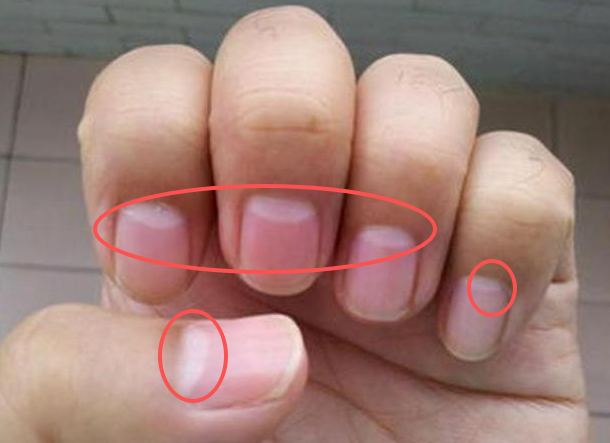
You’re trimming your nails or applying a bit of polish, and you notice them: one or more crisp, white horizontal lines stretching across the nail plate, like tiny ridges on a topographic map. They’re smooth to the touch, but they catch the light. For decades, you might have heard the old wives’ tale: “Those are calcium spots.” So you dutifully drink more milk or pop a supplement, yet the lines stubbornly remain, slowly growing out with the nail.
It’s time to retire that persistent myth. While nutrition plays a role in overall nail health, those specific white horizontal lines have little to do with your dairy intake. They are not a sign of calcium deficiency, but something far more specific and revealing: they are a historical record of stress, written in keratin.
The condition has a name: Beau’s Lines. And they are less about what you’re lacking, and more about what your body has recently endured.
The Nail as a Timeline: How Stress Leaves a Mark
To understand Beau’s Lines, think of your nail not as a dead piece of material, but as a living document being written at the base, under your cuticle. This area, called the nail matrix, is the factory. Here, specialized cells churn out the hard keratin protein that is stacked and pushed forward to become your visible nail plate.
For the nail to grow smooth and even, this factory needs to operate at a steady, uninterrupted pace. When your body undergoes a significant systemic shock or stress, it can temporarily disrupt the matrix’s delicate work. The factory slows down or even halts production for a short period.
When it starts up again, the new nail growth begins from the same spot, but the disruption leaves a tiny fault line—a ridge where the nail plate is thinner and less dense. As this ridge grows out, air gets trapped under it, which is what we see as that distinctive white or pale horizontal line. The nail itself isn’t discolored; you’re seeing a gap.
Decoding the Message: What Kind of Stress Leaves a Line?
The beauty (and diagnostic value) of Beau’s Lines is their timing. Because nails grow at a relatively predictable rate—about 3 millimeters per month—you can often backtrack to when the stress occurred. The line will be about halfway down the nail if the event was 2-3 months ago.
So, what kinds of events can shut down the nail factory? The list is a catalog of major bodily challenges:
- The Physiological Stressors:
- High Fever: A severe bout of flu, pneumonia, or any illness that spiked your temperature.
- Major Surgery or Hospitalization: The trauma of surgery and anesthesia is a classic trigger.
- A Heart Attack or Stroke: A major cardiovascular event.
- Severe Infection: COVID-19, a serious bacterial infection, or shingles.
- The Metabolic & Nutritional Stressors:
- Uncontrolled Diabetes: Major fluctuations in blood sugar can affect growth.
- Chemotherapy: A powerful disruptor of all rapidly dividing cells, including those in the nail matrix.
- Extreme Dieting or Malnutrition: While not a calcium issue, severe protein or calorie deprivation can impact the matrix. Zinc deficiency, in particular, is linked to lines.
- The Emotional & Physical Stressors:
- Profound Psychological Stress: The death of a loved one, divorce, or extreme anxiety can, for some people, manifest physically in this way.
- A Severe Accident or Physical Trauma.
The Important Distinction: Not All White Lines Are Beau’s
Beau’s Lines are horizontal grooves that span the nail and are often depressed. They should not be confused with:
- Vertical Ridges: These are almost universally a normal sign of aging, like wrinkles for your nails, as the matrix slows down naturally.
- Small White Spots (Leukonychia): These tiny, random white specks are usually the result of minor trauma to the base of the nail—bumping your finger—not systemic illness.
- Mee’s Lines: These are also horizontal white lines, but they are very fine, run parallel to the moon (lunula), and can be a sign of heavy metal poisoning (like arsenic) or other specific systemic poisoning. They are much rarer and require medical attention.
What Your Nails Are Asking You to Do
Finding Beau’s Lines is not typically a reason for panic. In fact, they are most often a reassuring sign of recovery. They mean your body faced a significant challenge, weathered it, and is now back to producing healthy nail. They are a badge of survival, growing out as a visible reminder of what you’ve overcome.
However, they serve as an excellent prompt for a bit of personal inventory:
- Play Detective: Look at all ten fingernails. If the lines are on multiple nails and line up across them, that points to a systemic event that affected your whole body at a specific time. If it’s on just one nail, it’s likely local trauma to that specific finger.
- Connect the Dots: Think back 2-3 months. Did you have a bad illness, a surgery, or a period of extreme stress? The lines likely confirm that event had a real physiological impact.
- When to See a Doctor: Schedule a check-up if:
- You see these lines but cannot recall any corresponding illness or stressor.
- They are deep, numerous, and recurring without explanation.
- They are accompanied by other nail changes like pitting, spooning, or dramatic color changes.
Your nails are a silent biographer. Those white horizontal lines are not a flaw or a deficiency to be corrected with a pill. They are a sentence in your body’s story, telling of a time when all resources were diverted to a more critical fight. They are a testament to resilience, a faint scar in keratin that says, “I was here, I endured, and now I am growing past it.” The best treatment is simply to let them grow out, and as you do, perhaps offer a little acknowledgment to the body that carried you through.